
Automotive body architectures endure severe dynamic flex during road operation. Applying a brittle joint compound instead of an elastomeric urethane seam sealer results in premature fatigue cracking, moisture ingress, and interior noise intrusion.
Modern lightweight vehicles utilize thinner high-strength steel and aluminum panels. Thinner sheet metal flexes more under torsional load, transmitting vibration frequencies into the passenger cabin. Seam sealers must therefore deliver structural elasticity and acoustic damping simultaneously.
Selecting an unverified auto sealant risks joint debonding under low-temperature shock. This technical review evaluates polyurethane modulus design, elongation limits, and acoustic loss factors to guide body engineering teams.
Key Takeaways: Urethane Seam Sealer NVH & Elasticity Standards
- Elongation Performance: High-grade polyurethane delivers over 300% elongation at break, preventing bead rupture across moving chassis seams.
- Vibration Damping: Viscoelastic damping properties absorb structure-borne acoustic resonance, reducing cabin noise by up to 3 dB across mid-frequency bands.
- Torsional Stress Distribution: Flexible sealant beads distribute spot-weld stress concentrations across continuous overlap flanges.
- Low-Temperature Resilience: Formulations maintain elastomeric flexibility down to -40°C without glass transition embrittlement.
- Application Versatility: Suitable for extruded hem flange beads, brushed floor pans, and sprayable underbody stone-chip protection.
Polymer Modulus Design: High vs Low Modulus Polyurethanes
Polyurethane sealers combine flexible polyether or polyester soft segments with rigid diisocyanate hard segments. Chemical engineers adjust the soft-to-hard phase ratio to tailor tensile modulus and elongation for specific vehicle body locations.
High-modulus sealers offer high tensile strength with lower ultimate stretch. Low-modulus formulations maximize joint accommodation, absorbing continuous cyclic movement between dissimilar metals without cohesive rupture.
300% Elongation at Break Engineering Standards
Vehicle body joints experience severe differential thermal expansion. When an aluminum roof panel joins a steel side frame, summer heat generates lateral shear displacement along the joint line.
An industrial pu seam sealer meeting DIN 53504 standards stretches beyond 300% without tearing. This high elongation preserves hermetic seal integrity through extreme temperature fluctuations.
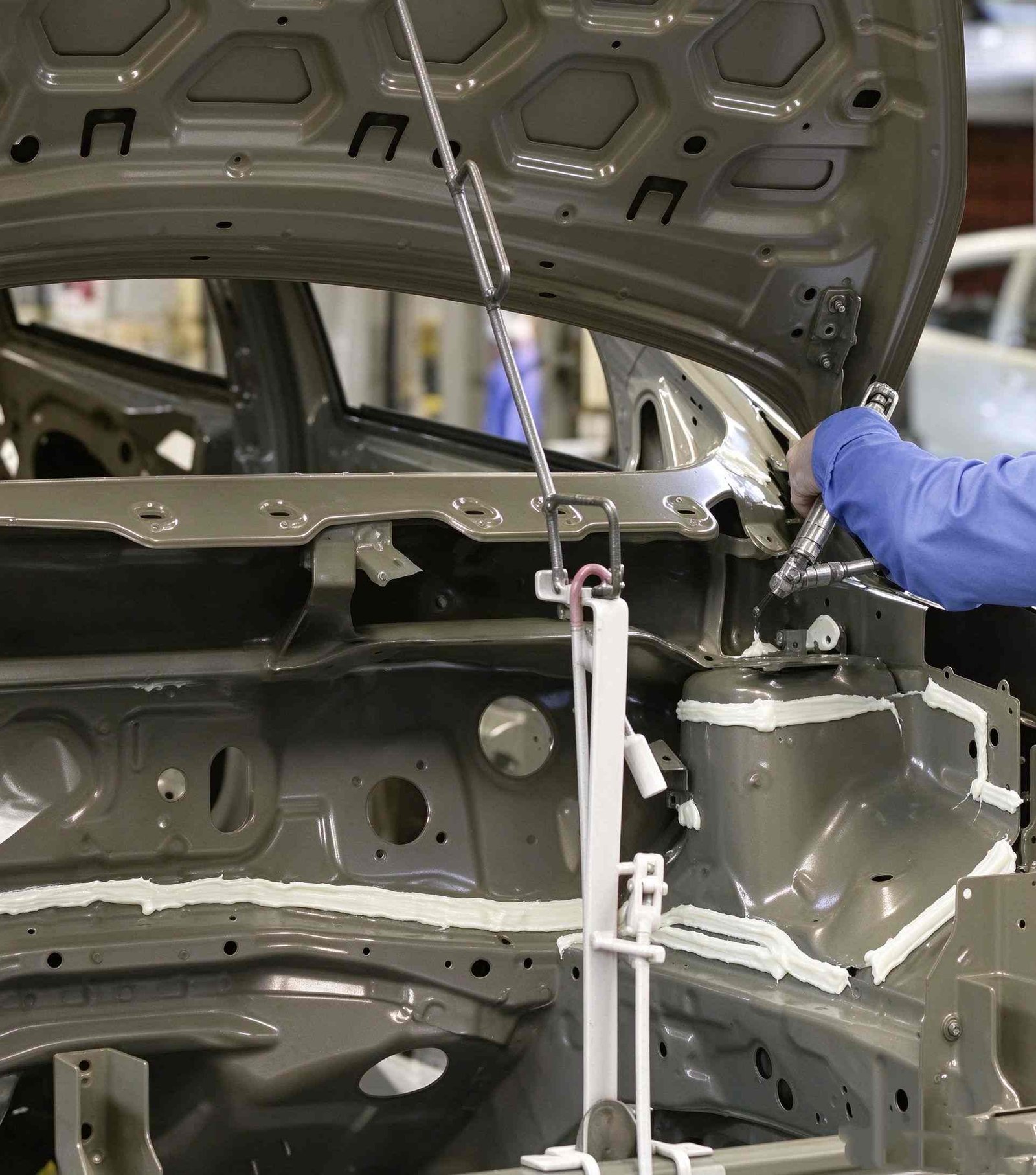
Figure 1: Vehicle body in automotive workshop receiving precision polyurethane sealant along engine compartment strut towers and cowl panels.
Acoustic Damping and NVH Vibration Attenuation
Noise, Vibration, and Harshness (NVH) engineering directly impacts vehicle passenger comfort. Unsealed metal seams act as acoustic conduits, transmitting road noise and aerodynamic whistling directly into passenger compartments.
Polyurethane displays pronounced viscoelastic behavior under cyclic deformation. When sound waves strike the bonded joint, polymer chain segments slide past one another, converting mechanical vibrational energy into negligible heat dissipation.
| Physical Property | Automotive Specification | Functional NVH Benefit | Test Method |
|---|---|---|---|
| Tensile Strength | 2.0 – 3.2 MPa | Resists dynamic panel separation | ASTM D412 |
| Elongation at Break | 350% – 450% | Accommodates chassis frame twisting | DIN 53504 |
| Acoustic Loss Factor (tan δ) | 0.15 – 0.30 (at 20°C) | Dissipates structural vibration energy | ISO 6721 |
| Tear Propagation Resistance | 8.0 – 12.0 N/mm | Prevents crack growth from sharp edges | ASTM D624 |
| Glass Transition Temp (Tg) | -45°C to -55°C | Maintains rubber elasticity in winter | DSC Analysis |
Dynamic Loss Factor Measurement Standards
Dynamic Mechanical Analysis under ISO 6721 measures the material loss factor (tan delta). Polyurethane formulations engineered for automotive joints maintain a tan delta above 0.20 across ambient driving temperatures.
This loss factor dampens drumming resonance across wide trunk floors, spare wheel cavities, and roof sheets. Quality car sealants eliminate annoying low-frequency cabin booms during highway cruising.
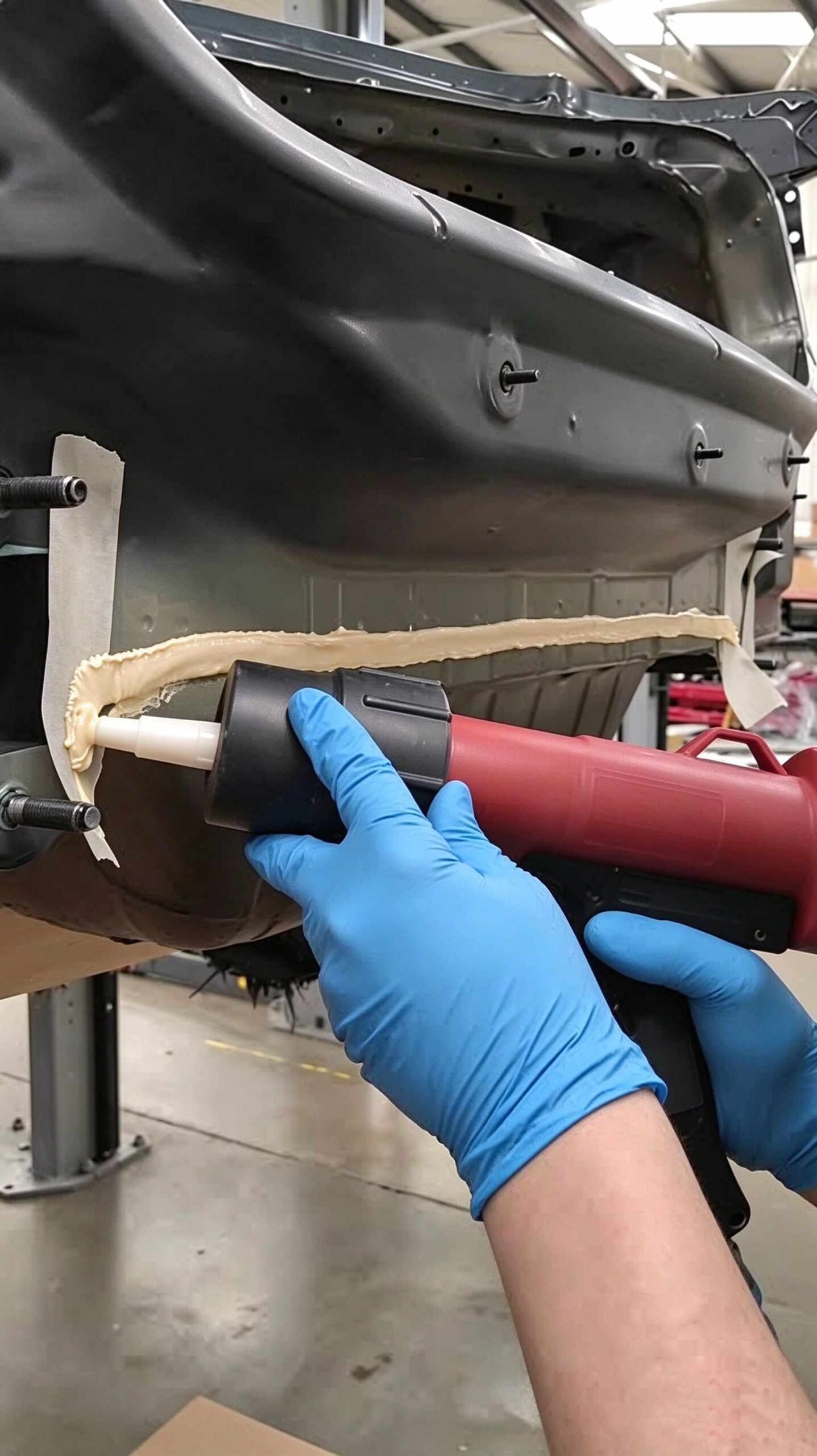
Figure 2: Battery-powered electric dispenser extruding continuous uniform PU sealant beads along vehicle body seam overlaps.
Thermal Shock Resistance and Environmental Fatigue
Vehicles experience severe environmental cycling from sub-zero arctic winters to scorching desert summers. Poorly compounded sealants lose plasticizers over time, resulting in polymer hardening and interfacial debonding.
Automotive grade urethane seam sealer utilizes high-molecular-weight plasticizers resistant to volatilization. Sealed joints maintain Shore A hardness between 40 and 50 after 1,000 hours of 90°C accelerated heat aging.
Preventing Delamination Along Spot-Welded Pinch Welds
Spot welding creates sharp metal step-downs and heat-tinted margins. High-tear polyurethane encapsulates these microscopic ridges, preventing moisture bridging.
Technicians reviewing our seam sealer failure analysis understand that cohesive elasticity protects pinch welds from stone-chip impacts and corrosive de-icing salts.
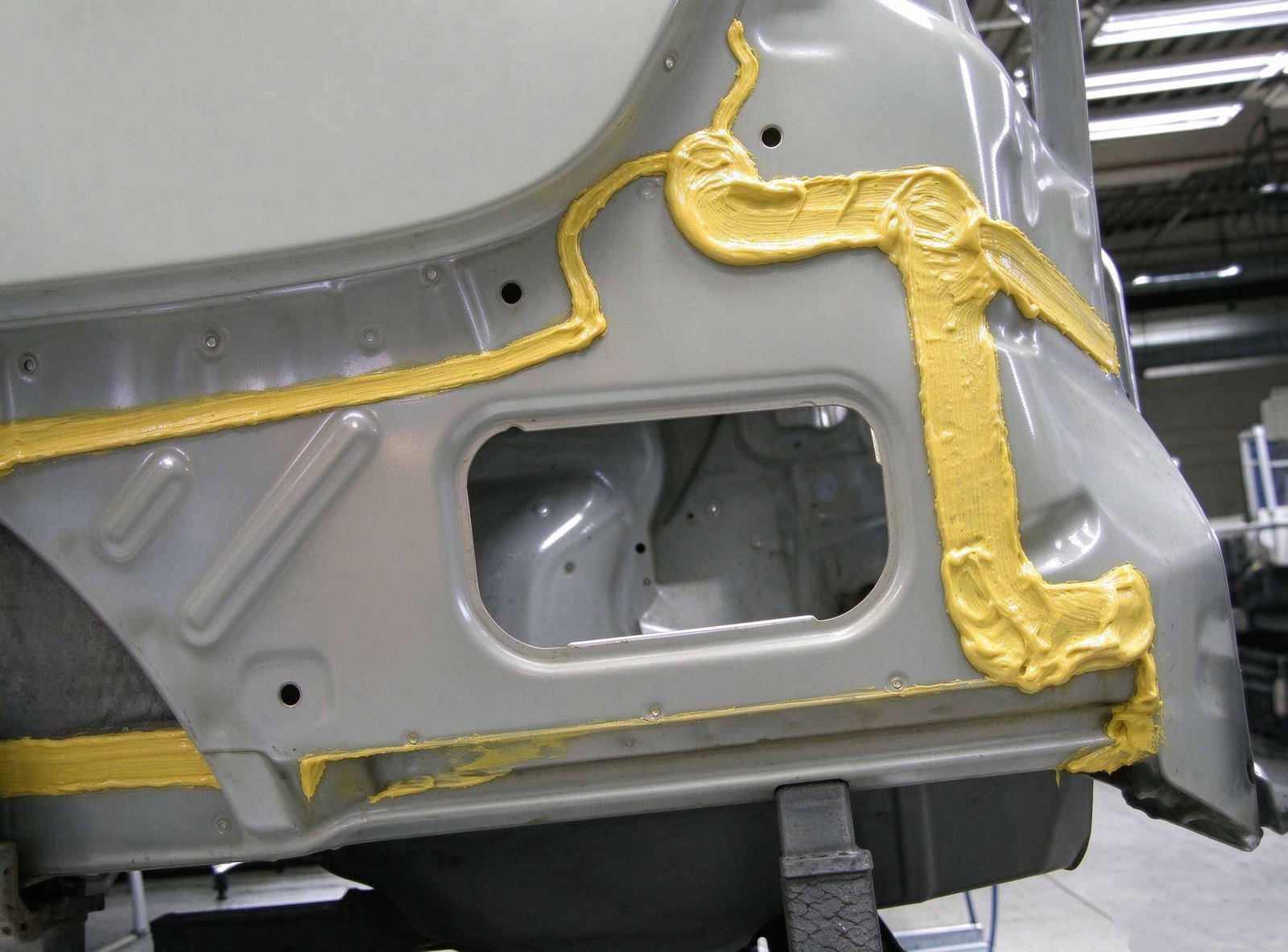
Figure 3: Brush application of protective body sealant reproducing OEM floor pan factory texture while sealing multi-layer sheet overlaps.
Application Tooling and Bead Profiling Protocols
Achieving optimal acoustic and barrier performance requires calibrated application thickness. Excessive bead height wastes material, while insufficient depth risks joint perforation.
Technicians pair specialized nozzle tips from our sealant accessory tools collection with professional battery or pneumatic dispensers. Standard flat ribbon beads should span 15 to 20 mm across joint centers with a minimum 2 mm dry thickness.
Tooling Agents and Surface Finishing
Wiping freshly extruded beads with solvent thinners extracts surface prepolymers, causing brittle surface crusting. Certified technicians utilize pH-neutral water-based tooling fluids or dry plastic profile spreaders.
Proper tooling procedures, detailed in our extrusion bead tooling protocol, ensure feathered edges that blend seamlessly with electro-coated body panels.
Vehicle Zone Engineering Matrix
Different vehicle zones demand tailored joint protection strategies based on vibration amplitude, mechanical stress, and exposure to road debris.
Recommended Urethane Deployment by Location
- Strut Towers and Cowl Panels: Apply medium-modulus urethane seam sealer to isolate front suspension shock and engine bay vibration.
- Floor Pan Overlaps: Brush high-build polyurethane across overlapping floor pans to damp acoustic drumming and seal water out.
- Quarter Panel Pinch Welds: Extrude calibrated flat ribbon beads along wheelhouse arches to withstand gravel impingement.
- Roof Ditch Joints: Utilize high-elongation formulations to absorb dynamic chassis twisting between A-pillars and rear pillars.
Typical Application Scenario: Commercial Bus Chassis Assembly
Reducing Interior Cabin Decibel Levels in Transit Coaches
Manufacturing Profile: An urban transit bus manufacturer assembling 800 hybrid transit coaches annually with tubular steel chassis frames and riveted aluminum side panels.
Engineering Challenge: Passengers reported acoustic drone and rattling noises near rear wheelhouses during highway transit. Decibel meters registered interior cabin sound peaks of 74 dBA at 80 km/h. Inspection revealed that rigid acrylic sealers had cracked under frame torsion, allowing panel vibration transmission.
Intervention: The engineering department upgraded all floor and wheelhouse joint specifications to ChemPU high-damping polyurethane seam sealer. Technicians applied continuous 15 mm wide brushed beads over cleaned epoxy-primed chassis ribs using battery-powered dispensers.
Validation Results: Full-vehicle acoustic testing demonstrated a 3.2 dBA sound reduction across passenger seating zones. Road test inspections after 50,000 kilometers showed zero joint fatigue cracking or water leakage into underfloor electrical conduits.
Frequently Asked Questions: Urethane Seam Sealers
Why is elongation at break critical for automotive seam sealers?
Vehicle bodies twist continuously during cornering and uneven road transit. Seam sealers lacking sufficient elongation tear under cyclic shear stress. A rating above 300% ensures the bead stretches and recovers elastically without peeling away from sheet metal flanges.
Does urethane seam sealer harden and become brittle over time?
Low-quality urethanes formulated with volatile monomeric plasticizers can harden after prolonged heat exposure. Certified automotive polyurethanes utilize non-migrating polymeric plasticizers, preserving rubber elasticity across decade-long vehicle service lifetimes.
How does seam sealer thickness affect acoustic damping performance?
Viscoelastic damping requires adequate material mass to absorb vibrational amplitude. Thin films under 1 mm cannot dissipate acoustic energy effectively. Maintaining a nominal 2 to 3 mm wet thickness maximizes shear damping across vibrating metal panels.
Technical Review by ChemPU NVH & Polymer Materials Engineering Team
Authored by Senior NVH Specialists and Materials Scientists with 15+ years of experience in automotive polyurethane formulation, acoustic vibration loss testing, and OEM chassis joint durability. Certified under ISO 9001 and IATF 16949 standards.
Source High-Elasticity OEM Urethane Seam Sealers
Partner with ChemPU, an ISO 9001 and IATF 16949 certified Chinese manufacturer. We formulate high-elongation polyurethane seam sealers engineered to eliminate cabin vibration, resist thermal fatigue, and deliver long-lasting corrosion defense.
Direct WhatsApp Technical Inquiry: +86 15216655520

