
In the automotive glass replacement industry, releasing a vehicle before the bonding urethane attains structural strength represents a severe safety hazard. Technicians face constant commercial pressure from vehicle owners demanding immediate drive-away. Commercial fleet operators frequently misinterpret surface skinning as structural curing.
Accurately determining windshield adhesive cure time requires evaluating ambient moisture, temperature variables, and federal safety mandates. When an adhesive bond fails prematurely during a frontal collision, passenger airbags lose their critical deflection backstop.
This technical engineering guide delivers an in-depth breakdown of Safe Drive-Away Time (SDAT), chemical cross-linking kinetics, and FMVSS 212/216 crash compliance. Automotive glass technicians and shop owners will discover exact environmental calculation protocols to safeguard vehicle occupants while maintaining shop efficiency.
Key Takeaways: SDAT and Structural Glazing Safety
- Critical Distinction: Tack-free skinning occurs in 15 to 30 minutes. Safe Drive-Away Time (SDAT) demands minimum lap shear strength exceeding 1.0 to 1.5 MPa. Full chemical curing requires 24 to 72 hours.
- FMVSS 212 Mandate: Federal Motor Vehicle Safety Standard 212 requires direct-glazed windshields to retain 50% to 75% of their perimeter bond during a 30 mph frontal barrier collision.
- Airbag Backstop Function: Passenger-side airbags deploy at 320 km/h directly against the inside glass surface. Premature release causes complete windshield ejection and catastrophic airbag failure.
- Environmental Vulnerability: Low ambient humidity and winter temperatures drop chemical reaction rates exponentially. A 1-hour fast-cure urethane at 23°C may require over 4 hours at 5°C.
Defining SDAT: Surface Skinning vs. Structural Crash Readiness
Safe Drive-Away Time (SDAT) represents the verified period required for an adhesive to withstand severe crash deceleration forces while fully supporting passenger airbag deployment.
In replacement workshops, technicians frequently confuse three distinct physical milestones during polyurethane curing. Understanding actual windshield adhesive cure time prevents premature vehicle release and costly liability claims:
1. Tack-Free Time (Surface Skinning)
Within 15 to 30 minutes post-extrusion, atmospheric humidity reacts with surface prepolymers to form a thin non-sticky polymer skin. This skin prevents airborne dust contamination. It provides virtually zero mechanical resistance against vehicle chassis twist. Explore our 25-minute surface drying time specifications for initial tooling guidelines.
2. Safe Drive-Away Time (SDAT)
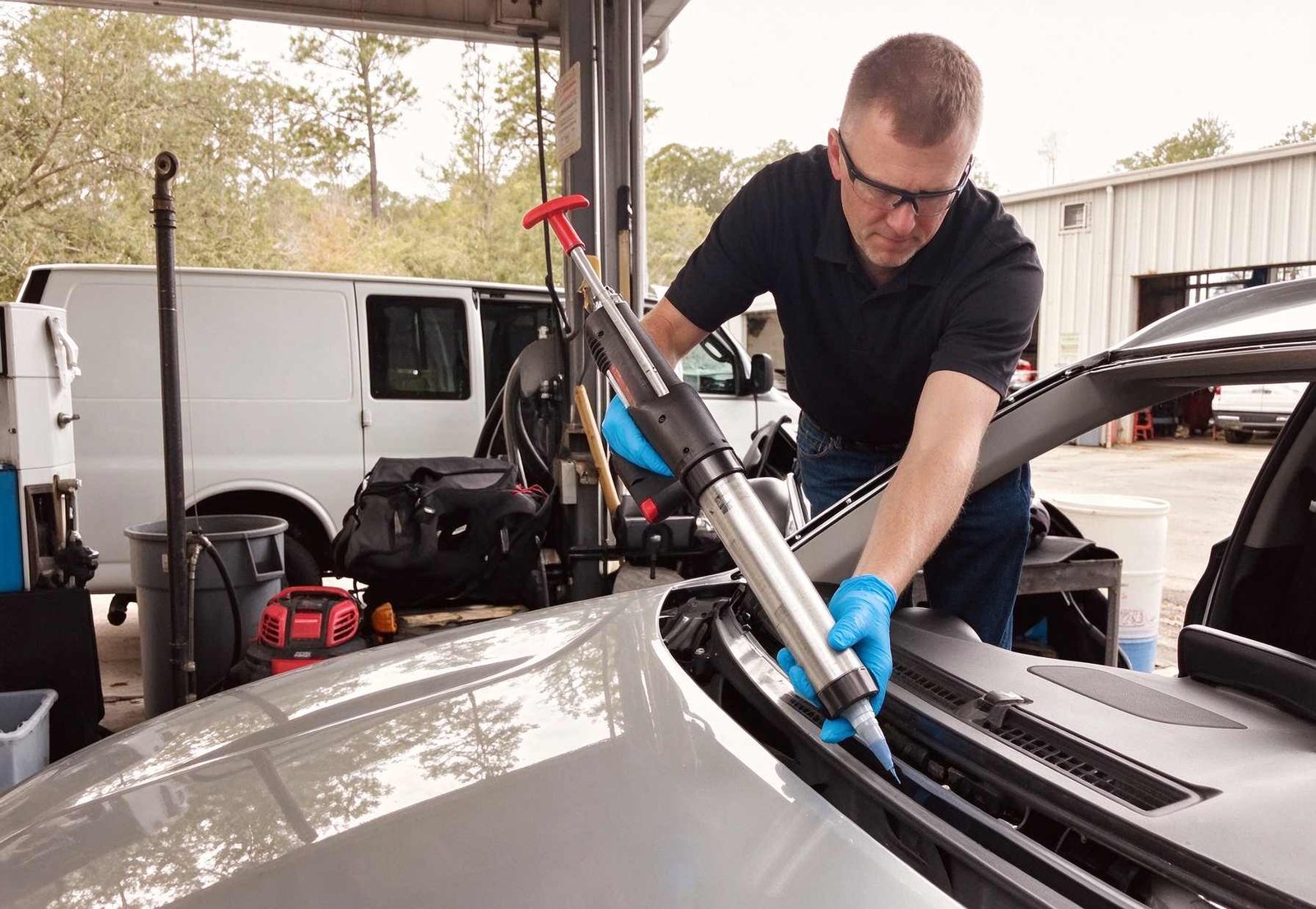
SDAT marks the exact point where internal molecular cross-linking reaches critical threshold strength. Under Auto Glass Replacement Safety Standards (AGRSS), the adhesive layer must demonstrate at least 1.0 MPa lap shear strength. This mechanical threshold ensures compliance with federal collision barrier standards.
3. Final Through-Cure
Standard one-component polyurethanes cure from the outer perimeter inward at approximately 2.5 to 3.5 millimeters per 24 hours. Attaining ultimate tensile strength above 6.5 MPa and maximum elongation requires 48 to 72 hours.
Chemical Cross-Linking Kinetics: Temperature and Humidity Dependencies
One-component (1K) direct glazing adhesives cure through an irreversible chemical reaction with atmospheric moisture. Terminal isocyanate (-NCO) prepolymers encounter gaseous water molecules ($H_2O$) in ambient air. This reaction generates unstable carbamic acid, releasing carbon dioxide gas and yielding reactive amine compounds.
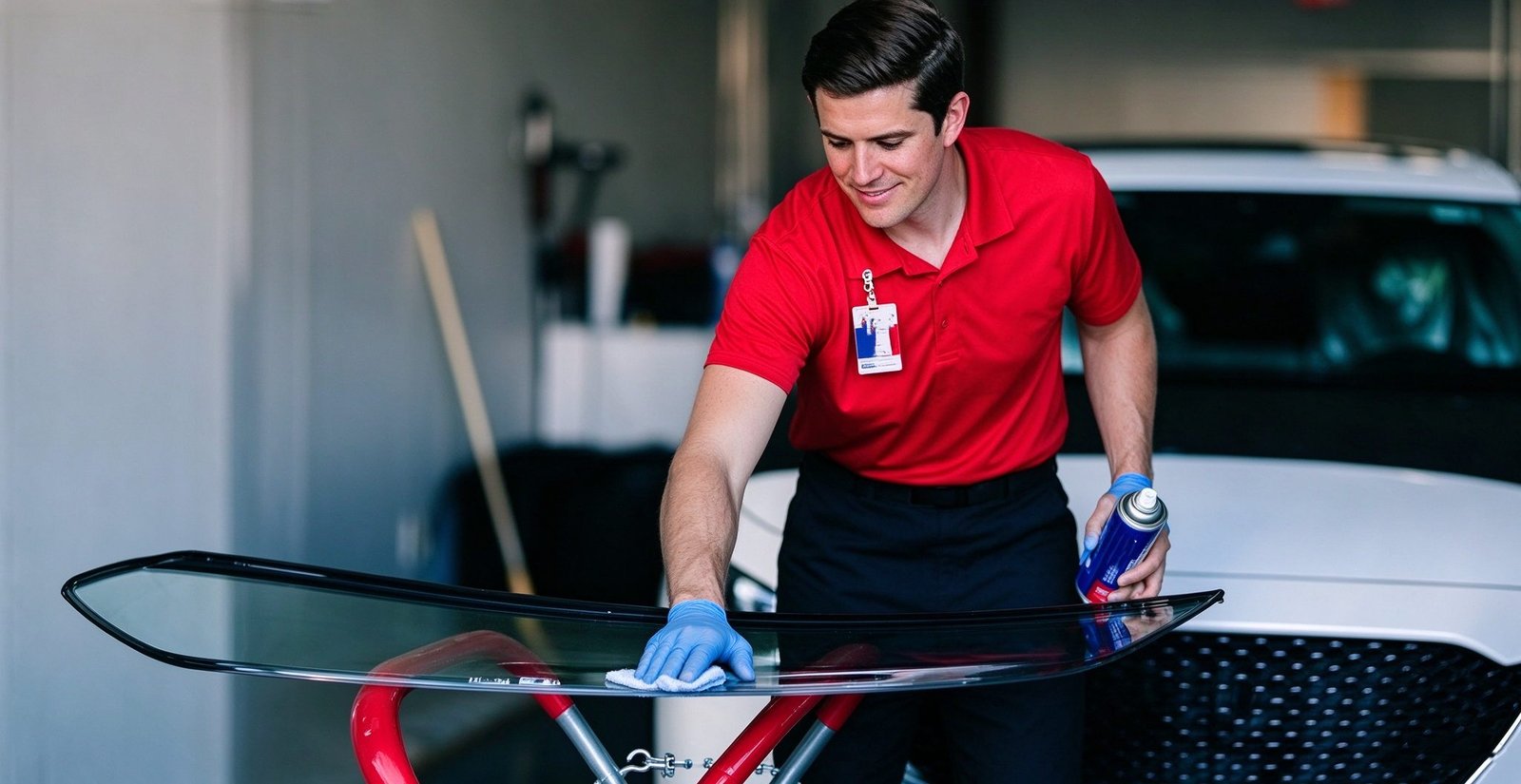
These free amines instantly bond with adjacent isocyanate groups, forming durable polyurea linkages. Because atmospheric water vapor drives this chemical cascade, ambient absolute humidity directly controls curing rates. When calculating a project’s windshield adhesive cure time, technicians must measure ambient relative humidity rather than assuming laboratory baseline values. Review our dedicated safe drive-away time technical manual for comprehensive environmental calculations.
| Ambient Temperature | Relative Humidity (RH) | Fast-Cure 1-Hour Urethane | Standard 4-Hour Urethane | Crash Retention Status |
|---|---|---|---|---|
| 30°C (86°F) – Hot/Humid | 75% – 90% | 30 – 45 Minutes | 2.5 Hours | Optimal Rapid Cure |
| 23°C (73°F) – Standard Lab | 50% – 60% | 60 Minutes (1 Hour) | 4.0 Hours | Nominal SDAT Baseline |
| 10°C (50°F) – Cool Workshop | 35% – 45% | 2.0 – 2.5 Hours | 6.0 – 8.0 Hours | Moderate Reaction Delay |
| 0°C to 5°C (32–41°F) – Winter Mobile | 20% – 30% | 4.0 – 6.0 Hours | 12.0+ Hours | Severe Retardation Hazard |
When ambient temperatures drop below 5°C, air holds minimal absolute water vapor. Cold conditions virtually halt isocyanate cross-linking. In winter installations, shops must maintain heated bays or switch to dual-cure booster adhesives. Compare chemical formulations in our polyurethane versus silicone technical benchmark.
Crash Compliance Mandates: FMVSS 212, FMVSS 216, and Airbag Dynamics
In modern unibody vehicle architecture, the windshield is an indispensable structural safety element. Regulatory standards govern direct glazing performance across global jurisdictions:
FMVSS 212: Windshield Mounting Retention
The Federal Motor Vehicle Safety Standard 212 establishes strict retention benchmarks during a 30 mph (48.3 km/h) full-frontal collision into a rigid concrete barrier. For vehicles equipped with active passenger-side airbags, the adhesive perimeter must maintain at least 50% unbroken bond retention. In vehicles without passenger airbags, at least 75% of the perimeter must remain securely bonded.
When a vehicle collides head-on, unbelted occupants strike the interior cabin forward. The windshield prevents passenger ejection. Passenger ejection accounts for one of the highest fatality rates in highway rollovers.
The Critical Airbag Backstop Mechanism
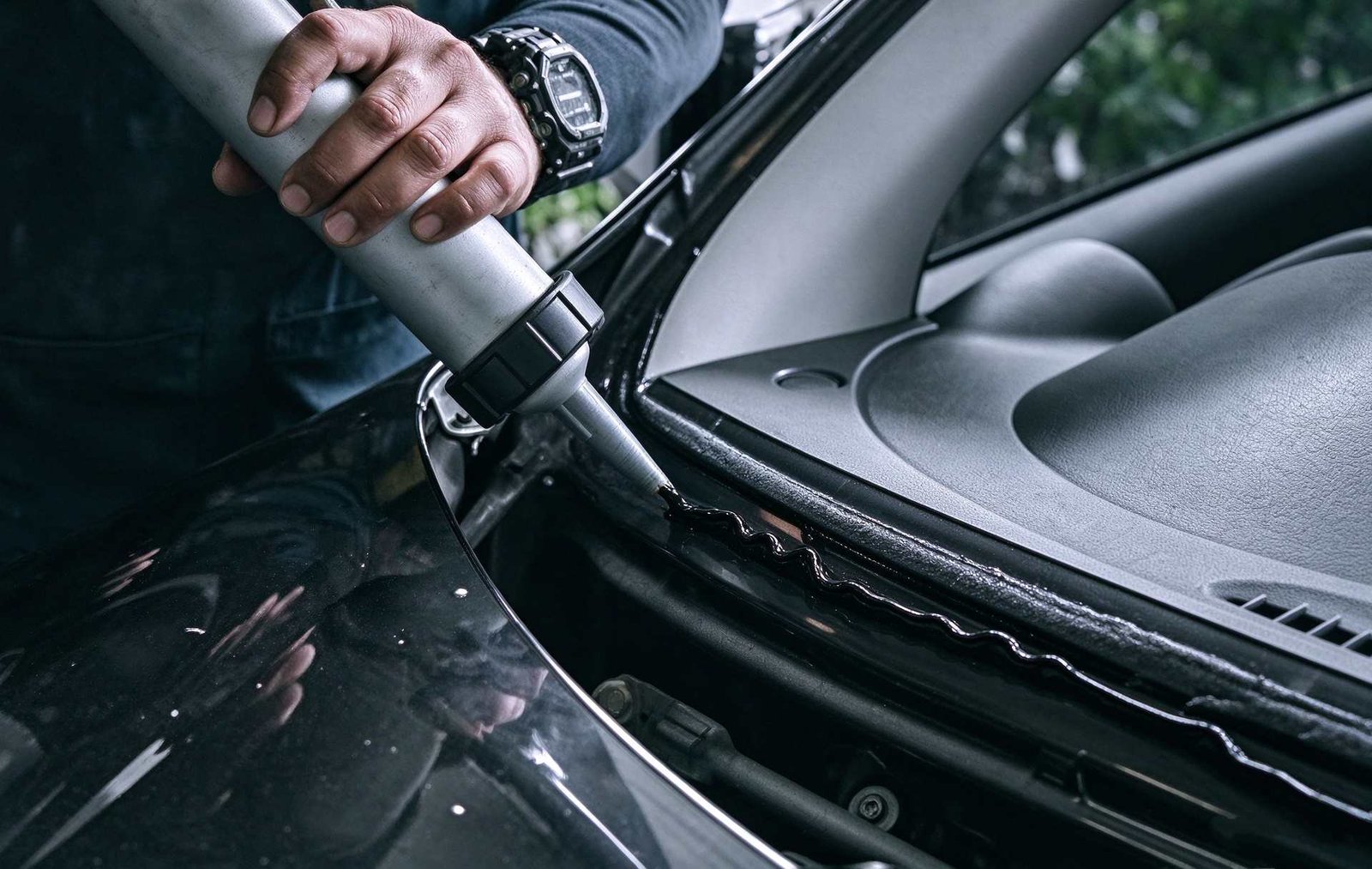
In modern vehicles, passenger airbags deploy upward from the dashboard top at explosive velocities reaching 320 km/h (200 mph). The airbag cushion strikes the windshield inner surface, using the laminated glass as an immovable backstop to deflect rearward toward the occupant.
This deployment exerts several thousand Newtons of outward shear force against the freshly applied urethane bondline within 30 milliseconds. If the adhesive has not achieved structural SDAT, the entire glass assembly blows out forward into the street. The deploying airbag fails completely, leaving the passenger unprotected.
FMVSS 216: Roof Crush Resistance Integration
During vehicle rollover accidents, FMVSS 216 requires roof pillars to withstand three times the vehicle unloaded weight without caving into the passenger survival space. Directly bonded windshields provide 30% to 45% of the total rollover structural resistance. Premature drive-away compromises roof crush safety.
Adhesive Selection: Fast-Cure 1-Hour vs. Standard Formulations
Auto glass business owners must balance adhesive unit costs against workshop throughput. Selecting the proper windshield adhesive cure time profile shapes shop profitability:
Fast-Cure 1-Hour SDAT Formulations (Premium Repair Bays & Mobile Vans)
- Chemical Composition: Incorporates active tertiary amine catalysts and high-reactivity MDI prepolymers.
- Commercial Advantage: Customer vehicles can safely depart within 60 minutes, maximizing mobile installation turnaround.
- Trade-Off: Shorter working open time (8 to 12 minutes), demanding rapid glass deck alignment before skinning begins.
Standard 4-Hour to 8-Hour Formulations (Overnight Shop & Fleet Depots)
- Chemical Composition: Standard aromatic isocyanate backbone with moderate cross-linking kinetics.
- Commercial Advantage: Generous open time (20 to 25 minutes) ideal for heavy commercial bus and truck installations.
- Trade-Off: Extended bay holding time required before customer pickup, reducing daily stall capacity.
Typical Application Scenario: Mobile Fleet Replacement on a Cold Morning
Field Safety Audit: Cold Weather Mobile Glass Replacement
Operating Context: A mobile glass technician replaced a broken windshield on a delivery van parked outdoors at 4°C (39°F) with 25% relative humidity. The technician applied a standard 1-hour fast-cure polyurethane cartridge stored in an unheated mobile service van.
The Critical Error: The technician advised the fleet driver that the vehicle was road-ready after 60 minutes based on label room-temperature specifications. At 4°C, the actual cross-linking kinetics were delayed by nearly 300%. The lap shear strength reached barely 0.3 MPa at the 1-hour mark.
Corrective Safety SOP: The fleet maintenance supervisor halted vehicle departure until the vehicle sat in a heated 20°C maintenance bay for three hours. The workshop updated its standard operating procedures: mobile vans now carry heated cartridge warming boxes and digital hygrometers to verify actual temperature-adjusted SDAT.
Frequently Asked Questions: Windshield Cure Time & Safety
Can a customer drive in the rain immediately after the windshield is installed?
Light rain will not dissolve polyurethane once initial skinning occurs after 20 minutes. Moisture accelerates chemical curing. Driving at highway speeds is strictly prohibited before certified SDAT because wind pressure and chassis twist break unbonded adhesive molecules.
How long after windshield replacement can a customer use an automated high-pressure car wash?
Wait at least 48 hours before entering a high-pressure commercial car wash. While SDAT allows road driving, the internal adhesive bead requires 48 to 72 hours to achieve full chemical cross-linking against 1,000+ PSI rotating water jets.
Why does low humidity delay polyurethane curing even in warm weather?
One-component polyurethanes require water molecules from ambient air to initiate polymer chain growth. In arid desert climates (below 20% relative humidity), dry air lacks sufficient water vapor to sustain cross-linking, extending SDAT significantly.
Engineering Conclusion: Strict SDAT Compliance Protects Lives and Businesses
Automotive safety engineering permits zero guesswork regarding windshield adhesive cure time. Adhering to temperature-adjusted Safe Drive-Away Time guarantees that every installed windshield satisfies FMVSS 212 barrier crash standards and provides dependable airbag deflection support. By deploying certified OEM direct glazing polyurethanes, auto glass replacement businesses protect both passenger lives and commercial brand liability.
Authored by ChemPU Automotive Application Engineering Team
Specializing in OEM direct-glazing polyurethane formulation, crash-retention validation per FMVSS 212 standards, and high-performance structural elastomeric bonding solutions for global automotive manufacturers.
Quality Certification: ISO 9001 / IATF 16949 Certified Adhesive Manufacturing
Source Certified OEM Direct Glazing Polyurethane Adhesives
Partner with ChemPU, an ISO 9001 and IATF 16949 certified Chinese manufacturer. We provide high-modulus polyurethane direct glazing adhesives, black glass primers, and private label cartridges for international distributors and fleet repair networks.
Direct WhatsApp Technical Inquiry: +86 15216655520

