
Modern automotive manufacturing has transformed the vehicle windshield from a simple passive wind barrier into an active structural component. Contemporary vehicles feature lightweight unibody frames, panoramic glass profiles, and sophisticated glass-embedded electronics. Collision repair technicians and fleet buyers must navigate technical acronyms like HM (High Modulus) and NC (Non-Conductive).
Selecting an incorrect adhesive grade risks severe operational failures. Applying a standard low-modulus urethane on a modern performance vehicle causes body flex, cornering creaks, and handling degradation. Applying an electrically conductive adhesive over integrated antenna circuits causes severe radio frequency interference and accelerates galvanic corrosion.
Understanding when to specify a high modulus windshield adhesive versus a non-conductive formulation is essential for modern workshop compliance. This engineering guide details the chemical rheology, chassis rigidity dynamics, and electrical resistivity requirements demanded by original equipment manufacturers (OEMs).
Key Takeaways: High Modulus & Non-Conductive Glazing
- High Modulus (HM) Role: High modulus adhesives feature elevated shear modulus ($G \ge 2.0\text{ MPa}$), reinforcing vehicle body stiffness by 15% to 20% and eliminating chassis torsional squeaks.
- Non-Conductive (NC) Mandate: Formulated with specialized non-conductive carbon blacks to achieve volume resistivity above $10^{10}\ \Omega\cdot\text{cm}$, preventing signal attenuation across embedded antennas.
- Galvanic Corrosion Protection: In aluminum body frames and hybrid composite chassis, non-conductive urethanes isolate metal flanges, stopping electrochemical oxidation between glass brackets and vehicle steel.
- OEM Specification Pairing: Premium European and electric vehicle manufacturers frequently mandate combined HMLC (High Modulus, Low Conductive) adhesives to fulfill structural and electronic needs simultaneously.
What Is High Modulus (HM)? Mechanics of Torsional Chassis Stiffness
Modulus of elasticity measures a polymer’s resistance to mechanical deformation under stress. In direct glazing, shear modulus ($G$) dictates how efficiently the adhesive bead transfers torsional loads between vehicle roof pillars and laminated glass.
Vehicle engineers continuously reduce steel gauge thickness to decrease curb weight and improve fuel economy. To offset lighter body frames, designers treat the laminated windshield as a stressed structural member.
Standard automotive polyurethanes provide shear modulus ratings between 0.8 and 1.2 MPa. Under dynamic road inputs, standard urethane flexes excessively. A certified high modulus windshield adhesive provides a shear modulus of 2.0 to 3.0 MPa.
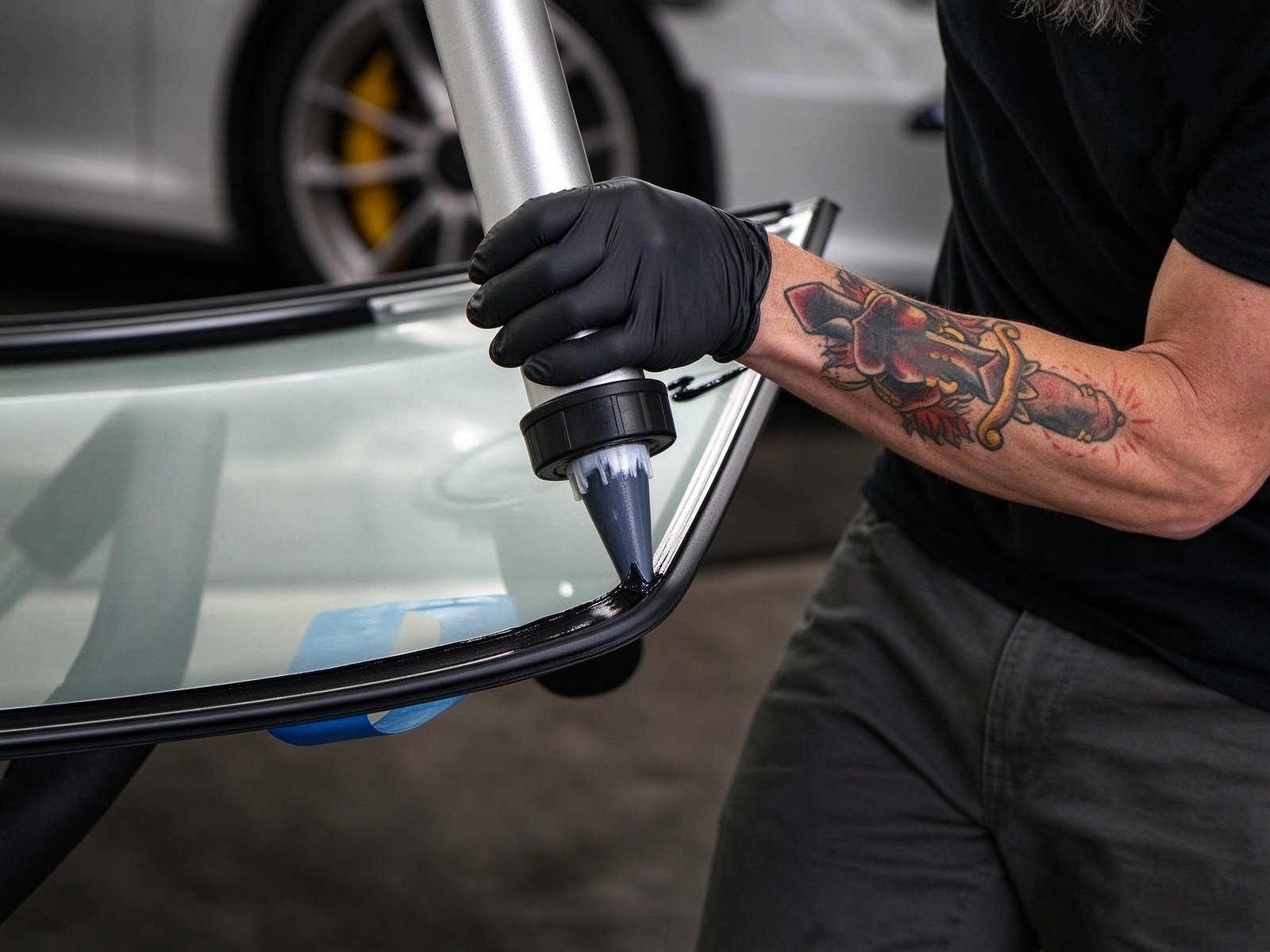
Chassis Torsional Rigidity Gains
When a vehicle traverses speed bumps diagonally, the chassis experiences severe twisting moments. Bonding the windshield with an HM adhesive increases total vehicle torsional stiffness by 15% to 20%.
This added structural stiffness delivers noticeable driver benefits: crisper steering response, reduced cabin vibration, and the elimination of annoying friction squeaks around door apertures. Check out our Shore A 60 hardness polyurethane adhesive for exact mechanical hardness ratings.
What Is Non-Conductive (NC)? Protecting Electronic Systems
Standard polyurethanes incorporate heavy loadings of industrial carbon black to provide UV resistance and mechanical reinforcement. Standard carbon black creates conductive electrical pathways through the polymer matrix.
Electrically conductive adhesives compromise modern automotive electronic integrations. Non-conductive urethanes utilize specialized high-purity carbon black grades with unique particle geometries. These formulations interrupt electron flow while maintaining excellent tensile performance.
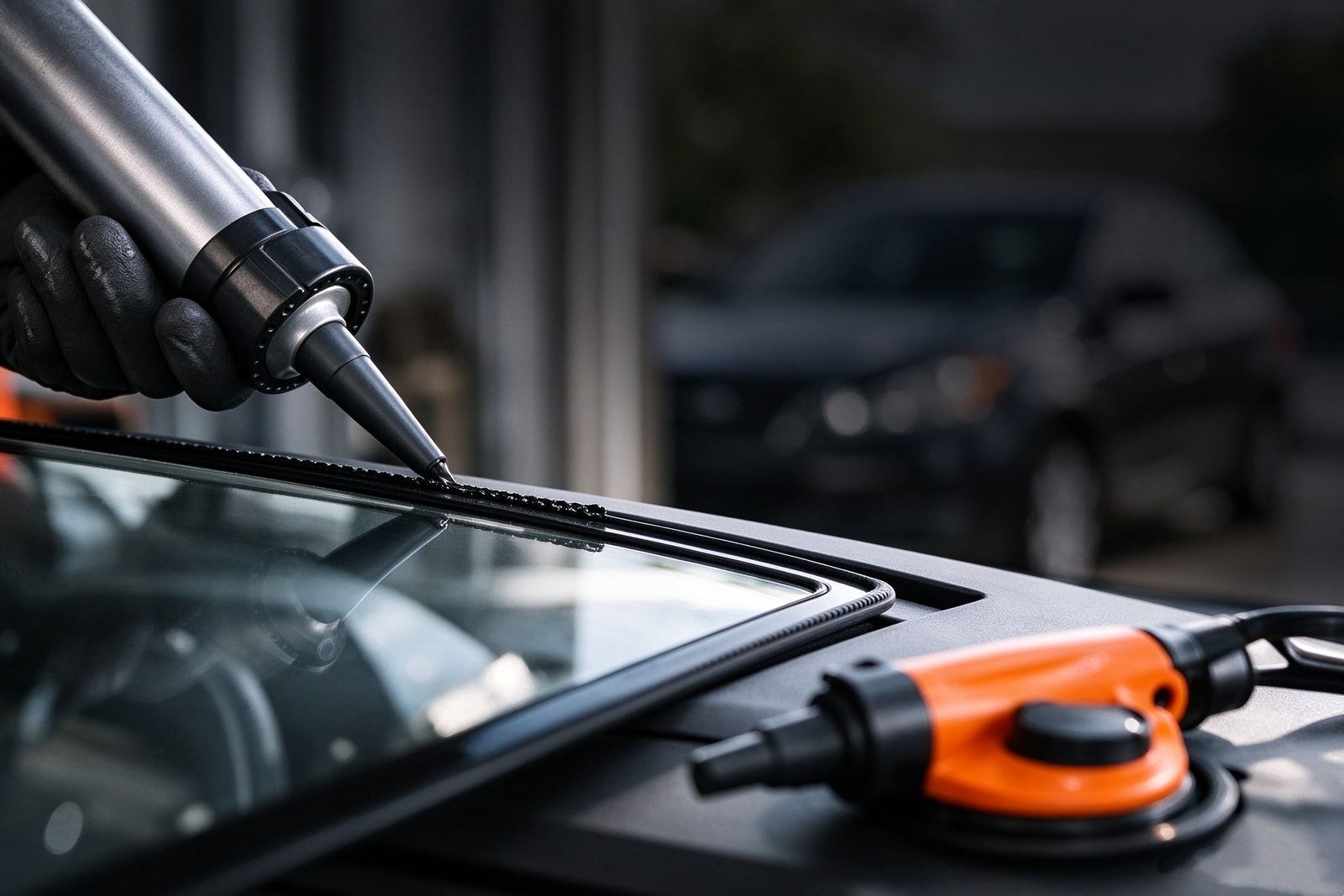
Preventing Radio Frequency Signal Attenuation
Contemporary vehicles feature FM, DAB, GPS, and keyless entry antennas printed directly onto the glass ceramic frit. A conductive adhesive acts like a short-circuit ground path.
Using standard conductive adhesive creates severe audio static, drops navigation signals, and shortens key fob reception range. Non-conductive adhesives guarantee zero signal bleeding into the steel body ground.
Galvanic Corrosion Prevention on Aluminum Bodies
Vehicles built with aluminum windshield pillars (such as Audi, Jaguar, and Ford F-150) face serious electrochemical corrosion risks. When conductive adhesive touches aluminum in the presence of road salt, an electrolytic galvanic cell forms.
The aluminum flange corrodes rapidly, bubbling paint and causing bondline detachment. Non-conductive adhesive provides total electrical isolation ($> 10^{10}\ \Omega\cdot\text{cm}$), permanently suppressing galvanic corrosion.
High-Frequency Sensor and Camera Bracket Integration
Modern windshields house forward-facing ADAS cameras, rain sensors, and lidar modules behind the upper frit band. These sensitive sensor arrays operate adjacent to direct glazing bondlines.
Electromagnetic compatibility (EMC) standards require adhesives to maintain high dielectric breakdown strength. Non-conductive polyurethanes provide stable dielectric constants, preventing unwanted capacitive coupling and electromagnetic interference across ADAS vision sensors.
Specification Comparison: Standard vs. HM vs. NC vs. HMLC Urethanes
Selecting the correct adhesive requires matching OEM engineering standards against shop capabilities. Laboratory tensile testing confirms that a certified high modulus windshield adhesive maintains elastic recovery under repetitive structural fatigue. Review the standardized technical parameters below:
| Property Parameter | Standard Aftermarket | High Modulus (HM) | Non-Conductive (NC) | Combined HMLC Grade |
|---|---|---|---|---|
| Shear Modulus ($G$) | 0.8 – 1.2 MPa | ≥ 2.0 – 2.5 MPa | 1.0 – 1.4 MPa | ≥ 2.2 – 2.8 MPa |
| Volume Resistivity | < 10^5 Ω·cm | < 10^6 Ω·cm | ≥ 10^10 Ω·cm | ≥ 10^10 Ω·cm |
| Shore A Hardness | 50 – 55 | 60 – 65 | 55 – 58 | 60 – 65 |
| Tensile Lap Shear | 4.0 – 4.8 MPa | 5.5 – 7.0 MPa | 4.5 – 5.5 MPa | 6.0 – 7.5 MPa |
| Glass Antenna Friendly | No (Static Risk) | No (Static Risk) | Yes (Zero Loss) | Yes (Zero Loss) |
| Primary Vehicle Targets | Older Steel Chassis | Performance Cars | Glass Antenna Cars | Luxury, EV & Aluminum |
Learn more about comparative chemical structures in our foundational high modulus versus non-conductive technical overview.
Vehicle Selection Decision Matrix: Choosing the Right Adhesive
When specifying a high modulus windshield adhesive, automotive technicians evaluate both dynamic chassis loads and manufacturer service manuals. Specifying the proper direct glazing adhesive requires evaluating vehicle architecture and electronic configurations. Follow this practical decision framework:
When Must You Specify High Modulus (HM)?
- The vehicle manufacturer explicitly mandates an HM adhesive in service manuals (e.g., BMW, Mercedes-Benz, Audi, Volvo).
- Vehicles with panoramic glass roofs or frameless window designs requiring high torsional reinforcement.
- Vehicles experiencing cornering windshield squeaks due to excessive body flex.
When Must You Specify Non-Conductive (NC)?
- The glass panel features embedded radio, GPS, cellular, or toll-pass antenna elements.
- The vehicle incorporates heated defroster grids extending into the perimeter frit bonding zone.
- The vehicle body aperture is manufactured from aluminum alloys or composite materials.
Typical Application Scenario: Luxury Sedan Audio & Torsion Failure
Field Diagnostic Audit: Post-Replacement Radio Static & Cabin Squeaks
Customer Complaint: A customer operating a late-model German luxury sedan reported severe AM/FM radio static and clicking noises along the A-pillar when pulling into inclined driveways immediately following a windshield replacement.
Root Cause Investigation: The independent repair shop installed the replacement glass using a low-cost standard aftermarket polyurethane. Electrical testing detected continuity between the glass antenna terminal and the vehicle chassis ground. Physical road testing revealed excessive windshield movement under chassis twist.
Corrective Action: Technicians cut out the glass and reinstalled it using ChemPU HMLC (High Modulus, Low Conductive) certified polyurethane. Radio reception returned to pristine clarity, and the A-pillar body squeaks disappeared completely.
Frequently Asked Questions: High Modulus & Non-Conductive Adhesives
Can a shop use High Modulus adhesive on an older car that did not originally require it?
Yes. Using an HM adhesive on older steel vehicles provides superior bonding strength and enhanced structural stiffness. There is no downside to upgrading to HM, provided the adhesive meets appropriate elongation requirements.
Why are Electric Vehicles (EVs) mandating HMLC adhesives?
EVs carry heavy floor-mounted battery packs that change structural resonance frequencies, requiring high modulus adhesives to stiffen the upper cabin. Non-conductive chemistry prevents interference with sensitive high-voltage electrical architectures.
Does a non-conductive adhesive take longer to cure than standard urethane?
No. Curing speed depends on catalyst packages and prepolymer reactivity, not electrical conductivity. Modern OEM-grade HMLC formulations achieve standard Safe Drive-Away Times (SDAT) within 1 to 2 hours.
Engineering Conclusion: Specifying Premium Glazing Chemistry
Specifying the proper direct glazing system requires matching structural chassis dynamics with modern electronic requirements. Applying a certified high modulus windshield adhesive with non-conductive properties ensures compliance with OEM repair procedures, safeguards antenna clarity, and restores original structural rigidity. Modern auto glass replacement networks gain peace of mind and superior customer satisfaction by stocking all-in-one HMLC direct glazing systems.
Authored by ChemPU Automotive Application Engineering Team
Specializing in OEM direct-glazing polyurethane formulation, crash-retention validation per FMVSS 212 standards, and high-performance structural elastomeric bonding solutions for global automotive manufacturers.
Quality Certification: ISO 9001 / IATF 16949 Certified Adhesive Manufacturing
Source Certified OEM Direct Glazing Polyurethane Adhesives
Partner with ChemPU, an ISO 9001 and IATF 16949 certified Chinese manufacturer. We provide high-modulus polyurethane direct glazing adhesives, black glass primers, and private label cartridges for international distributors and fleet repair networks.
Direct WhatsApp Technical Inquiry: +86 15216655520

