
Automotive glazing has evolved into an active load-bearing structural component. In modern vehicles, the windshield provides substantial cabin rigidity during frontal impacts and rollovers. The rapid expansion of Advanced Driver Assistance Systems (ADAS) and Electric Vehicles (EVs) introduces new engineering challenges. Using standard modulus, conductive auto glass urethane on these vehicles risks optical miscalibration and structural deflection.
Forward-facing ADAS cameras rely on precise windshield geometry to monitor highway lanes. When a vehicle negotiates sharp turns, torsional chassis twist transfers mechanical stress into the glass perimeter. If technicians install low-modulus urethane, microscopic optical pitch variations occur. Front cameras miscalculate target distances, triggering unexpected lane departure warnings or delayed braking interventions.
Electric vehicles operate with massive battery arrays and lightweight aluminum structures. Standard polyurethanes contain carbon black conductive fillers, creating galvanic corrosion pathways against bare aluminum. Choosing an advanced high modulus windshield adhesive with non-conductive properties eliminates electrical short-circuiting risks. This technical guide examines physical testing metrics, chemical formulations, and shop calibration protocols required for modern vehicle fleets.
Executive Summary: Key Takeaways for Auto Glass Technicians & Fleet Engineers
- High Modulus (HM) Prevents ADAS Optical Drift: High modulus polyurethanes deliver a shear modulus rating of G10% ≥ 2.0 to 2.5 MPa. This rigid elasticity reinforces cabin torsional rigidity by up to 30%, stabilizing camera brackets.
- Non-Conductive (NC) Chemistry Eliminates Galvanic Corrosion: Formulations featuring volume resistivity above 1010 Ω·cm prevent stray currents. This chemistry shields glass antennas, defroster grids, and aluminum unibody pinchwelds from electrochemical pitting.
- Electric Vehicle Torsional Demands: Heavy skateboard battery packs produce severe low-frequency chassis twisting. Applying an approved automotive polyurethane adhesive prevents glass-to-body shearing and eliminates cabin squeaks.
- Installation Viscosity Trade-Off: HM/NC polyurethanes exhibit higher initial thixotropy and paste viscosity. Manual dispensing causes hand fatigue; installation teams must utilize commercial caulking gun tools with a high thrust ratio.
What Is High Modulus (HM) Auto Glass Adhesive?
High Modulus (HM) adhesive refers to a structural polyurethane characterized by elevated shear stiffness (typically G10% ≥ 2.0 MPa under DIN 54451). HM polyurethanes resist deformation under continuous dynamic driving stresses.
Mechanical Rigidity vs. Elastic Flexibility
Conventional auto glass urethanes prioritize elasticity to bridge gaps between curved float glass and stamped steel frames. These standard materials typically provide a shear modulus between 1.0 MPa and 1.4 MPa. Flexible adhesives absorb thermal expansion effectively, yielding under high torsional road loads.
A certified high modulus windshield adhesive provides an engineered balance between stiffness and elongation. High polymer crosslink density prevents the cured bead from acting as a flexing hinge. The bonded windshield functions as a rigid reinforcement panel that ties vehicle pillars together into a unified structural cage.
The Impact on Vehicle Torsional Stiffness
Automotive structural tests reveal that direct glazing contributes up to 30% of total unibody torsional stiffness. When vehicle wheels hit uneven pavement, torsional twisting forces travel across the subframe. A stiff HM urethane bead resists this rotation. This stiffness reduces body shake, improves steering response, and prevents stress cracking.
Increased chassis stiffness reduces acoustic resonance inside passenger cabins. When workshops replace OEM glass using substandard soft sealants, drivers notice new creaks and high-speed wind rattles. Reviewing our detailed polyurethane windshield adhesive guide offers deeper insights into FMVSS 212 crash-retention benchmarks.
Why Modern ADAS Systems Demand High Modulus Glass Bonding
Advanced Driver Assistance Systems depend on windshield-mounted forward cameras, LiDAR units, and rain sensors. With geometric accuracy paramount, a minimal pitch deviation of only 0.5 degrees creates a target calculation error exceeding 1.5 meters at highway distances.
Sensor Mounting Geometry and Dynamic Glass Deflection
Modern vehicles feature camera brackets bonded directly to the inner surface of the upper windshield. These sensors continuously track road lanes, oncoming vehicles, and pedestrian crossings. When glass flexes dynamically under aerodynamic drag or rough pavement, camera optical alignment shifts relative to the vehicle thrust angle.
High modulus polyurethane prevents this optical displacement. The cured polymer provides rigid resistance, immobilizing the glass within factory tolerances. The camera lens maintains a stable geometric plane, allowing Lane Keeping Assist (LKA) and Autonomous Emergency Braking (AEB) systems to calculate reliable telemetry.
Preventing Calibration Failures and Diagnostic Trouble Codes
After glass replacement, technicians execute static and dynamic camera calibration. During static targeting, computerized alignment rigs verify pitch, roll, and yaw values. If the windshield rests on soft urethane, the camera bracket angle sits outside OEM calibration windows.
In severe cases, scanning tools throw persistent calibration error codes that prevent shop sign-off. Even when initial calibration passes on a flat shop floor, road driving creates dynamic flex that triggers intermittent dashboard warnings. Utilizing an HM-certified adhesive ensures long-term calibration stability across changing road terrains.
Non-Conductive (NC) Adhesives: Critical for Electric Vehicles & Antennas
Non-Conductive (NC) adhesives provide high volume resistivity (greater than 1010 Ω·cm according to IEC 60093 standards). This dielectric barrier isolates electrical circuits, blocks galvanic oxidation on aluminum frames, and prevents capacitive antenna disruption.
Dielectric Insulation: Protecting Integrated Antennas and Defrosters
Traditional polyurethanes rely on high-structure carbon black to achieve tensile strength and UV stabilization. Carbon black conducts electrical currents across the cured joint. Modern automotive windshields integrate delicate electronic printed tracks, including FM/DAB radio aerials, GPS receivers, and micro-wire heating elements.
When conductive urethane contacts these printed circuits, capacitive leakage drains radio frequency signals. Drivers experience static audio interference, intermittent GPS satellite drops, and remote keyless entry range loss. Non-conductive formulations replace conductive carbon particles with specialized mineral reinforcements, guaranteeing absolute dielectric isolation.
Preventing Galvanic Corrosion on Aluminum and Mixed-Metal Bodies
Weight reduction strategies in electric vehicles rely heavily on aluminum chassis components. When an auto glass technician scrapes away old urethane during replacement, microscopic tool scratches expose bare aluminum on the pinchweld.
If conductive adhesive bridges this scratched surface in the presence of atmospheric road moisture, a galvanic battery cell forms. Carbon behaves as a cathode; aluminum acts as an anode. Over several months, galvanic corrosion converts the aluminum pinchweld into brittle white aluminum oxide powder. Adhesion fails completely, water leaks develop, and crash retention safety degrades.

Technical Comparison: Standard vs. High Modulus vs. Non-Conductive Adhesives
Specifying the appropriate formulation requires matching laboratory performance benchmarks against specific vehicle architecture demands. The matrix below outlines standard engineering parameters verified under standardized DIN and ISO procedures.
| Technical Parameter | Standard Auto Glass Urethane | High Modulus (HM) Urethane | HM / Non-Conductive (HMNC) |
|---|---|---|---|
| Shear Modulus (G10%) | 1.0 to 1.4 MPa | 2.2 to 2.8 MPa | 2.0 to 2.6 MPa |
| Volume Resistivity (IEC 60093) | 104 to 106 Ω·cm | 105 to 107 Ω·cm | Above 1010 Ω·cm |
| Tensile Strength (DIN 53504) | Min. 6.0 MPa | Min. 8.0 MPa | Min. 7.5 MPa |
| Elongation at Break | Above 500% | 350% to 450% | 400% to 500% |
| Substrate Suitability | Steel Unibody Only | Stiffened Steel Bodies | Aluminum, Steel & EVs |
| Primary Application | Older Pre-ADAS Vehicles | ADAS Sedans & SUVs | Modern ADAS & Electric Fleets |
Typical Application Scenario: Electric Delivery Van Windshield Replacement
Consider a typical commercial fleet operating electric delivery vans with Level-2 ADAS cameras. These commercial vans log significant daily highway mileage under heavy payload conditions. Floor battery weight creates rigid frame rails; the tall cargo box twists over roadway curbs, exposing windshield bonds to aggressive shear stress.
In this operational context, installing standard aftermarket windshield sealant presents dual risks. Chassis deflection moves the upper windshield forward, knocking camera alignment out of threshold limits. Aluminum roof headers risk galvanic corrosion if conductive urethane contacts unprimed metal.
Implementing an HMNC specification eliminates both failure modes. The high modulus core immobilizes the glass perimeter, preserving optical camera calibration across severe delivery routes. Concurrently, the non-conductive dielectric matrix protects the aluminum cab frame from oxidation, ensuring compliant safety per NHTSA Federal Motor Vehicle Safety Standards (FMVSS 212).
Step-by-Step Installation Protocol for HM/NC Adhesives
High modulus polyurethanes feature elevated paste viscosity; installation requires rigorous procedural discipline to prevent air voids and incomplete pinchweld wetting.
- Pinchweld Inspection and Trim-Back: Cut existing urethane down to a clean, flat 1.0 mm base bead using an oscillating knife. Never scrape down to bare metal unless active rust is present. If bare aluminum or steel is exposed, apply an approved etching primer and allow full flash-off.
- Glass Cleaning and Ceramic Frit Priming: Thoroughly clean the glass frit perimeter using an oil-free glass cleaner. Apply dedicated black primer to guarantee molecular bonding and 100% UV blocking against polymer photodegradation.
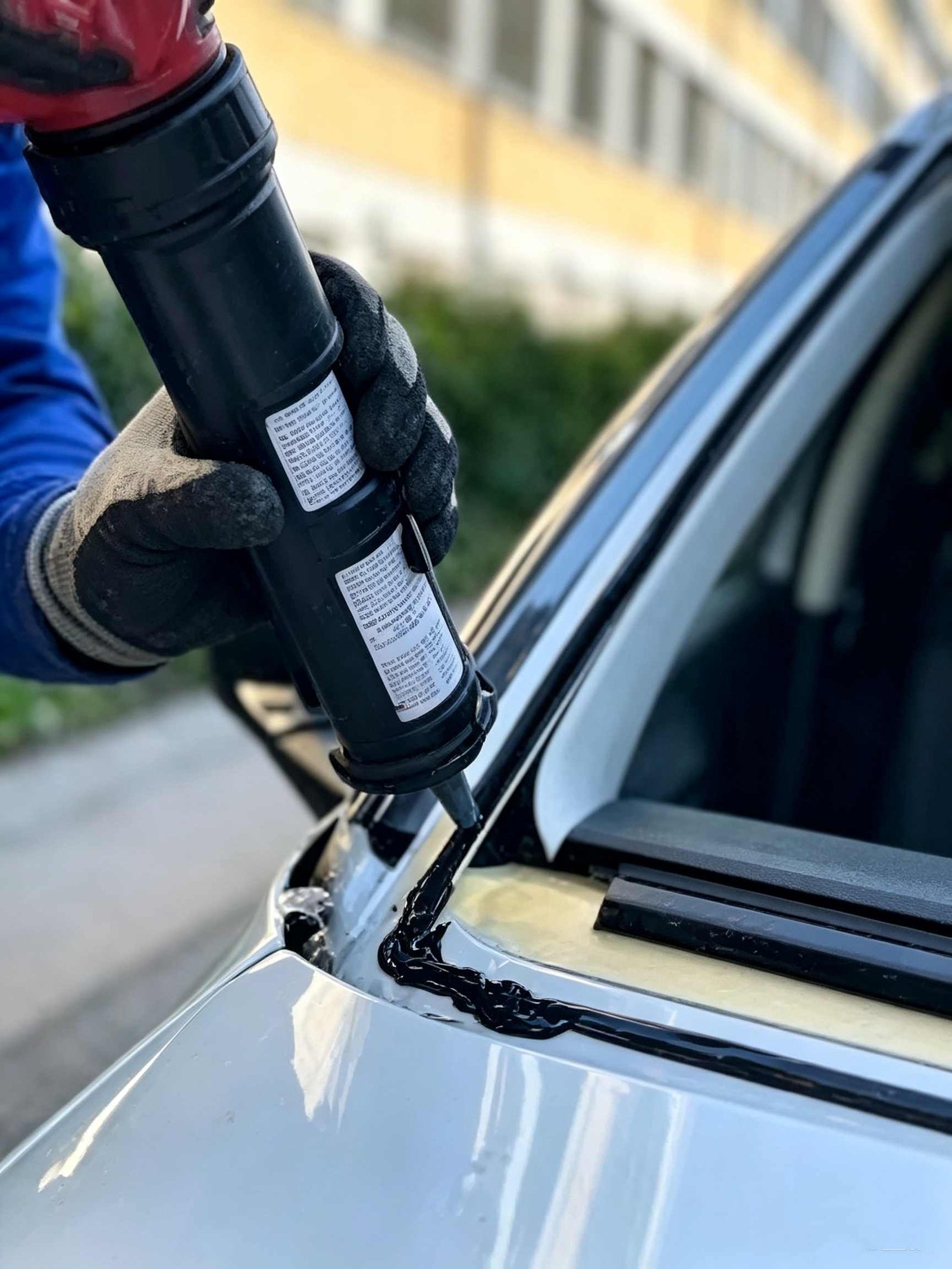
- Triangular V-Notch Nozzle Extrusion: Cut the extrusion nozzle to create a triangular profile matching OEM glass gap specifications. Holding the gun at a strict 90-degree angle, extrude adhesive evenly to produce an upright, symmetrical triangular bead without overlap seams.
- Decking and Securing Glass: Install the replacement glass within the specified open-time window. Apply uniform downward pressure until the glass aligns with surrounding body lines. Use non-marking retaining tape to secure position during initial curing.
For related seam sealing repairs on vehicle quarter panels, technicians can utilize compatible automotive seam sealer formulations to complete comprehensive corrosion barriers.
Engineer’s Technical Trade-Offs: Practical Boundaries of HM Polyurethanes
High modulus, non-conductive adhesives represent the engineering standard for modern fleets; field practitioners must evaluate real-world mechanical limitations prior to deployment:
- Higher Extrusion Force Demands: HM formulations possess high initial viscosity. When technicians attempt extrusion with standard 12:1 manual caulk guns, they experience hand fatigue and uneven bead heights. Pneumatic or battery-powered dispensers with thrust ratings ≥26:1 are mandatory.
- Stricter Pinchweld Preparation: High modulus polymers exhibit lower elongation than soft sealants, transferring stress concentrations rapidly along the bond line. Any surface dust, oil residue, or unprimed scratch will suffer adhesive release under lower peeling forces.
- Temperature Sensitivity During Application: At temperatures below 5°C (41°F), high modulus urethanes stiffen noticeably. Shop pre-heating in cartridge warming cabinets at 40°C is strongly recommended to maintain smooth, uniform bead flow.
Frequently Asked Questions
Can you use standard modulus polyurethane on an ADAS-equipped vehicle?
Standard urethane bonds glass to metal; it fails to maintain structural stiffness under dynamic loads. Under highway driving dynamics, soft adhesive permits optical camera bracket movement, which causes camera recalibration faults, false alerts, and potential sensor warranty rejections from vehicle manufacturers.
How do technicians verify if an adhesive is genuinely non-conductive?
Non-conductive adhesives must state a volume resistivity above 1010 Ω·cm on their Technical Data Sheet per IEC 60093 standards. Alternatively, a digital mega-ohmmeter applied across a cured test coupon should demonstrate complete electrical resistance.
Is high modulus adhesive required on older non-ADAS passenger cars?
Applying an HM adhesive increases chassis torsional rigidity and roof crush resistance on legacy steel passenger sedans. Vehicles with aluminum body panels demand non-conductive formulations across all model years.
Engineering Summary: Selecting the Right Direct Glazing Solution
The convergence of intelligent electronic safety aids and electric vehicle architectures has redefined auto glass bonding requirements. Specifying a genuine high modulus windshield adhesive with non-conductive properties is no longer an optional upgrade. It represents an essential engineering safeguard to maintain factory structural rigidity, ADAS camera accuracy, and long-term aluminum corrosion protection.
Authored by ChemPU Automotive Application Engineering Team
Specializing in OEM direct glazing polyurethane synthesis, crash-retention validation (FMVSS 212/208), and dielectric isolation coatings for commercial transport and electric vehicle assembly.
Technical Review: ISO 9001 / IATF 16949 Certified Polymer Testing Laboratory.
Request Technical Data Sheets & OEM Adhesive Samples
Are you managing an auto glass replacement network or commercial vehicle assembly line? Contact our application engineers for custom formulation testing, bulk pricing, and IATF 16949 compliance documentation.
Direct WhatsApp Technical Inquiry: +86 137 7441 4434

