
Collision repair facilities and restoration centers regularly struggle to duplicate visible factory seam sealer patterns after replacing front strut towers or welded floor pans. Applying low-viscosity sealants often results in saggy, uneven finishes, while incorrect tool selection exposes repairs to client rejection and diminished vehicle resale value.
Automotive vehicle manufacturers specify heavy-bodied brushable seam sealer formulations along engine bay towers, trunk wells, and floor pans. These high-solids polymers combine acoustic damping with watertight defense, retaining distinct nylon brush striations identical to robotic assembly lines.
However, laying excessive film thickness or topcoating before solvent flash-off causes solvent pop pinholes and intercoat delamination. Replicating authentic OEM textured finishes requires disciplined control over nylon brush angles, stroke speeds, and flash-off schedules. This engineering protocol provides standard operating procedures to replicate factory strut tower and floor pan seam textures.
Key Takeaways: Brushable Sealer Application Standards
- OEM Texture Replication: Heavy-bodied thixotropic sealants hold directional nylon bristle striations without leveling out flat.
- Solvent Pop Prevention: Apply film builds under 2.5 mm per pass to ensure complete solvent evaporation before bake cycles.
- Tooling Technique: Short, stiff nylon flat brushes held at a 45-degree angle reproduce factory robotic brush appearances.
- Substrate Adhesion: Always apply brushable sealers over fully cured, scuffed 2K epoxy primer rather than bare, unprimed steel.
- Acoustic & Barrier Defense: Dense brushable polymer layers absorb floor pan acoustic resonance while sealing out road spray.
Polymer Rheology: Thixotropy & Bristle Stroke Retention
Standard sealants are engineered to self-smooth or hold rounded beads without running. In contrast, authentic brushable seam sealer requires tailored pseudoplastic rheology with a high yield stress point.
Under the mechanical shear of a stiff nylon brush, the polymer viscosity drops instantaneously. This thinning allows smooth spreading along floor pan welds. The moment bristle shear stops, the thixotropic network rebuilds instantly, locking directional ridges into place.
Nylon Filament Dynamics vs Natural Hair Brushes
Technicians often make the mistake of using soft natural bristle paintbrushes. Natural hair bristles bend excessively under heavy paste viscosity, creating smeared, flat finishes without defined striations.
Automotive OEMs utilize stiff, solvent-resistant nylon bristles cut straight across. Stiff nylon filaments displace the paste uniformly, leaving defined 0.5 mm ridges that mirror original robotic assembly textures.
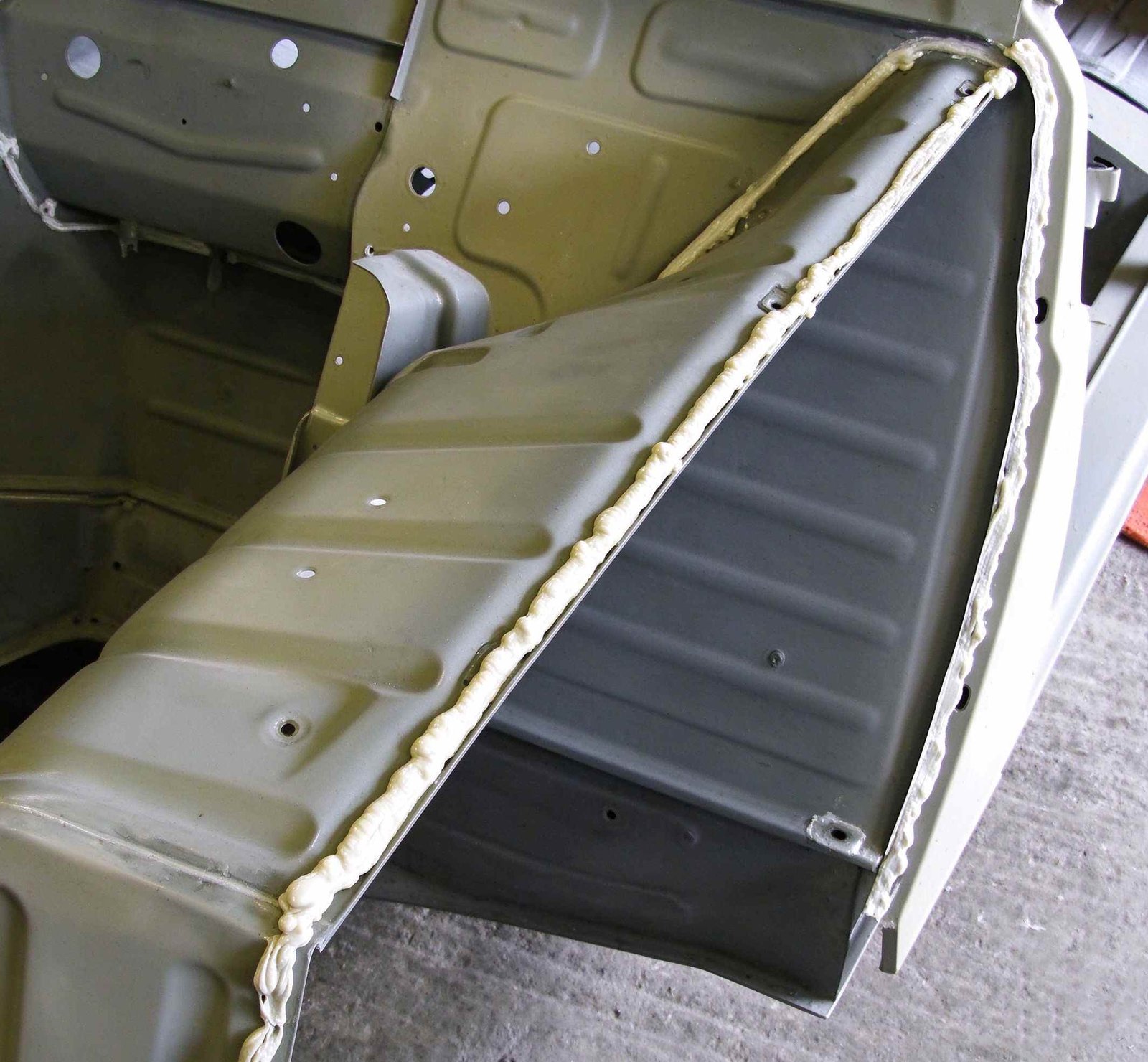
Figure 1: Heavy-bodied seam sealer bead applied over primed automotive panel before manual brush texturing.
Application Method Performance Benchmark: Brushable vs Extruded vs Sprayable
Evaluating automotive seam sealing methods demonstrates why specific vehicle zones demand brushable chemistry. The table below compares texture retention, application speed, and barrier defense across modern sealing technologies.
| Sealer Technology | Texture Appearance | Thixotropic Index | Primary Vehicle Zone |
|---|---|---|---|
| 1K / 2K Brush-On Formulation | Directional brush marks | > 5.5 (High yield) | Strut towers, floor pans, trunk wells |
| Standard Extruded Bead Sealer | Smooth cylindrical bead | 3.5 – 4.5 (Moderate) | Door skins, roof ditches, hem flanges |
| Sprayable Pneumatic Sealer | Orange peel / stippled mist | 2.5 – 3.5 (Low shear) | Wheel arches, underbody floor pans |
| Self-Leveling Joint Sealer | Glass-smooth flat puddle | < 1.5 (Near-Newtonian) | Roof channels, horizontal trunk gutters |
Solvent Pop Blistering from Excessive Film Builds
Solvent-borne formulations release volatile organic compounds during ambient skinning. If technicians deposit thick coatings exceeding 3.0 mm in a single pass, the outer surface skins over prematurely.
When the vehicle enters a heated paint booth, trapped solvents boil beneath the skin. Expanding gas ruptures the surface, creating pinholes that destroy corrosion resistance. Keep single passes under 2.5 mm to ensure clean, void-free curing.
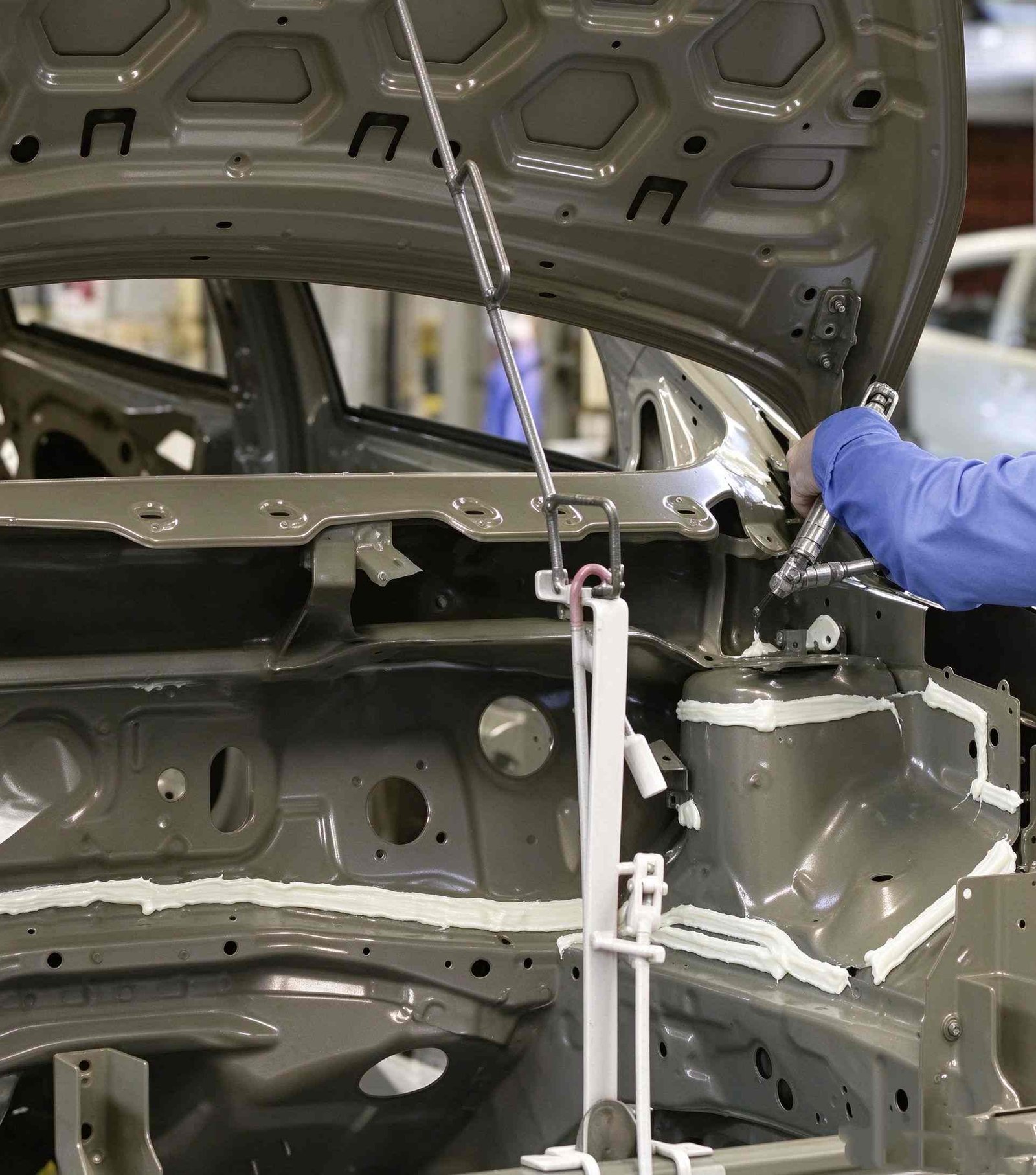
Figure 2: Technician inspecting factory seam sealer texture along engine bay strut tower reinforcement flanges.
Standard Operating Procedure: Replicating OEM Strut Tower & Floor Pan Texture
Reproducing undetectable OEM factory finishes requires disciplined execution of this step-by-step texturing protocol.
Four-Stage OEM Texture Replication Sequence
- Substrate Priming & Scuffing: Ensure bare steel welded joints receive two coats of 2K epoxy primer. Allow 24 hours cure, then scuff with a maroon P320 abrasive pad and clean with solvent degreaser.
- Paste Dispensing & Bead Control: Extrude a continuous 10 mm to 12 mm bead of brushable seam sealer directly along the center of the overlapping floor pan seam.
- Directional Brush Texturing: Hold a stiff 30 mm nylon brush at a consistent 45-degree angle. Pull the brush in uniform, overlapping 100 mm strokes in a single direction. Never brush back and forth, as reverse strokes destroy crisp factory ridges.
- Flash-Off & Topcoating: Allow the textured coating to flash off at 20°C for 30 to 45 minutes until fully tack-free. Apply basecoat and clearcoat according to refinish technical schedules.
Strut Tower Curved Flange Manipulation
Front strut towers feature circular, contoured metal stamping flanges. Maintaining uniform brush texturing around these curves requires technicians to rotate their wrist smoothly with the flange radius.
Keep brush pressure light and steady around the circular weld. Consistent pressure prevents paste buildup on outside edges, ensuring authentic factory appearance across shock towers.
OEM Quality Guidelines & Defect Prevention
Automobile manufacturers publish strict refinish inspection guidelines to identify substandard collision repairs. Noticeable differences in brush striation angle or missing textured overlaps signal structural repair history to insurance adjusters and vehicle inspectors.
Maintaining factory joint appearances using tools and methods described in our dispensing and sealant application guide ensures repairs pass stringent insurance audits and factory warranty standards.
Edge Lifting & Paint Flaking Troubleshooting
Edge lifting occurs when material is applied over glossy, unscuffed e-coat or bare, uncleaned metal. Without mechanical micro-profiling, the polymer peels away from the steel under chassis flex.
Always scuff underlying primers with abrasive pads to achieve ASTM D3359 5B intercoat adhesion. Thorough prep prevents moisture creeping beneath feathered brush strokes.
Typical Application Scenario: Luxury Sedan Front Strut Tower Replacement
Replicating European OEM Engine Bay Sealer Appearance
Repair Facility: A certified European collision repair center replacing the left front strut tower apron and inner wheelhouse on a late-model luxury sports sedan.
Field Failure: The technician replaced the inner apron and applied standard round-bead urethane seam sealer. The insurance inspector rejected the repair because the smooth, rounded bead mismatched the right-hand factory strut tower, which featured distinct 30 mm nylon brush striations.
Corrective SOP: Technicians stripped the smooth bead, scuffed the 2K epoxy primer with P320 pads, and extruded an 11 mm bead of ChemPU high-viscosity brush-on paste. Using a stiff nylon flat brush angled at 45 degrees, the technician duplicated the factory directional brush texture in single continuous sweeps matching the passenger side.
Audit Results: High-resolution optical inspection confirmed the replacement apron matched factory bristle ridge heights (0.45 mm) and stroke angles within 3 degrees. The insurance audit approved the repair immediately, restoring full vehicle resale valuation.
Frequently Asked Questions: Brushable Seam Sealers & Tooling
Can you thin brushable seam sealer with lacquer thinner or acetone?
Never thin brushable paste with solvents. Adding thinners breaks down the internal thixotropic polymer network, causing the paste to sag, lose brush texture ridges, and shrink excessively upon drying.
What type of brush produces the best OEM seam sealer texture?
A stiff, solvent-resistant nylon flat brush measuring 25 mm to 35 mm wide provides the best results. Natural hair bristle brushes are too soft and collapse under heavy paste, flattening the finish.
How long should brushable seam sealer flash off before spray painting?
Allow at least 30 to 45 minutes at 20°C ambient temperature until the surface forms a tack-free skin. Applying topcoats too early traps evaporating solvents, causing solvent pop blisters during paint baking.
Technical Review by ChemPU Body Refinish & Tooling Lab
Authored by Senior Automotive Refinish Specialists focusing on thixotropic sealant rheology, OEM robotic texture replication, and ASTM D3359 intercoat adhesion standards. Certified under ISO 9001 and IATF 16949 standards.
Source Professional Brushable Seam Sealers
Upgrade your collision repair centers and restoration workshops with ChemPU high-viscosity brushable seam sealers. Replicate OEM strut tower textures, prevent solvent pop, and ensure factory-grade watertight seals.
Direct WhatsApp Technical Inquiry: +86 15216655520

