
Automotive refinish centers and restoration workshops frequently battle visible paint mapping, edge lifting, and moisture blistering along welded body seams. These recurring defects usually stem from misapplying metal to metal body filler over flexible overlap joints that require elastomeric seam sealers.
Aluminum-reinforced polyester fillers provide dimensional stability and featheredge sanding across stationary surface low spots. However, body fillers possess high rigidity and minimal elongation. Overlap seams undergo cyclic thermal expansion and road chassis flex.
Attempting to bridge active structural seams with rigid body filler causes micro-cracking and capillary water entry within months. Understanding the physical performance boundary between cosmetic shaping and elastomeric sealing is vital for durable vehicle builds. This engineering guide defines substrate preparation, thermal movement thresholds, and primer sequences across welded automotive panels.
Key Takeaways: Filler vs Sealer Engineering Rules
- Functional Separation: Metal fillers shape static contours, while elastomeric sealers absorb dynamic joint movement.
- Elongation Mismatch: Aluminum-reinforced fillers provide under 3% elongation, whereas seam sealers deliver 300% to 600% elasticity.
- Moisture Permeation Risk: Polyester resins absorb ambient moisture through microscopic pores, requiring an epoxy primer barrier before filler application.
- Thermal Coefficient Conflicts: Metal filler expands at different rates than sheet steel, cracking if forced into overlapping gaps.
- Application Sequence: Grind and epoxy-prime welded joints, shape stationary low spots with filler, then apply seam sealer along dynamic seams.
Material Physics: Rigid Contouring vs Dynamic Joint Flex
Formulating metal to metal body filler involves dispersing microscopic aluminum flakes within unsaturated polyester or vinylester resins. Aluminum particles increase thermal conductivity, reduce shrinkage during crosslinking, and prevent sagging over large surface imperfections.
Once cured by benzoyl peroxide hardeners, the polyester crosslinks into a dense, rigid thermoset solid. It machines smoothly and feathers to a zero edge under orbital sanders.
Thermal Expansion & Chassis Vibration Fatigue
A passenger vehicle driven through seasonal weather cycles experiences panel temperature swings from -30°C to +85°C. Sheet steel expands and contracts constantly along longitudinal roof ditches, quarter panel junctions, and floor seams.
Because metal filler elongates less than 3% before brittle failure, differential thermal strain shears the filler bondline. In contrast, automotive polyurethanes stretch over 400% without tearing, absorbing thermal movement seamlessly.
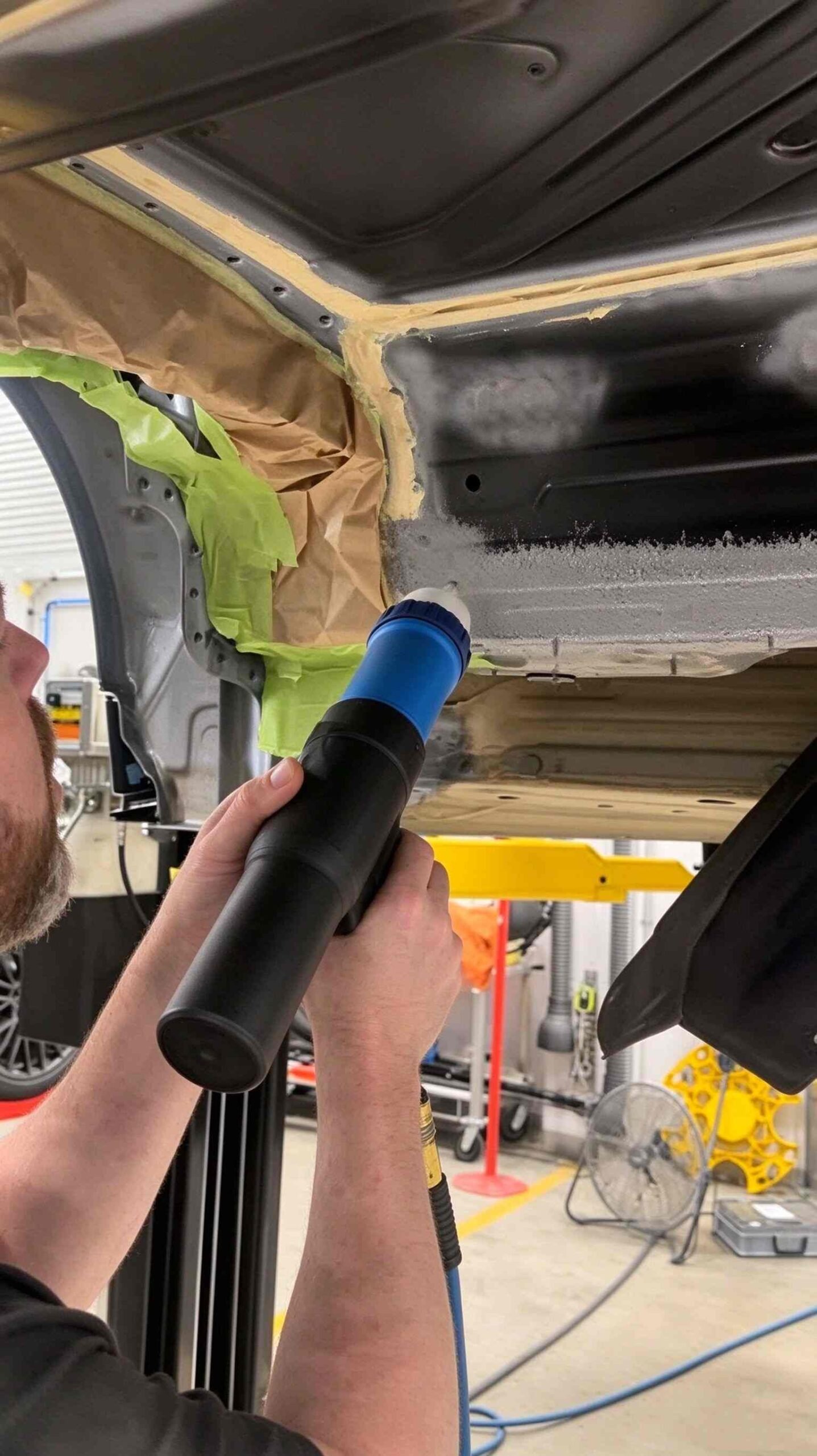
Figure 1: Application of elastomeric sprayable seam sealer over welded wheel arch flanges to establish flexible barrier defense.
Material Property Benchmark: Metal Filler vs Elastomeric Sealer
Comparing material properties clarifies why body filler and seam sealer must never be swapped across vehicle body joints. The table below outlines hardness, elongation, moisture absorption, and thermal tolerances.
| Technical Metric | Metal Body Filler | PU / MS Seam Sealer | Functional Consequence |
|---|---|---|---|
| Shore Hardness | Shore D 78 – 85 | Shore A 45 – 60 | Fillers resist sanding; sealers absorb flex |
| Elongation at Break | 1.5% – 2.8% | 350% – 600% | Filler snaps under active seam movement |
| Moisture Permeation | Porous (Micro-wicking) | 100% Watertight Barrier | Direct bare metal filler traps rust cells |
| Sanding Capability | Featheredges to Zero | Non-sandable (Gums paper) | Sealers must be tooled wet to shape |
Pore Wicking & Hydroscopic Rust Bubbling
Standard polyester resins are hydroscopic. When applied directly to bare unprimed steel, humidity diffuses through the filler matrix over time, condensing at the steel boundary.
This trapped moisture forms microscopic rust cells that expand into visible paint blisters. Applying an impervious two-component epoxy primer barrier before filler application prevents this catastrophic rust bubbling.
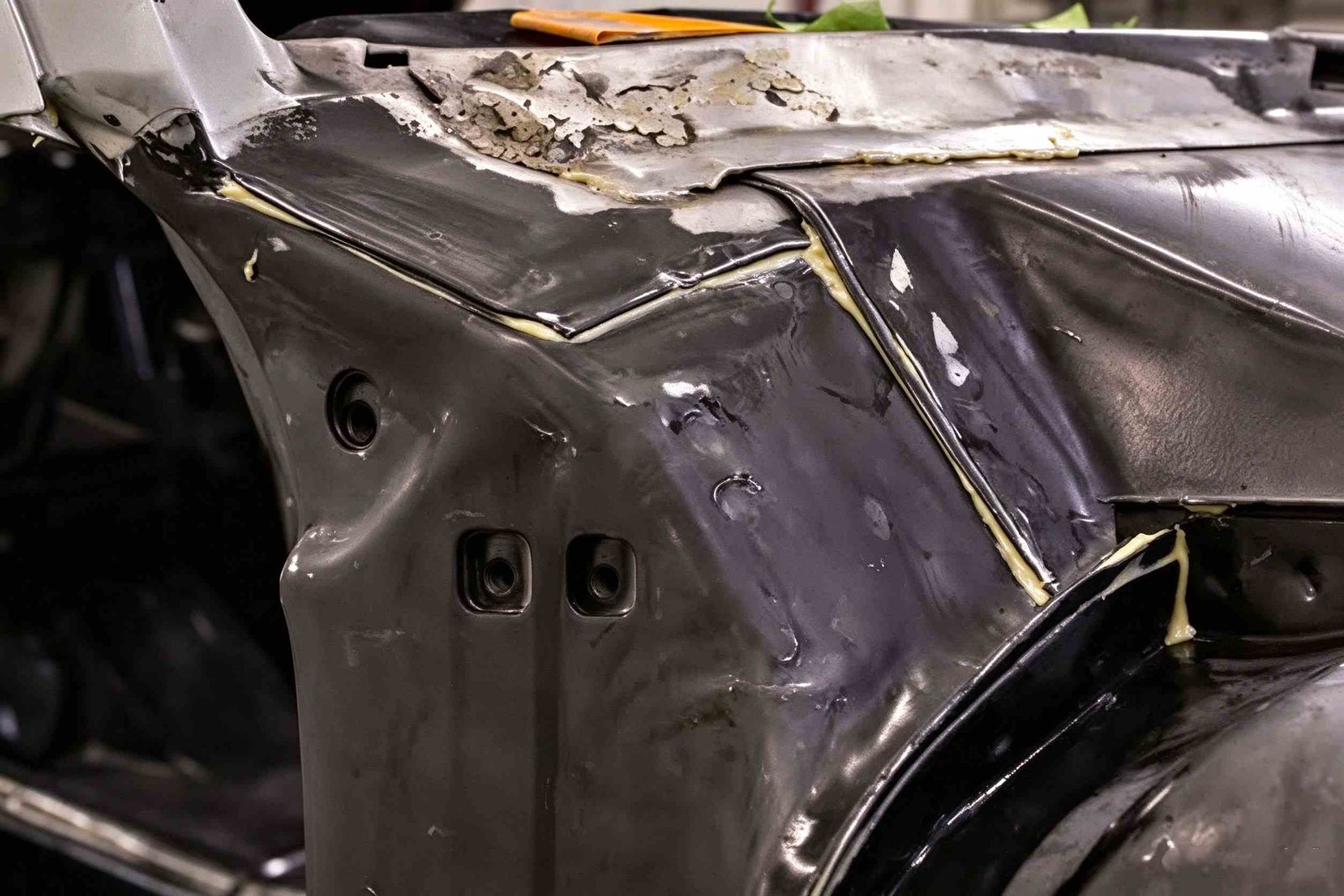
Figure 2: Precision application of flexible seam sealer over primed joint overlaps to accommodate thermal chassis movement.
Standard Operating Procedure: Sequencing Welded Seams & Outer Surfaces
Preserving restored bodywork requires disciplined adherence to this step-by-step refinish protocol.
Four-Step Repair & Sealing Sequence
- Weld Grinding & Epoxy Priming: Grind welds flush with P36 discs. Clean thoroughly with degreaser and spray two medium coats of 2K epoxy primer. Allow full cure to passivate bare steel.
- Static Panel Contouring: Scuff the cured epoxy with P180 abrasive pads. Apply metal to metal body filler only across stationary sheet metal depressions to restore original body lines. Block-sand progressively from P80 to P240.
- Sealer Application Over Joint Lines: Mask off joint edges. Dispense flexible automotive seam sealer directly into the overlapping seam valley. Tool with a nylon brush or spreader within the open working time.
- Topcoat Refinishing: Allow the seam sealer to flash off or cure according to product specifications. Apply 2K primer surfacer and topcoat according to OEM bake cycle schedules.
Avoiding the Common Valley Filling Mistake
Technicians often fill the visible valley of a roof seam with body filler to make it look flush. This practice guarantees repair failure.
Roof joints flex during highway cornering and chassis loading. When body filler bridges this seam, it fractures under shear stress, creating a cracked line through the basecoat within months. Always maintain the designed expansion valley with flexible sealant.
OEM Quality Guidelines & Defect Troubleshooting
Automotive manufacturers mandate that welded quarter panel wheel arches, C-pillar joints, and rocker panels maintain distinct separation between contouring materials and flexible barrier sealers.
Adhering to structural adhesives and sealers outlined in our panel bond vs seam sealer technical guide prevents joint delamination and preserves original vehicle warranty standards.
Ghost Lines and Edge Mapping Diagnosis
Ghost lines appear when body filler is feathered directly over seam sealer edges. Sealer solvents migrate upward into the porous filler, softening the polyester resin and causing uneven topcoat absorption.
Never apply body filler over seam sealer. Always complete all contouring, sanding, and epoxy sealing before dispensing elastomeric seam sealers along dedicated joint tracks.
Typical Application Scenario: Classic Muscle Car Quarter Panel Splice
Preventing C-Pillar Weld Cracking & Blistering
Restoration Project: A vintage vehicle restoration workshop splicing replacement rear quarter panels onto a 1969 unibody muscle car chassis.
Field Failure: The technician butt-welded the C-pillar seam and filled the welded trunk drop-off flange with standard polyester filler. After six months of aggressive driving, engine torque flex cracked the filler along the trunk drop-off seam. Moisture penetrated the fracture, producing rust blisters and lifting clearcoat along the quarter panel.
Corrective Protocol: The team stripped the joints to bare metal and primed both sides with ChemPU 2K epoxy primer. Contouring on the flat C-pillar sail panel utilized ChemPU metal to metal body filler blocked flat. The vibrating trunk drop-off overlap was masked and sealed with ChemPU polyurethane automotive seam sealer.
Audit Results: After two years and 15,000 road miles, ultrasonic and visual audits confirmed zero edge mapping, zero paint fractures on the sail panel, and 100% moisture-tight seal along the trunk drop-off flange.
Frequently Asked Questions: Body Fillers & Seam Sealers
Can you apply seam sealer over body filler or body filler over seam sealer?
Never apply body filler over seam sealer. Sealer flexibility causes rigid filler to crack, and solvent migration softens the polyester. However, you can apply seam sealer over properly cured, epoxy-primed body filler if joint sealing passes across a repaired panel.
Why is metal to metal body filler superior to lightweight plastic filler on welded seams?
Metal-reinforced filler contains aluminum flakes that improve thermal stability and moisture resistance compared to standard talc-filled body fillers. It provides higher impact resistance over butt-welded splices while resisting heat shrinkage under infrared bake lamps.
Do you have to prime bare metal before applying body filler?
Yes. Applying a quality two-component epoxy primer over bare steel before body filler provides maximum corrosion protection. It prevents trapped humidity from forming rust bubbles under hydroscopic polyester filler resins.
Technical Review by ChemPU Refinish Engineering & Joint Systems Lab
Authored by Senior Automotive Refinish Specialists focusing on aluminum-reinforced polyester fillers, elastomeric joint sealers, and ASTM D3359 cross-hatch intercoat adhesion. Certified under ISO 9001 and IATF 16949 standards.
Source Professional Body Fillers & Seam Sealers
Upgrade your automotive restoration centers and body shops with ChemPU metal-reinforced body fillers and OEM-grade seam sealers. Prevent edge mapping, eliminate weld seam cracking, and deliver flawless show-quality finishes.
Direct WhatsApp Technical Inquiry: +86 15216655520

