
Applying the wrong chemical primer causes catastrophic bonding failure and premature corrosion. In collision repair, the generic term automotive primer covers radically different chemical formulations. Each type serves distinct substrates, mechanical loads, and environmental exposures.
Body technicians often confuse cosmetic paint surfacers with corrosion-inhibiting epoxy coatings. Others mistake metal etch primers for black ceramic glass primers. Applying polyurethane over an incompatible paint primer ruins vehicle structural integrity. The windshield can detach during rollover crashes.
Selecting the right automotive primer requires understanding chemical boundaries. Surface leveling, bare steel passivation, and glass silane coupling demand dedicated chemistries. This technical guide delivers an engineering breakdown of body surfacers, anti-rust pinchweld primers, and black ceramic glass primers.
Key Takeaways: Automotive Primer Chemistry & Selection
- Functional Divergence: Body paint primers level sand scratches. Epoxy primers passivate bare metal against corrosion. Black glass primers block UV radiation and promote silane adhesion.
- Structural Adhesion Warning: Never apply structural polyurethane adhesive over 1K or 2K body filler surfacers. The porous pigment matrix shears under impact loads, causing bondline failure.
- Pinchweld Rust Protocols: Bare metal scratches on pinchwelds exceeding 25 millimeters require a certified 2K epoxy primer. This prevents rust creeping beneath the cured urethane bead.
- UV Shielding Mandate: Black glass primer contains furnace carbon black. It absorbs 100% of solar UV rays, preventing photochemical breakdown of the isocyanate polymer matrix.
Auto Body Primer Surfacers: Leveling, Sanding, and Paint Prep
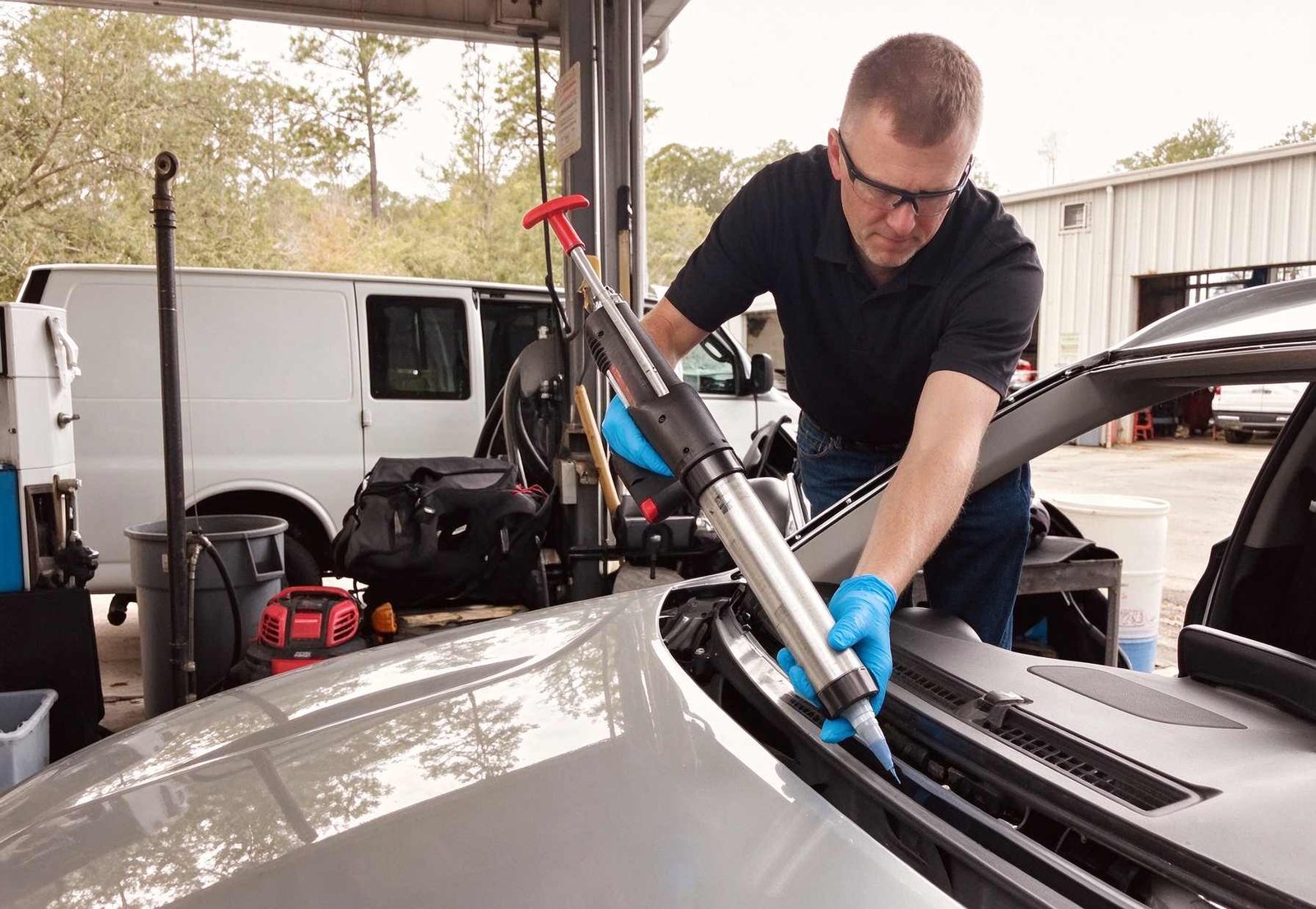
Body paint surfacers feature high pigment volume concentration. Formulators design them for easy sanding and cosmetic leveling, never for high-shear structural loads.
Standard auto body primer formulations blend 2K acrylic urethane or polyester resins. They carry heavy mineral fillers like talc, barium sulfate, and calcium carbonate. These soft fillers let technicians sand surfaces smooth using 320 to 600 grit abrasives, producing an even foundation for topcoat paint.
Porosity and Tensile Strength Limitations
Because filler surfacers sand easily, their internal tensile strength remains low (1.5 to 3.0 MPa). Their microscopic structure stays porous, readily absorbing atmospheric moisture when left unsealed.
When glass specialists install windshields into repainted apertures, they must mask the pinchweld bondline. Bonding direct glazing adhesive onto an automotive primer surfacer invites delamination under FMVSS 212 barrier crash conditions.
Anti-Rust Epoxy and Etch Primers: Electrochemical Metal Protection
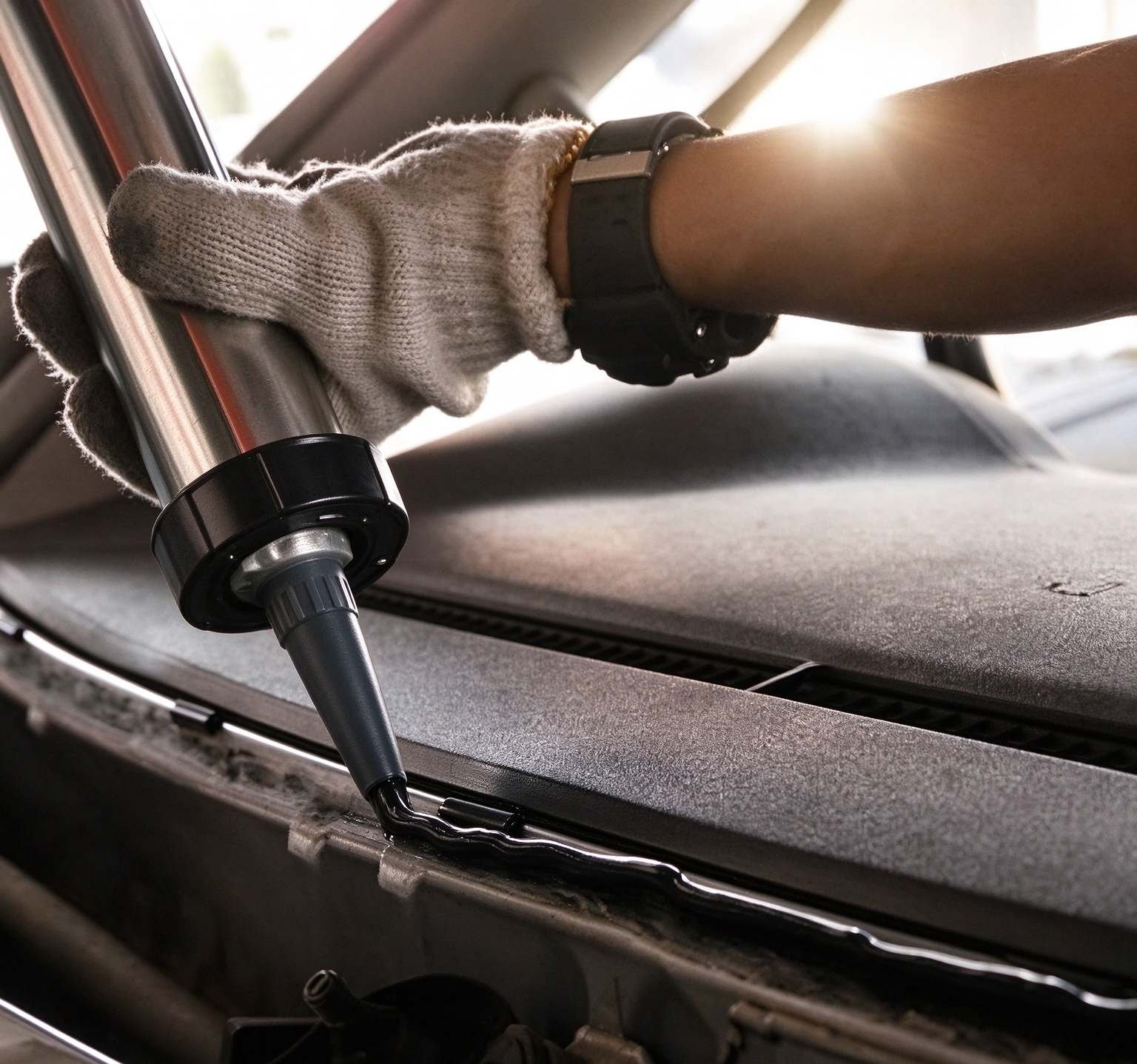
Pinchweld corrosion protection demands an entirely different chemical strategy. During glass cut-out, vibrating blades and cold knives scratch the factory e-coat, exposing bare sheet steel or aluminum.
Unprotected bare metal oxidizes rapidly when exposed to road moisture. Applying an anti-rust automotive primer passivates the metal substrate, stopping galvanic rust beneath the cured adhesive.
2K Epoxy Primer vs. 1K Self-Etching Primer
Collision repair facilities select between two distinct corrosion-inhibiting technologies:
- Two-Component (2K) Epoxy Primer: Formulated with bisphenol-A epoxy resin and polyamide curatives. Loaded with zinc phosphate, it delivers high lap shear strength (> 12 MPa) and survives 1,000 hours of ASTM B117 salt spray testing.
- One-Component (1K) Self-Etching Primer: Formulated with polyvinyl butyral (PVB) resins and phosphoric acid. The acid etches microscopic anchor profiles into metal. Do not apply polyurethane over 1K etch primer, because residual acid terminates isocyanate polymerization.
Pinchweld Scratch Area Thresholds
OEM repair manuals specify strict bare metal area thresholds. Minor scratches under 25 millimeters wide can receive an OEM-approved all-in-one black glass and pinchweld primer.
When scratches exceed 25 millimeters, or when corrosion removal reveals extensive bare steel, technicians must apply a 2K epoxy primer. They must allow the epoxy coating to cure completely before dispensing direct glazing adhesive.
Black Glass Ceramic Frit Primer: Silane Coupling and UV Shielding
Direct glazing polyurethane bonds tenaciously to trimmed urethane beads. It cannot adhere directly to bare inorganic glass without specialized chemical coupling. This vital role belongs to black glass automotive primer.
Modern black glass primers contain organosilane coupling agents and isocyanate prepolymers. Silane groups form covalent siloxane bonds ($Si-O-Si$) with inorganic glass ceramics. Isocyanate groups react directly with the applied polyurethane adhesive. For primerless comparisons, read our primerless vs primer-required windshield adhesive guide.
Total Optical UV-A and UV-B Radiation Blocking
Black glass primer creates an impermeable optical barrier. Furnace carbon black pigments absorb 100% of solar UV radiation up to 400 nanometers.
Without this dense black barrier film, ultraviolet radiation penetrates through the glass and ceramic frit dots. Solar photon energy breaks polymer urethane links, turning structural adhesive into powdery chalk within 12 to 24 months.
Flash-Off Timing and Open Bonding Windows
Applying black glass primer requires strict temperature monitoring. Technicians must allow carrier solvents to flash off completely, typically requiring 3 to 10 minutes at ambient workshop conditions.
Dispensing urethane over wet primer traps volatile solvent vapor inside the bondline, causing severe adhesive blistering and porosity. Conversely, waiting past the 24-hour open window allows isocyanate groups to cross-link with room humidity, rendering the primer chemically inert.
Technical Shootout: Body Surfacer vs. Epoxy Primer vs. Black Glass Primer
Review the chemical compositions, mechanical properties, and application constraints across all three major primer categories:
| Technical Parameter | Auto Body Surfacer Primer | 2K Anti-Rust Epoxy Primer | Black Glass Frit Primer |
|---|---|---|---|
| Primary Chemical Resin | Acrylic Urethane / Polyester | Bisphenol-A Epoxy / Polyamide | Organosilane / Isocyanate |
| Target Substrate | Body filler, sanded OEM paint | Bare steel, aluminum, pinchweld | Ceramic frit, raw glass, PVC |
| Dry Film Thickness (DFT) | 75 – 150 μm (High Build) | 25 – 50 μm (Medium Build) | 15 – 25 μm (Thin Film) |
| UV Radiation Resistance | Low (Requires topcoat clear) | Moderate (Degrades under UV) | Total 100% Optical Blocking |
| Direct Polyurethane Bonding | STRICTLY FORBIDDEN | Approved (Full Cure Required) | MANDATORY OEM STANDARD |
| Flash-off / Cure Window | 2 – 4 Hours (Before Sanding) | 4 – 8 Hours (Baking Expedited) | 2 – 10 Minutes (Fast Solvent) |
Understanding these chemical distinctions prevents catastrophic workshop bonding failures. For adhesive chemistry fundamentals, review our polyurethane vs silicone vs butyl adhesive guide.
Typical Application Scenario: Body Shop Pinchweld Contamination
Field Engineering Audit: Delamination After Quarter-Panel Collision Repair
Operating Problem: A commercial van involved in a minor rollover accident suffered total windshield detachment. The glass popped out intact. The cured polyurethane bead remained stuck to the glass frit, but separated completely from the vehicle body aperture.
Root Cause Investigation: The collision center had replaced the passenger A-pillar following a side collision. The painter sprayed 2K acrylic urethane filler surfacer across the aperture to fill sanding scratches. Then came basecoat and clearcoat. The glass installer applied polyurethane directly over the freshly painted surface without sanding or priming.
Resolution & Corrective Action: Forensic cross-hatch adhesion testing per ASTM D3359 showed that failure occurred inside the soft filler primer layer, not at the urethane interface. The shop revised its SOP. Technicians must mask all glass bonding apertures before spraying cosmetic surfacers, and apply approved 2K epoxy pinchweld coatings to bare metal repairs.
Frequently Asked Questions: Automotive Primer Application
Can I use auto body spray primer to touch up scratches on a windshield pinchweld?
No. Aerosol auto body spray primers lack the structural cross-linking and chemical density needed for direct glazing bonds. Scratches on pinchwelds must be treated with OEM-approved black all-in-one glass/pinchweld primer or certified 2K epoxy primer.
What happens if black glass primer is allowed to dry for more than 24 hours?
Black glass primers feature an open bonding window, typically 2 to 24 hours. After 24 hours, reactive isocyanate groups become fully moisture-cured and inert, preventing cross-linking with fresh polyurethane. The surface must be reactivated or re-primed per manufacturer guidelines.
Why is 1K acid etch primer prohibited under direct glazing urethanes?
Acid etch primers contain active phosphoric acid. Unneutralized acid migrates into the moisture-curing polyurethane, poisoning amine catalysts and terminating isocyanate chain polymerization, resulting in gummy, uncured adhesive bonds.
Engineering Conclusion: Match Chemistry to Substrate and Load
Professional collision centers and fleet repair facilities must never treat an automotive primer as an interchangeable commodity. Using paint surfacers for leveling, anti-rust epoxy coatings for bare metal protection, and black ceramic primers for glass bonding preserves cosmetic perfection and structural passenger safety.
Authored by ChemPU Automotive Application Engineering Team
Specializing in OEM direct-glazing polyurethane formulation, crash-retention validation per FMVSS 212 standards, and high-performance structural elastomeric bonding solutions for global automotive manufacturers.
Quality Certification: ISO 9001 / IATF 16949 Certified Adhesive Manufacturing
Source Certified OEM Direct Glazing Polyurethane Adhesives
Partner with ChemPU, an ISO 9001 and IATF 16949 certified Chinese manufacturer. We provide high-modulus polyurethane direct glazing adhesives, black glass primers, and private label cartridges for international distributors and fleet repair networks.
Direct WhatsApp Technical Inquiry: +86 15216655520

