
Vehicle bodies are assembled from hundreds of stamped steel and aluminum panels joined by resistance spot welding, structural riveting, and laser brazing. These overlapping metal joints leave microscopic capillary gaps along quarter panels, floor pans, door hems, and strut towers.
Without permanent hermetic protection, road moisture, de-icing salts, and acidic rain penetrate these joints, initiating hidden crevice corrosion. Substandard sealers shrink, crack automotive paint topcoats, or blister inside heated spray booths.
Selecting the right automotive seam sealer is essential for long-term corrosion prevention and factory-original texture replication. This technical guide examines the chemistry, paintability, and application characteristics of 1K moisture-curing polyurethane versus modern silyl modified polymers (MS polymers).
Key Takeaways: Seam Sealer Chemistry & Selection
- Chemical Divergence: 1K polyurethane offers maximum mechanical tear strength and elasticity. MS polymer (SMP) provides zero-isocyanates, zero solvent shrinkage, and superior UV radiation resistance.
- Paintability Windows: Polyurethane sealers require skin formation before painting to prevent solvent entrapment. MS polymers can be painted wet-on-wet within 20 to 30 minutes without causing paint wrinkling.
- Volume Shrinkage Risk: Low-solids sealers suffer 3 to 8 percent shrinkage, cracking paint along panel seams. High-solids MS polymers experience less than 1 percent volume change during curing.
- Bare Metal Corrosion Rule: Never apply seam sealer directly over bare, unprotected steel. All welded joints must receive a certified 2K epoxy primer before seam sealing.
Four Critical Functions of Vehicle Body Seam Sealers
A professional seam sealer must protect structural weld seams while replicating factory robotic textures, damping noise vibrations, and supporting automotive paint layers.
In automotive collision repair and assembly, a seam sealer serves four essential engineering purposes:
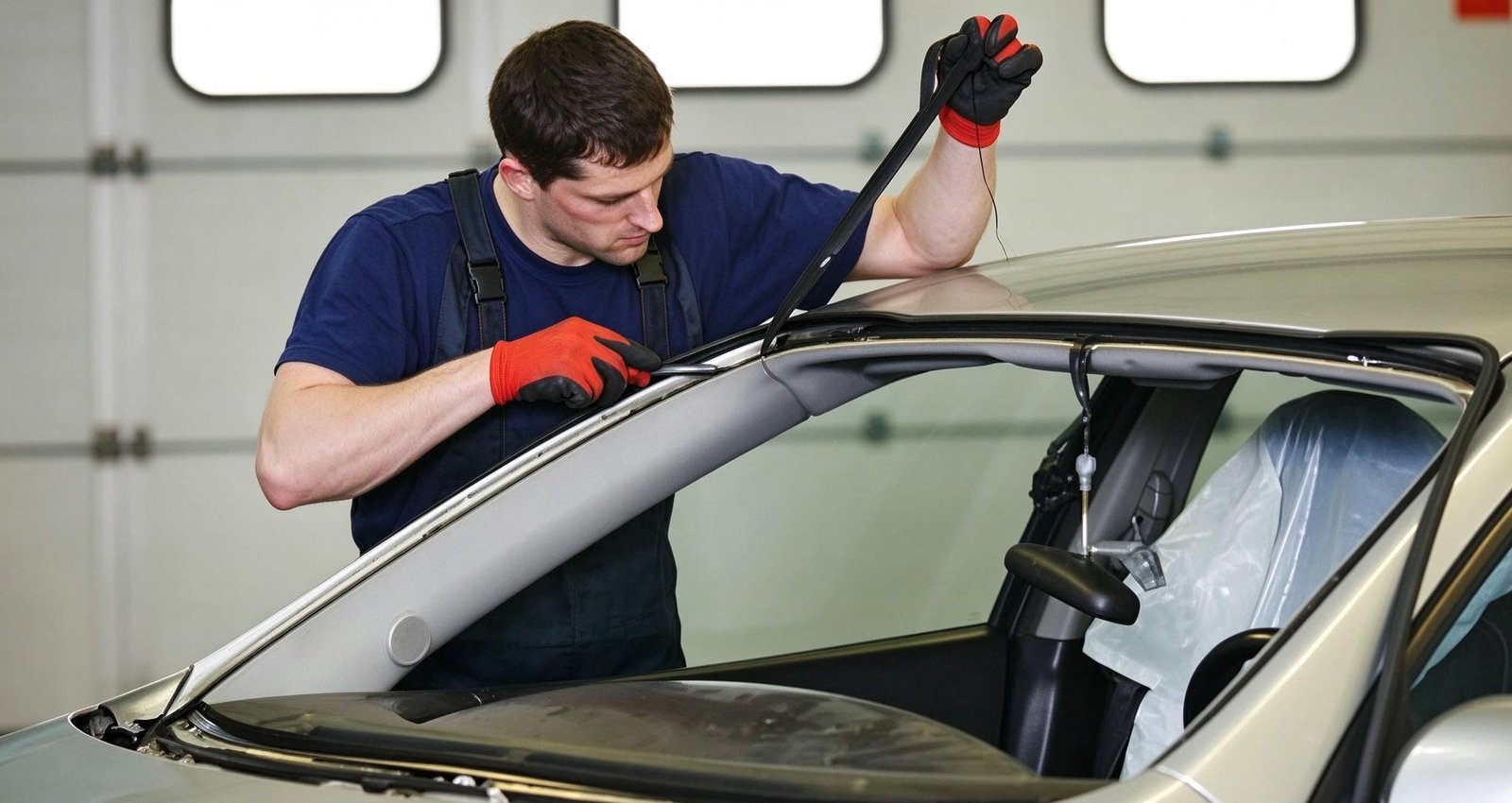
1. Hermetic Crevice Corrosion Prevention
Spot-welded flanges create microscopic capillary paths. An elastomeric automotive seam sealer seals these seams hermetically, blocking moisture, dirt, and road salts from initiating crevice corrosion from within.
2. Acoustic Damping and NVH Reduction
Thin stamped sheet metal panels resonate under road vibration. Elastomeric sealers absorb acoustic energy and mechanical flex, reducing Noise, Vibration, and Harshness (NVH) inside the passenger cabin.
3. Factory OEM Texture Replication
Automakers use specialized robotic dispensers to create distinct seam finishes. These include smooth extruded beads, nylon brush marks, and wide textured spray ribbons. Collision technicians must replicate these factory finishes precisely to maintain vehicle resale value.
Chemical Comparison: 1K Polyurethane vs. MS Polymer (STP/SMP)
Body shops rely primarily on two chemical platforms for joint sealing:
- 1K Moisture-Curing Polyurethane (PU): Formulated with isocyanate-terminated prepolymers. Polyurethane delivers high mechanical tear strength, high Shore A hardness (40 to 50), and rugged impact resistance. However, unpainted polyurethane degrades and chalks under intense solar ultraviolet radiation.
- Silyl Modified Polymer (MS / SMP): Formulated with silane-terminated polyether backbones. MS polymers cross-link through siloxane ($Si-O-Si$) bonds. They contain zero isocyanates and zero solvents, providing exceptional UV stability, zero shrinkage, and outstanding primerless adhesion to metals.
Pneumatic Dual-Pressure Atomizing and Texture Control
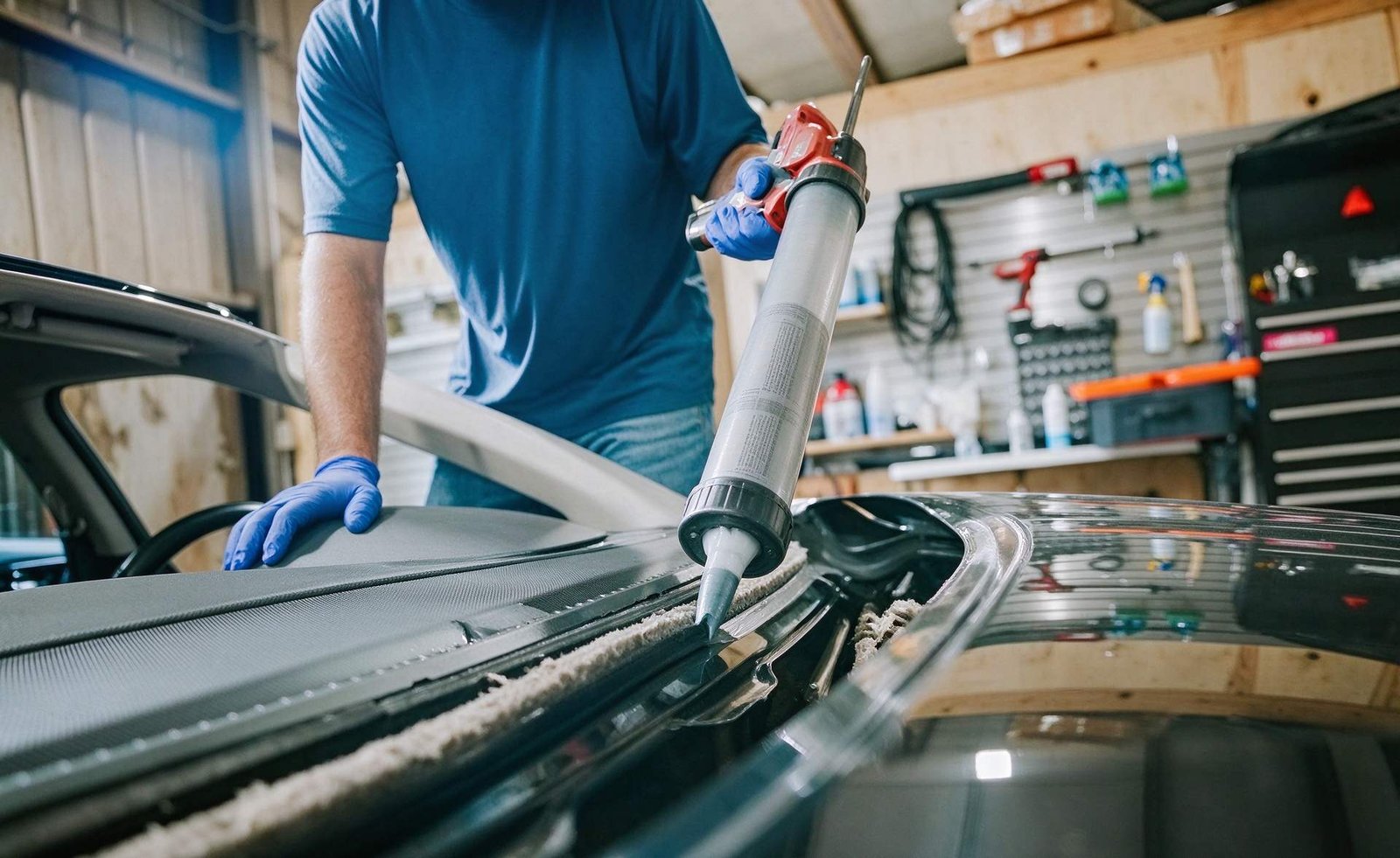
Modern OEM assembly lines use robotic spray guns to apply wide textured ribbons across wheel arches and floor pan overlaps. Replicating this texture manually requires specialized dual-pressure pneumatic guns.
One air regulator controls piston product delivery pressure, while a separate air circuit atomizes the sealant at the specialized nozzle tip. Technicians adjust air pressure ratios to produce smooth narrow beads, wide overlapping ribbons, or textured stone-chip protective coatings.
Paintability, Thermal Baking, and Blistering Resistance
A frequent headache in paint booths is paint blistering over freshly sealed seams. When painters apply basecoat over uncured polyurethane, the isocyanate-water reaction releases carbon dioxide gas ($CO_2$).
Trapped $CO_2$ gas bubbles through the wet paint film during 60°C booth baking, forming microscopic pinholes. In contrast, MS polymers cure through silane condensation without generating gas, allowing safe wet-on-wet painting within 20 to 30 minutes.
Thermal Expansion and Clearcoat Flexibility
Automotive panels expand and contract across seasonal temperature extremes. If a seam sealer is too stiff, the painted surface develops hairline cracks along the joint edges.
MS polymers maintain permanent elastomeric flexibility (-40°C to +100°C), accommodating metal movement without stressing automotive basecoats or clearcoats. Learn about primer preparation in our automotive primer classification guide.
Technical Shootout: 1K Polyurethane vs. MS Polymer Seam Sealers
Review the chemical formulations, shrinkage metrics, and application boundaries across primary seam sealing technologies:
| Technical Parameter | 1K Polyurethane Sealer | MS Polymer (SMP) Sealer | Solvent-Based Rubber Sealer |
|---|---|---|---|
| Solids Content | 92% – 96% | 100% (Solvent Free) | 60% – 75% (High Solvent) |
| Volume Shrinkage | 3% – 5% | < 1% (Zero Sag/Shrink) | 15% – 25% (Heavy Cracking) |
| Paintability Window | After Skinning (45 – 90 min) | Wet-on-Wet (20 – 30 min) | After Full Dry (4 – 8 hours) |
| Unpainted UV Stability | Moderate (Yellows/Chalks) | Excellent (Does Not Chalk) | Poor (Dries & Flakes) |
| Isocyanate & Solvent Content | Contains Free Isocyanates | 100% Isocyanate & Solvent Free | High VOC Content |
| Shore A Hardness | 45 – 55 (Firm/Tough) | 35 – 45 (Flexible) | 30 – 40 (Brittle over time) |
Understanding these parameters ensures dependable body shop repairs. For adhesive fundamentals, review our polyurethane vs silicone vs butyl comparison.
Standard Operating Procedure: Five-Step Seam Sealer Application
Professional collision technicians should apply an automotive seam sealer following this proven shop sequence:
Collision Seam Sealing Protocol
- Joint Cleaning and Epoxy Priming: Grind weld spatter smooth. Clean the joint with solvent degreaser. Apply two coats of 2K epoxy primer to passivate bare steel, allowing full cure before sealing.
- Joint Masking: Apply automotive masking tape 3 to 5 millimeters along each side of the seam to ensure clean, razor-sharp edge lines.
- Sealant Extrusion or Spraying: Dispense seam sealer using an appropriate pneumatic gun. For spray textures, adjust air pressure to achieve the desired ripple or orange-peel pattern.
- Surface Tooling: Smooth the bead using a nylon seam brush dampened with solvent, or leave the pneumatic spray ribbon untouched to duplicate OEM appearance.
- Topcoat Painting: Remove masking tape immediately. Apply automotive basecoat and clearcoat within the recommended wet-on-wet painting window.
Typical Application Scenario: Commercial Van Quarter Panel Repair
Field Engineering Audit: Overcoming Seam Paint Cracking
Operating Problem: A commercial fleet body shop replaced a rear quarter panel on a delivery van. After painting and baking the vehicle at 60°C, the clearcoat developed deep cracks and bubbles directly over the exterior roof ditch seam.
Root Cause Investigation: Technicians applied a low-cost, solvent-borne rubber seam sealer. During high-temperature baking, rapid solvent evaporation caused 18 percent volume shrinkage, pulling the sealant away from the joint while outgassing through the curing clearcoat.
Resolution & Outcome: Technicians stripped the cracked joint, primed bare steel with 2K epoxy primer, and applied ChemPU sprayable MS polymer seam sealer. The 100% solids formulation showed zero shrinkage under paint booth baking. The repair matched factory robotic ripples with flawless clearcoat gloss.
Frequently Asked Questions: Automotive Seam Sealer Usage
Can automotive seam sealer be applied directly over bare, unpainted steel?
No. While MS polymers adhere to bare metal, seam sealers do not provide active anti-corrosion passivation. Bare steel joints must always receive a coat of 2K epoxy primer before applying seam sealer.
What is the difference between brushable, extrudable, and sprayable seam sealers?
Extrudable sealers dispense as narrow beads for door hems. Brushable sealers have heavier thixotropy for floor pans. Sprayable sealers atomize with specialized pneumatic air guns to replicate wide factory textured ribbons across wheelhouses.
Can windshield direct glazing polyurethane be used as a body seam sealer?
While windshield urethane adheres well to e-coat, it has very high viscosity and is difficult to tool smoothly. Windshield polyurethanes also chalk rapidly when exposed to direct sunlight without protective paint.
Engineering Conclusion: Selecting the Optimal Chemical Seam Barrier
Automotive corrosion protection relies on meticulous seam preparation. By applying 2K epoxy primers to bare metal and using a high-performance automotive seam sealer, collision repair facilities prevent rust creep, eliminate paint cracking, and replicate factory-original finishes.
Authored by ChemPU Automotive Application Engineering Team
Specializing in OEM direct-glazing polyurethane formulation, crash-retention validation per FMVSS 212 standards, and high-performance structural elastomeric bonding solutions for global automotive manufacturers.
Quality Certification: ISO 9001 / IATF 16949 Certified Adhesive Manufacturing
Source Certified OEM Direct Glazing Polyurethane Adhesives
Partner with ChemPU, an ISO 9001 and IATF 16949 certified Chinese manufacturer. We provide high-modulus polyurethane direct glazing adhesives, black glass primers, and private label cartridges for international distributors and fleet repair networks.
Direct WhatsApp Technical Inquiry: +86 15216655520

