
Releasing a vehicle before adhesive cure completes creates severe liability for autoglass technicians. In reality, the windshield serves as a vital structural component in modern vehicle architecture. Specifically, it provides up to 45% of cabin structural strength in front-end crashes. It also prevents roof collapse during rollovers. Furthermore, the passenger airbag relies directly on the windshield as a structural backstop during deployment. In consequence, applying an unverified polyurethane windshield adhesive compromises vehicle occupants. The bond simply cannot protect them before developing full lap shear strength.
Premature vehicle release remains a leading cause of windshield detachment during road impacts. Based on extensive lab testing across commercial fleets, SHCHEMPU has engineered this comprehensive technical guide. In this analysis, we outline the chemical kinetics, federal crash safety mandates, and environmental factors governing true safe drive-away time.
Key Takeaways.
- FMVSS 212 & 208 Compliance: Safe drive-away time represents the minimum cure period needed for full crash retention. Specifically, it ensures the windshield remains bonded during a 30 mph barrier impact. In addition, it must fully absorb passenger airbag deployment forces.
- Chemical Cure Dynamics: Standard single-component polyurethane cures via ambient atmospheric moisture. Consequently, cold and dry conditions significantly extend curing schedules compared to laboratory baselines.
- Critical Material Selection: Modern vehicles with ADAS sensors and electric powertrains require high modulus (HM) and non-conductive (NC) automotive polyurethane adhesives. These specialized formulations preserve chassis torsional rigidity. Moreover, they prevent camera calibration errors and electrical signal disruption.
What Is Safe Drive-Away Time (SDAT) in Auto Glass Replacement?
Safe Drive-Away Time (SDAT) is the validated cure period required for an autoglass adhesive to achieve critical lap shear strength (≥ 1.0 to 1.5 MPa). As a result, this mechanical strength allows the bond line to withstand severe vehicle collisions without adhesive failure. SHCHEMPU verifies every formula against FMVSS 212 and FMVSS 208 crash impact criteria.
FMVSS 212: Windshield Mounting Retention Requirements.
The Federal Motor Vehicle Safety Standard FMVSS 212 establishes rigid retention minimums during a 30 mph barrier crash. For vehicles fitted with active passenger airbags, at least 50% of the windshield perimeter must remain securely bonded along the pinchweld. In contrast, vehicles without airbags require 75% retention. Therefore, professional autoglass technicians mandate 100% perimeter retention. This higher standard completely eliminates occupant ejection hazards during severe rollover impacts.
FMVSS 208 and FMVSS 216: Airbag Cushioning and Roof Crush Resistance.
Under FMVSS 208 occupant crash protection guidelines, passenger airbags fire upward against the interior windshield surface within 30 milliseconds. Therefore, the glass acts as a reaction backstop to redirect the airbag cushion toward the occupant. If the adhesive bead yields under this explosive force, the windshield pops out. As a consequence, the airbag deploys through the opening, leaving the passenger unprotected.
FMVSS 216 Specifies roof crush resistance. During rollover incidents, an intact windshield bonded with high-modulus adhesive provides up to 60% of total roof structure support. Thus, proper adhesive choice directly prevents cabin collapse.
Polyurethane Curing Kinetics: How Temperature and Humidity Dictate SDAT
One-component moisture-curing polyurethane adhesives depend strictly on ambient water vapor to initiate crosslinking. A drop of 10°C in workshop temperature roughly doubles the required cure window before vehicles can be driven safely.
Chemical Crosslinking Mechanism of Automotive Polyurethanes.
Single-component automotive adhesives consist of isocyanate-terminated polyurethane prepolymers (R-NCO). When exposed to atmospheric moisture, isocyanate groups react with ambient water vapor (H2O). This step produces amine groups and releases carbon dioxide (CO2). These amine groups immediately react with remaining isocyanates to generate strong polyurea linkages. Consequently, an elastomeric polymer matrix develops from the outside skin inward. It cures at approximately 3 to 4 mm per 24 hours at standard laboratory conditions (23°C and 50% Relative Humidity).
The Real-World Temperature and Humidity Cure Matrix.
Technicians frequently make the mistake of trusting nominal label cure times without measuring workshop humidity. The matrix below illustrates how environmental shifts dramatically impact safe release windows for single-component polyurethanes compared to booster-accelerated systems.
| Environmental Condition. | Standard 1K Polyurethane. | Fast-Cure 1K Polyurethane. | Dual-Component System. |
|---|---|---|---|
| Warm & Humid (30°C / 80% RH). | 1.5 – 2 Hours. | 30 – 45 Minutes. | 30 Minutes Constant. |
| Standard Lab (23°C / 50% RH). | 4 – 6 Hours. | 60 Minutes. | 30 Minutes Constant. |
| Cool & Dry (10°C / 30% RH). | 8 – 12 Hours. | 2 – 3 Hours. | 30 Minutes Constant. |
| Freezing Winter (-5°C / 20% RH). | Unsafe without Heated Booth. | 4 – 6 Hours. | 45 Minutes. |
Need certified Safe Drive-Away Time data sheets for your autoglass repair network?
High Modulus and Non-Conductive Adhesives: Essential for ADAS and EV Safety
Modern vehicle engineering mandates high shear modulus (G ≥ 2.0 MPa). It also requires high volume resistivity (ρ ≥ 1010 Ω·cm). Using conventional low-modulus sealants causes vehicle chassis flex, camera calibration drift, and galvanic body corrosion.
High Modulus (HM) Windshield Adhesives and Chassis Rigidity.
Torsional stiffness in contemporary unibody vehicles relies heavily on bonded glass components. Standard windshield adhesives provide a shear modulus of roughly 0.6 to 1.0 MPa. In contrast, High Modulus (HM) formulations deliver a shear modulus exceeding 2.0 to 2.5 MPa. This structural stiffness increases vehicle body torsional rigidity by up to 35%. Consequently, it stabilizes suspension geometry and eliminates squeaks and rattles.
Most importantly, Advanced Driver Assistance Systems (ADAS) depend on forward-facing optical cameras mounted against the upper windshield. If a low-modulus adhesive flexes excessively over potholes, optical camera pitch shifts. As a result, autonomous emergency braking and lane-keeping systems can trigger false alarms or fail completely.
Non-Conductive (NC) Formulations for Electric Vehicles and Integrated Antennas.
Traditional polyurethane sealants utilize carbon black reinforcement fillers. These conventional fillers conduct small electrical currents. However, modern windshields incorporate embedded radio antennas, heating filaments, rain sensors, and heads-up display projections. Non-Conductive (NC) adhesives use specially purified low-conductivity carbon blacks. This special filler achieves a volume resistivity greater than 1010 Ω·cm.
In electric vehicles with high-voltage architecture and aluminum pinchwelds, non-conductive properties prevent electrochemical corrosion between bare metal and contact points. Furthermore, when sealing battery covers and seams, technicians combine these with compatible automotive seam sealer products. This practice preserves watertight integrity across vehicle joints.
Standard Operating Procedure: Achieving Certified SDAT in the Field
Even the highest-performing polyurethane adhesive will suffer adhesive delamination if surface preparation guidelines are ignored. Achieving lab-tested SDAT requires strict adherence to pinchweld trimming, black primer application, and triangular bead extrusion.
Step 1: Pinchweld Inspection and Close-Cut Trimming.
Technicians must cut out the damaged windshield carefully. In particular, take care not to scratch the painted vehicle flange. Then, trim the remaining polyurethane bead down to a uniform thickness of 1.0 to 2.0 mm across the entire aperture. Fresh polyurethane bonds exceptionally well to clean, existing polyurethane through cohesive chemical fusion. However, any exposed bare metal scratched during cutout must immediately receive an anti-corrosion primer to prevent future rust blisters.
Step 2: Glass Surface Cleaning and Black Primer Activation.
Thoroughly clean the ceramic frit band on the new glass using an approved residue-free glass cleaner. Afterwards, wipe the surface completely dry with a clean lint-free cloth. Subsequently, shake the black primer bottle vigorously for at least 30 seconds until the internal mixing ball rattles freely. Apply a single, continuous layer of primer around the frit perimeter. Allow the primer to flash off for 10 minutes until it achieves a matte black finish. This primer layer protects the polyurethane from long-term solar UV degradation.
Step 3: Triangular V-Bead Extrusion and Glass Setting.
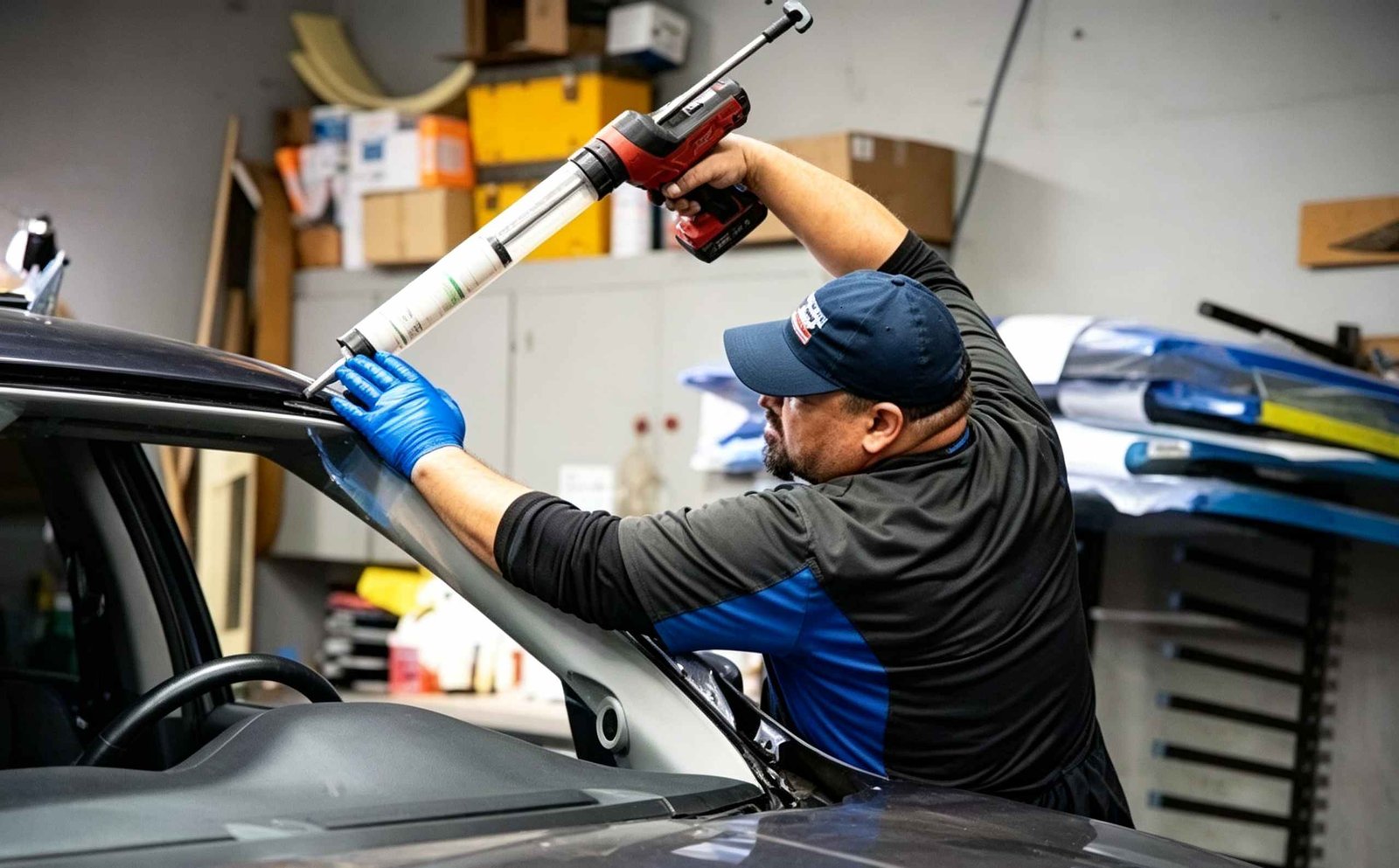
Never apply windshield adhesive with a round nozzle. Instead, utilize a specialized pre-cut triangular V-notch nozzle mounted on an ergonomic tool from our sealant accessory tools range. The triangular bead profile must feature a height of 12 to 15 mm. In addition, it requires a base of 8 to 10 mm. This specific geometry ensures that when the glass is seated, the adhesive compresses smoothly into a void-free rectangular bed without trapping air bubbles.
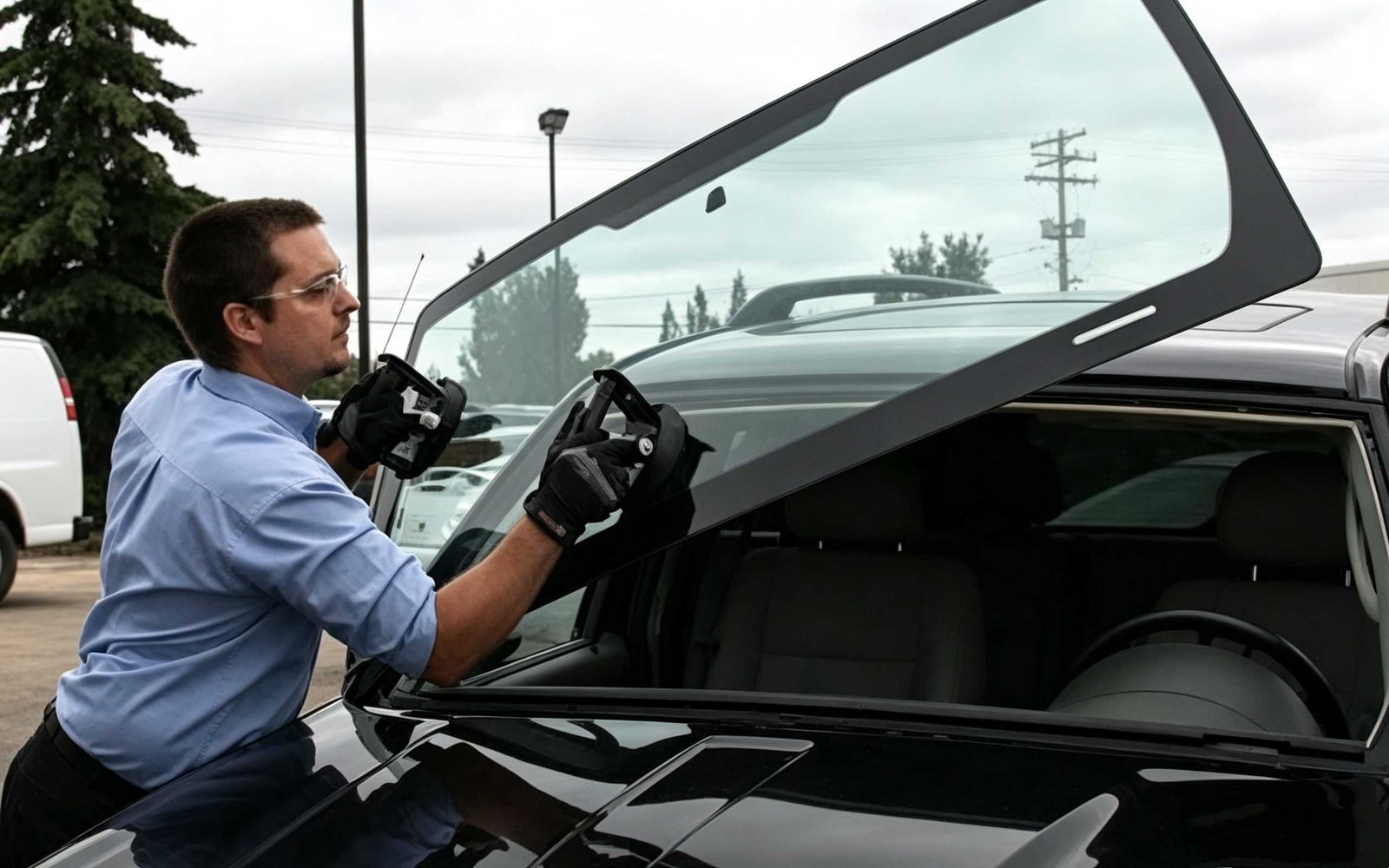
Immediately set the windshield within 10 to 15 minutes of adhesive extrusion before skinning occurs. Using dual suction lifters, two technicians align the glass precisely with the roofline and A-pillars. Press gently along the perimeter until the target bead thickness (typically 4.0 to 5.0 mm) is achieved. Finally, secure the glass with retention tape. Keep all vehicle windows rolled down slightly to prevent cabin pressure pulses when closing doors.
SHCHEMPU Case Study: Commercial Fleet Network Cuts Turnaround Time by 50% While Ensuring 100% Crash Safety
By transitioning to SHCHEMPU fast-curing polyurethane windshield adhesive, an express logistics fleet with 450 commercial delivery vans reduced mobile replacement turnaround from 4 hours to 60 minutes with zero safety incidents under FMVSS 212 standards.
CLIENT CHALLENGE.
- Specifically, a regional parcel delivery operator in Northern Europe managing 450 light commercial vans.
- In addition, average winter temperature hovered near 5°C with low humidity, stalling conventional 1K adhesive cure.
- Vehicles were detained for 4 to 6 hours per glass replacement. This delay generated vehicle downtime costs exceeding €180 per day per van.
OUR SOLUTION.
- Supplied SHCHEMPU Rapid-Cure High Modulus Non-Conductive Polyurethane Windshield Adhesive.
- Certified Safe Drive-Away Time of 60 minutes for dual-airbag commercial vehicles down to -5°C.
- Furthermore, we standardized mobile repair technicians with pre-cut V-notch nozzles and all-in-one chemical surface primers.
RESULTS & VALUE.
- Vehicle Bay Turnaround: 4.5 Hours → 1 Hour.
- Annual fleet productivity regained: over 1,200 commercial service hours across winter months.
- Zero windshield separation or ADAS sensor recalibration failures reported over 18 months of service.
Data source: SHCHEMPU Commercial Fleet Engineering Field Log, 2025. Vehicle Model: Commercial Transit Van Series. Material: SHCHEMPU HMNC Auto Glass Adhesive.
How to Select an Industrial Automotive Glass Adhesive Manufacturer
Procuring automotive glass adhesives for wholesale distribution, fleet service, or OEM bus manufacturing requires evaluating verifiable crash certificates. In addition, buyers must verify automated filling consistency and customized batch viscosity.
Key Audit Criteria for B2B Procurement Managers.
- Independent Crash Test Documentation: Ensure the manufacturer provides verified crash test reports. These documents demonstrate compliance with FMVSS 212 and FMVSS 208 under extreme temperature envelopes.
- Certified Tensile and Shear Modulus: Demand full physical properties data sheets. Specifically, check lap shear strength (≥ 2.5 MPa fully cured), Shore A hardness (60–65), and elongation at break (> 450%).
- High-Precision Packaging and Moisture Barriers: Moisture-curing polyurethane requires airtight aluminum cartridges or sausage foils. At SHCHEMPU, our automated manufacturing plants utilize advanced automatic sealant filling machine systems. This machinery guarantees zero moisture ingress and consistent 12-month shelf life.
- OEM Formulation Versatility: For specialized industrial transport, manufacturers should also offer compatible structural adhesives. Examples include RV roof sealant and hybrid MS polymers for multi-material bus and rail cabins.
Summary: Engineering Crash Safety into Every Auto Glass Replacement
Safe Drive-Away Time is not an arbitrary convenience metric. Instead, it represents a legally binding crash safety threshold validated by federal safety standards. By understanding how environmental conditions govern moisture-cure polyurethane kinetics, technicians can reliably schedule releases. Moreover, specifying high-modulus, non-conductive formulations protects fleet drivers while shielding repair businesses from catastrophic liability.
- Mandatory Retention: FMVSS 212 mandates that windshields remain bonded to absorb explosive passenger airbag loads. It also ensures the roof resists cabin collapse.
- Environmental Caution: Sub-10°C temperatures and dry conditions require doubling standard single-component cure expectations or upgrading to fast-cure systems.
- ADAS & EV Compatibility: High modulus prevents optical camera miscalibration. Meanwhile, non-conductive chemistries protect telematics and prevent galvanic corrosion.
Technical Automotive Engineering Team.
Polymer Synthesis & Crash Testing Division · SHCHEMPU · 18+ Years OEM Experience.
Our team specializes in high-modulus polyurethane adhesives and vehicle crashworthiness compliance. In addition, we design automated dispensing technologies for commercial bus, rail, and passenger vehicle networks worldwide.
SHCHEMPU FACTORY DIRECT.
Ready to Source Certified Polyurethane Windshield Adhesives?
Speak directly with our polymer synthesis engineers. We supply factory-direct cartridges, sausages, and bulk drums with complete FMVSS crash test reports and customizable Safe Drive-Away Time ratings.
Related Technical Guides.
Continue with SHCHEMPU engineering resources covering structural automotive glazing, body seam sealing, and professional dispensing tooling.
Automotive Glazing.
Complete Guide to Polyurethane Windshield Adhesives: Chemistry & Standards.
In-depth analysis of polyurethane windshield adhesives, FMVSS 212 barrier crash specs, high-modulus ratings, and pinchweld priming protocols.
Vehicle Body Sealing.
Automotive Seam Sealer Selection, Weld Seam Waterproofing & Application.
Technical sealing specifications for vehicle hem flanges, underbody corrosion protection, and EV battery enclosure seams.
Application Tools.
High-Thrust Caulking Guns for Viscous Polyurethanes: 18:1 vs 26:1 Ratios.
Mechanical thrust selection, pneumatic vs cordless dispensers, and triangular V-notch nozzle extrusion techniques.

