
Industrial sealant manufacturing reaches its most critical bottleneck at the packaging stage. Highly viscous pastes like RTV silicones, one-component polyurethanes, and modified silanes resist fluid transfer under normal atmospheric pressure. When packaging lines rely on semi-manual dosing, volumetric inaccuracy and air entrapment frequently trigger customer rejections.
Discover our factory-grade polyurethane windshield adhesive engineered for industrial compliance.
Investing in an engineered automatic sealant filling machine transforms bulk production into profitable output as a result. Modern turnkey packaging lines combine hydraulic drum unloading presses with precision volumetric dosing cylinders, vacuum de-aeration systems, and high-speed rotary cappers as well. This automated integration preserves moisture-sensitive polymers while maximizing hourly container throughput.
Selecting packaging equipment therefore requires evaluating hydraulic pressures, dosing valve seals, and container compatibility. SHCHEMPU engineers turnkey adhesive filling systems for chemical plants and private-label packaging converters across international markets. Specifically, this comprehensive guide examines cartridge cappers, sausage foil form-fill-seal machines, drum unloader hydraulics, and plant engineering layout criteria.
Executive Summary: Key Takeaways for Plant Managers & Chemical Engineers
- Hydraulic Ram Presses Solve High Viscosity Transfer: Adhesives exceeding 800,000 cPs will not self-level into feed pumps. Hydraulic drum unloader presses apply force against 200L steel drums. This feeds high-viscosity paste directly into dosing cylinders without cavitation.
- Vacuum De-aeration Eliminates Internal Air Pockets: Atmospheric micro-bubbles inside silicone or polyurethane cartridges cause messy applicator sputtering on construction sites. Integrating vacuum-assisted bottom-up filling nozzles guarantees 100% solid, bubble-free container packing.
- Packaging Geometry Governs Equipment Architecture: Rigid 300ml tubes require rotary indexing tables, plunger inserters, and printers. In contrast, 600ml sausage packs require tubular film forming, servo extrusion, and dual-clipping closure units.
- Hermetic Nitrogen Purging Protects Moisture-Cure Chemistries: Packaging one-component polyurethanes demands completely sealed fluid circuits with dry nitrogen blankets. This chemical isolation prevents atmospheric moisture from curing prepolymers inside dosing valves during production pauses.
Overview of Modern Sealant Packaging Technology & Viscosity Physics
Unlike thin liquid packaging, an automatic sealant filling machine operates in the realm of extreme rheology. Handling non-Newtonian thixotropic pastes requires heavy mechanical displacement and precise volumetric metering.
Overcoming Non-Newtonian Rheology: Handling 500,000 to 1,500,000 cPs
Automotive urethanes and silicones exhibit high yield stress. At rest inside a 200L storage drum, the paste behaves like a solid rubbery gel. Gravity feeding from overhead hoppers is mechanically impossible because the material bridges across discharge ports.
Modern filling machines utilize high-pressure hydraulic ram discharge presses equipped with follower plates. Inflatable rubber O-rings wipe drum sidewalls clean under hydraulic force. This positive pressure forces paste into delivery pipes, thereby feeding volumetric metering pumps continuously.
The Transition from Manual Filling to Fully Automated Lines
Manual and semi-automatic cartridge filling relies on foot-pedal pneumatic rams. Specifically, operators manually load empty cartridges, align filling nozzles, and insert rear plastic plungers by hand. Manual lines suffer from volumetric drift (±3% to ±5%) and high scrap rates. In contrast, automated lines achieve continuous speeds of 30 to 60 units per minute with dosing accuracy within ±0.5%.
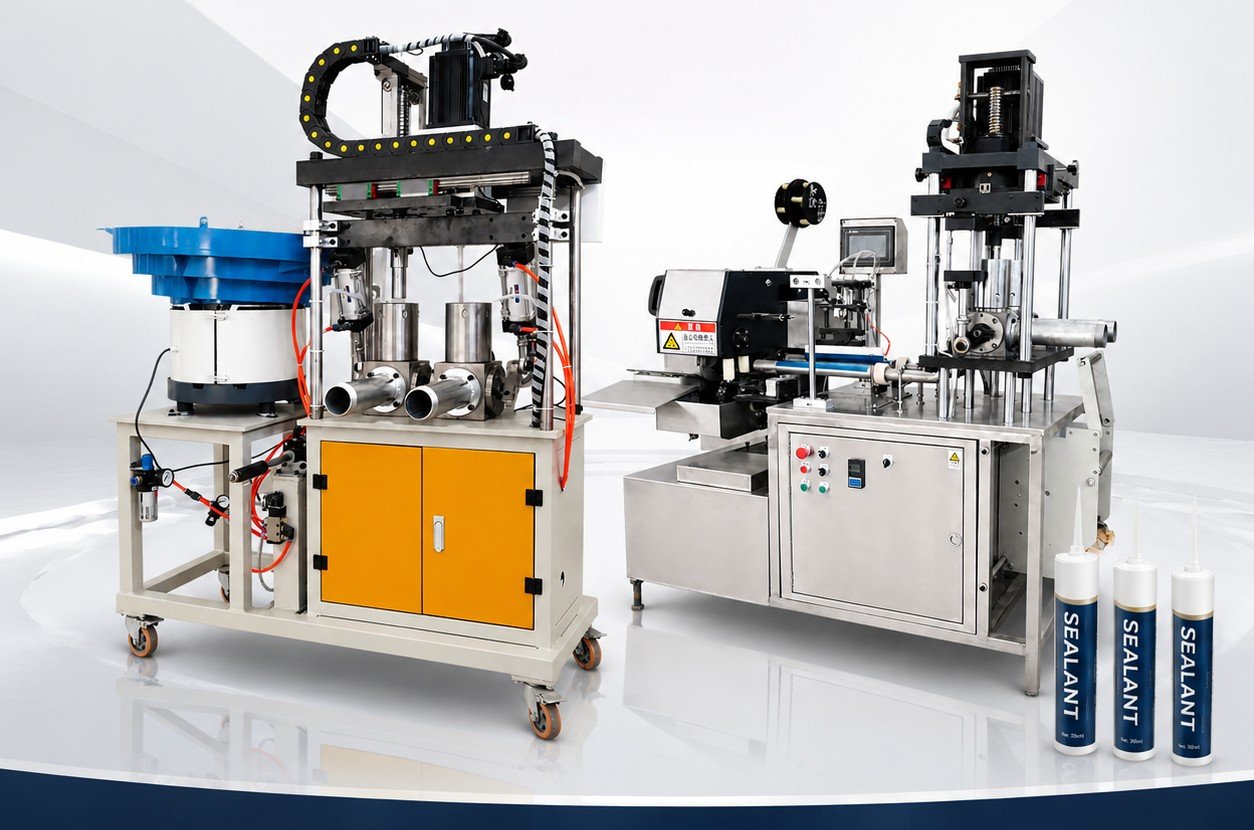
Core Machinery Types: Cartridge, Sausage Foil, and Bulk Pail Packaging
Sealant packaging machinery divides into three distinct categories based on target container geometry. Plant managers must therefore select equipment aligned with their target distribution channels.
Automatic Cartridge Filling & Plunger Capping Systems (300ml / 310ml)
Rigid plastic and aluminum cartridges dominate retail hardware and contractor trade markets. Fully automatic cartridge packaging machines integrate a vibrating bowl unscrambler that orientates empty cartridges onto a rotary indexing turret as well.
Specifically, the cartridge moves to a volumetric filling station where a diving nozzle descends to the cartridge base. As paste extrudes, the nozzle retracts at a matched speed to prevent air voids as well. At the subsequent station, a mechanical sorter inserts rear plungers under vacuum, thereby pressing them to calibrated depths without dislodging safety vent plugs.
Sausage Foil Pack Form, Fill, and Double-Clipping Lines (400ml / 600ml)
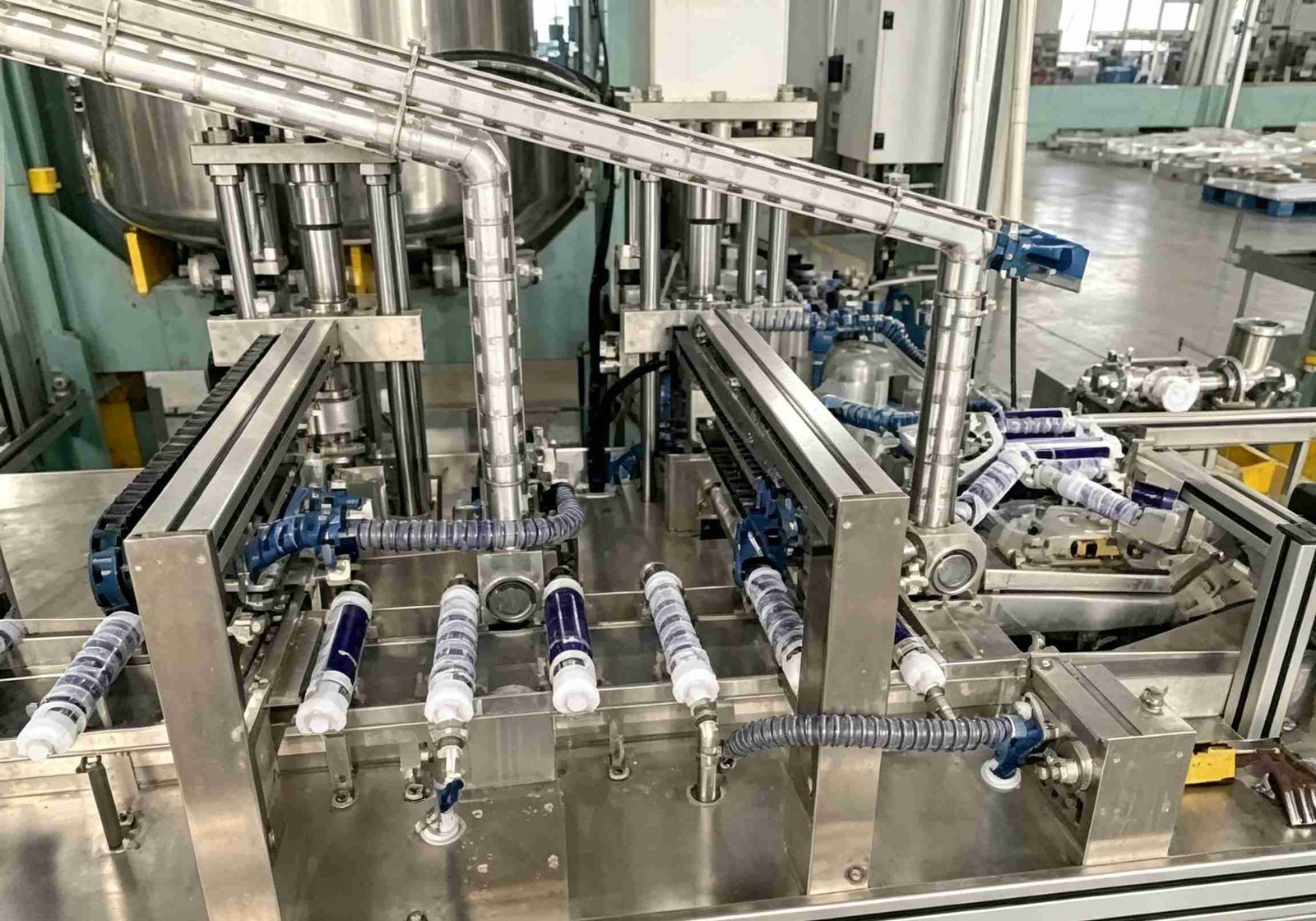
Commercial contractors prefer flexible sausage packs for structural glazing and civil joints instead. Specifically, sausage packaging machines operate on a vertical or horizontal Form-Fill-Seal (FFS) principle. Specifically, continuous laminated aluminum-plastic film feeds from a roll, wrapping around a cylindrical forming mandrel.
A longitudinal thermal or ultrasonic sealing unit bonds the film edges into a continuous tube. Simultaneously, a servo-driven metering pump injects precise volumes of sealant into the moving film sleeve as well. Finally, a pneumatic double-clipper crimps two aluminum wire clips across the neck and cuts between them, thereby delivering sealed sausage packs onto discharge conveyors.
Industrial Pail and Drum Filling Machines (20L to 200L)
Industrial clients and OEM bus assembly plants frequently purchase adhesives in 20L plastic pails or 200L steel drums instead. Bulk filling machines utilize heavy-duty load-cell scales combined with pneumatic diving lances as well. Tare weight subtraction ensures exact net fill weights, while nitrogen purging lances blanket the surface before automated lid crimping as well.
| Machine Type | Packaging Format | Output Speed (PPM) | Dosing Precision | Best Suited Materials |
|---|---|---|---|---|
| Automatic Cartridge Line | 300ml / 310ml Tubes | 35 – 60 pcs/min | ± 0.5% (Volumetric) | Silicone, Acrylic, MS Polymer, PU |
| Sausage Form-Fill-Seal | 400ml / 600ml Sausages | 25 – 45 pcs/min | ± 0.8% (Servo Meter) | Polyurethane, MS Hybrid, Polysulfide |
| Semi-Automatic Drum Filler | 20L Pails / 200L Drums | 2 – 6 drums/hour | ± 0.2% (Gravimetric) | Bulk Industrial Adhesives & Mastics |
Critical Engineering Specifications: Dosing Accuracy and Vacuum Control
High equipment reliability hinges on precision engineering subsystems. Evaluating core mechanical components ensures long-term operational consistency.
Servo-Electric vs. Hydraulic Piston Dosing Units
Specifically, piston metering units dictate filling consistency. Traditional packaging machines utilize pneumatic or hydraulic cylinders to drive the dosing piston instead. While powerful, hydraulic systems can experience minor volume changes as hydraulic oil heats up during multi-shift operations as a consequence.
Advanced packaging lines deploy servo-electric linear ball-screw actuators. The digital servo drive precisely controls piston travel to within fractions of a millimeter as a consequence. Operators program volume adjustments directly on touchscreen HMI panels, eliminating manual mechanical stroke limit adjustments.
Vacuum De-aeration and Bubble-Free Filling Technology
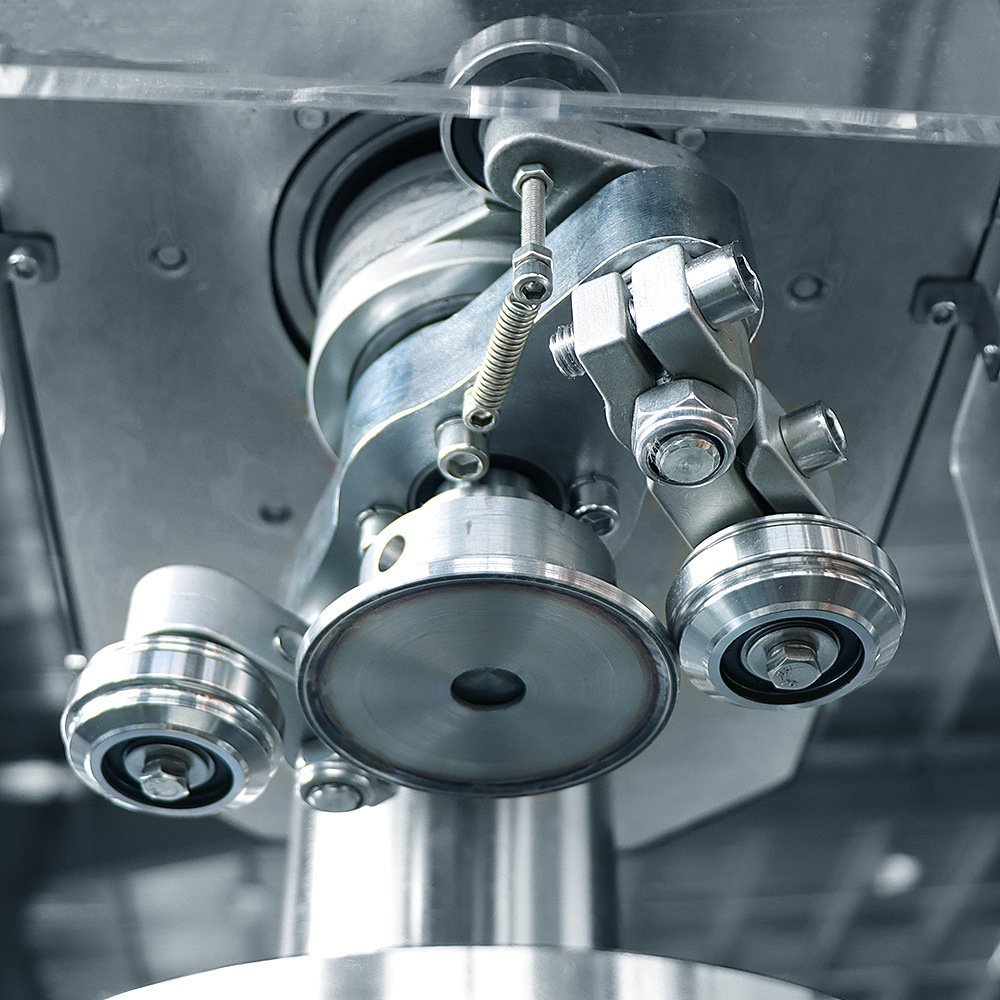
Air entrapment ruins sealant quality. When contractors dispense a cartridge containing trapped air bubbles, the release of compressed air causes the nozzle to sputter violently as a consequence. In automatic filling machines, a secondary vacuum hood engages the top of the cartridge during plunger insertion, drawing a vacuum to evacuate displaced air before the plunger seats as a result.
Maintenance Protocols: Material Changeover and Curing Prevention
Moisture-curing polyurethanes and neutral silicones react quickly when exposed to ambient air. Preventing cured polymer buildup inside packaging machinery requires disciplined operating protocols.
Hermetic Sealing and Dry Nitrogen Blanketing Circuits
When packaging one-component polyurethanes, air exposure inside the dispensing manifold initiates chemical curing within hours as a consequence. Turnkey packaging lines incorporate dry nitrogen injection ports along all valve manifolds. During operational pauses, the system maintains a nitrogen pressure blanket. This isolates reactive isocyanate groups from atmospheric humidity as a result.
Rapid Color Changeover and Solvent Flushing Procedures
Custom manufacturing demands frequent color shifts between white, grey, and black adhesives. Modern dosing manifolds feature polished interior surfaces with zero dead-space pockets as well. Quick-release tri-clamp connections allow rapid mechanical disassembly, thereby enabling thorough solvent flushing without prolonged downtime.
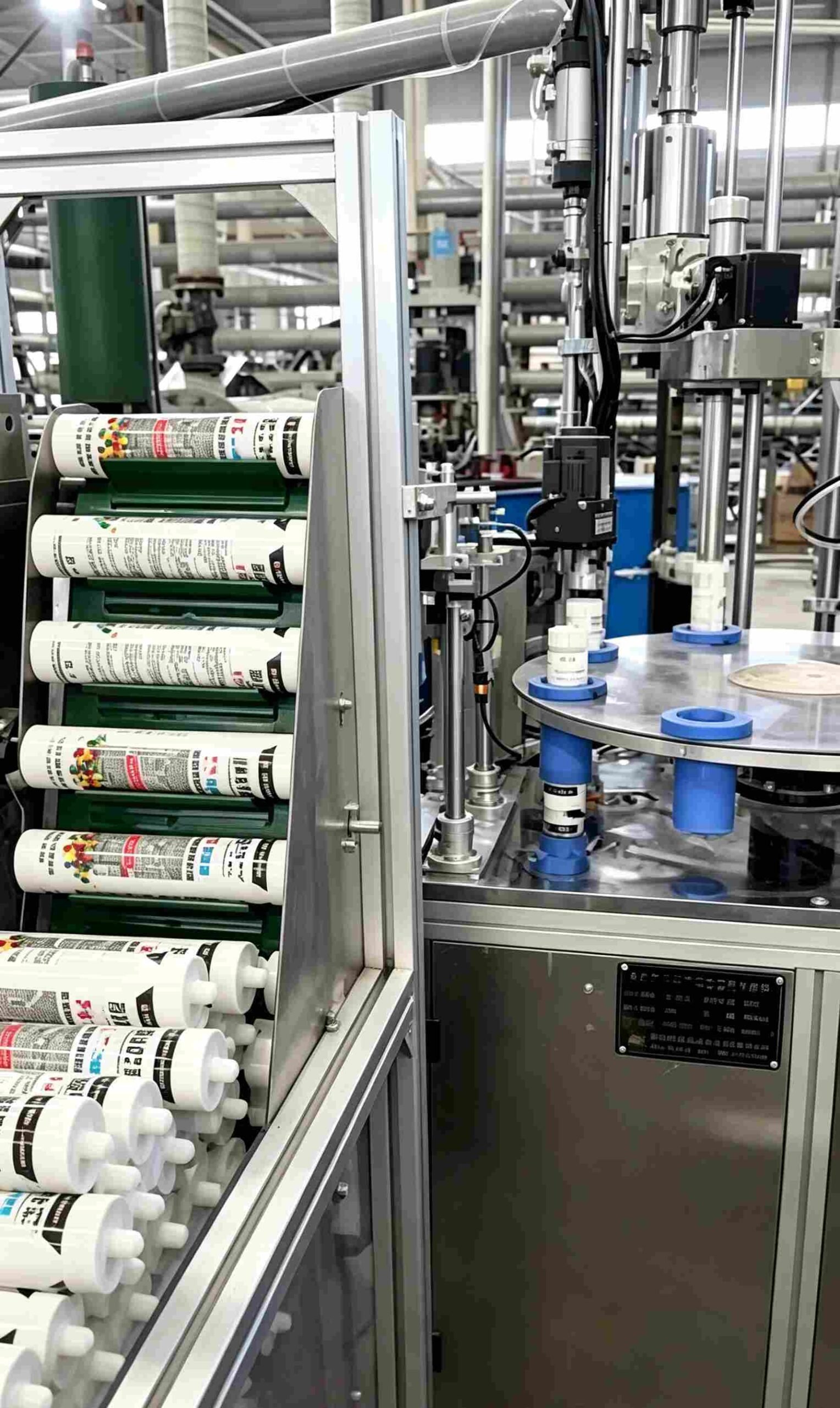
Engineering Field Scenario: Upgrading an Adhesive Packaging Facility
A regional chemical toll manufacturer experienced high product rejection rates due to weight variance and micro-bubble entrapment across manual cartridge packaging operations. Transitioning to a fully automated rotary filling system restored dosing precision and customer confidence.
OPERATING CHALLENGE
- Production Constraints: Manual cartridge feeding and pneumatic lever dispensing created substantial fill weight variance across production shifts.
- Quality Failures: Entrapped air bubbles inside 310ml neutral silicone cartridges caused nozzle sputtering on commercial construction sites, resulting in client warranty disputes.
TECHNICAL SOLUTION
- Turnkey Automation: Installed a SHCHEMPU high-speed rotary cartridge filling line equipped with automated hopper infeed and servo-metered volumetric dosing.
- De-aeration Integration: Integrated bottom-up diving filling nozzles and a -0.08 MPa vacuum plunger seating chamber to evacuate all headspace air.
- Inline Inspection: Implemented continuous inline dynamic checkweighing with automatic pneumatic reject gates for out-of-spec containers.
ENGINEERING PERFORMANCE
- Volumetric Accuracy: Packaging precision stabilized within ±0.5%, completely eliminating product underfill complaints.
- Zero Bubble Defects: Vacuum-assisted plunger seating eliminated internal air pockets, ensuring smooth, surge-free applicator extrusion for contractors.
Technical reference: SHCHEMPU machinery engineering report, automated packaging retrofit. Equipment series: AF-60 Automatic Rotary Cartridge System.
Frequently Asked Questions: Sealant Packaging Equipment
Machine Selection & Material Compatibility
Can a single machine fill both silicone and polyurethane sealants?
Yes. However, the machine must be engineered with stainless steel fluid contact parts and nitrogen purge circuits. However, complete solvent flushing between material changeovers is mandatory to prevent cross-contamination and isocyanate curing.
What is the difference between volumetric and gravimetric filling?
Volumetric filling measures exact displacement volume using a calibrated piston cylinder, which is ideal for high-speed cartridge lines. Gravimetric filling measures net mass using electronic load cells, which is preferred for large 20L pails and 200L bulk drums.
How does a hydraulic drum unloader press work?
Specifically, a hydraulic drum unloader features a heavy steel follower plate fitted with rubber seals that match 200L drum dimensions. Twin hydraulic cylinders press the plate downward, forcing thick paste out through a central discharge valve into the packaging machine.
Why is vacuum plunger insertion critical during cartridge packaging?
Specifically, inserting a plunger without a vacuum traps air between the plunger face and the paste. When the end-user dispenses caulk, this trapped air compresses and bursts through the nozzle, causing messy applicator sputtering and ruined beads.
Utility Requirements & Turnkey Plant Planning
What electrical power and compressed air supply are required?
A standard automatic cartridge packaging line requires a 380V/415V three-phase electrical supply (approx. 7.5 to 15 kW) and clean, dry compressed air at 6 to 8 Bar with a minimum flow rate of 0.8 to 1.2 m³/min.
Can one machine handle both 400ml and 600ml sausage foil packs?
Yes. In fact, most modern sausage packaging machines allow quick adjustments. Changing the film width, forming mandrel, and servo dosing stroke takes less than 30 minutes, allowing seamless switching between 400ml and 600ml production runs.
How often do dosing valve seals need to be replaced?
Depending on material abrasiveness (such as calcium carbonate filler content), PTFE and polyurethane valve seals typically deliver 500,000 to 1,000,000 cycles before requiring replacement. Regular lubrication and inspection prevent premature seal failure.
Does SHCHEMPU provide turnkey engineering plant setup?
Yes. SHCHEMPU provides end-to-end plant solutions, including chemical planetary mixing reactors, hydraulic drum presses, automatic packaging machinery, conveyor cartoning integration, and on-site commissioning services globally.
Direct Manufacturer & Turnkey Plant Engineering
Plan Your Turnkey Sealant Packaging Line with SHCHEMPU
Consult directly with SHCHEMPU machinery engineers for automatic cartridge filling machines, sausage foil packaging systems, and hydraulic drum unloaders. We offer customized automation layouts, factory installation, operator training, and comprehensive warranty support worldwide.

