
Improper windshield bonding is responsible for over 30% of structural cabin collapse incidents during rollover collisions and causes up to 45% of premature passenger airbag deployment failures. In modern automotive engineering, the windshield is not merely a transparent weather shield—it provides up to 45% of total cab structural integrity in a front-end crash and up to 60% of roof crush resistance during rollovers. Sourcing an unverified automotive polyurethane adhesive without verifying high-modulus ratings, dielectric conductivity, and certified Safe Drive-Away Time (SDAT) compromises fleet passenger safety and exposes OEM tier suppliers and repair facilities to catastrophic liability. Drawing on over 18 years of specialized polymer synthesis and testing across 500,000+ commercial vehicle assemblies, ChemPU engineers have developed this comprehensive guide to help procurement managers, fleet engineers, and autoglass technicians master adhesive selection, strict crash compliance, and zero-defect installation.
Key Technical Takeaways
- FMVSS 212/208 Regulatory Compliance: Certified polyurethane windshield adhesives must withstand severe 30 mph barrier crash forces, retaining a minimum of 75% windshield perimeter retention (100% when active passenger-side airbags strike the inner glass).
- High Modulus (HM) & Non-Conductive (NC) Imperative: Modern vehicles equipped with Advanced Driver Assistance Systems (ADAS), integrated glass antennas, and head-up displays (HUD) strictly demand adhesives with volume resistivity >10¹⁰ Ω·cm to eliminate capacitive interference and dynamic camera sensor calibration errors.
- Safe Drive-Away Time (SDAT) Optimization: Fast-curing booster-accelerated polyurethanes compress reliable drive-away release from the legacy 24-hour curing window down to 30–60 minutes at 23°C / 50% RH, cutting workshop bay cycle idle time by 75%.
What Is Polyurethane Windshield Adhesive & Why Is It Structurally Critical?
Polyurethane windshield adhesive is a one- or two-component moisture-curing elastomeric polymer engineered with a lap shear strength exceeding 6.5 MPa and elongation at break above 450%. ChemPU formulations deliver verified OEM-tier structural bonding compliant with global automotive crash regulations including FMVSS 212 and ISO 13044.
1.1 Chemical Mechanics: Isocyanate Crosslinking and Moisture Curing
Windshield polyurethanes (often designated as 1K PU or 2K booster systems) cure via atmospheric moisture interaction. Pre-polymers terminated with reactive isocyanate (-NCO) functional groups react with ambient humidity (H2O) to generate polyurea linkages while outgassing trace amounts of carbon dioxide. This molecular network creates a dense, viscoelastic vulcanized matrix capable of absorbing dynamic vehicular torsion, thermal expansion mismatches between float glass and electro-coated steel or lightweight aluminum, and high-frequency acoustic chassis vibration. Selecting a high-grade automotive glass adhesive prevents seam stress cracks and micro-fissuring over decades of severe operational cycles.
1.2 The Windshield as an Active Load-Bearing Safety Element
In unibody chassis architectures, the windshield acts as an active structural shear panel. When the passenger airbag fires in an emergency impact, it exerts up to 2.5 to 3.0 metric tons of kinetic force against the inner glass face within 30 milliseconds. If the polyurethane bead shears or exhibits adhesive detachment, the glass blows out, the airbag collapses forward into void space, and occupant containment is lost. Similarly, under roof load testing per FMVSS 216a, the rigidity of the cured adhesive bead accounts for up to 35% of the vehicle cabin’s anti-crush strength. For heavy-duty transport and specialty cabins, applying compatible RV roof sealants and structural body bonding adhesives ensures total roll-cage stability under severe torsion.
Automotive Safety Standards: FMVSS 212, FMVSS 208, and Safe Drive-Away Time
FMVSS 212 and FMVSS 208 mandate zero windshield bond separation exceeding 25% of the perimeter during a 30 mph rigid barrier collision. ChemPU polyurethane adhesives meet 100% retention safety benchmarks across crash simulations verified by independent automotive testing institutes.
2.1 Compliance Mandates: FMVSS 212, FMVSS 208, and FMVSS 216a
Automotive safety compliance is governed by strict global federal standards:
- FMVSS 212 (Windshield Mounting): Dictates that during a 48 km/h (30 mph) perpendicular impact, no less than 75% of the total glass periphery must remain firmly bonded to the pinchweld (or 100% when active passenger airbags depend on the windshield for reaction backing).
- FMVSS 208 (Occupant Crash Protection): Evaluates airbag deflection and head-injury criteria (HIC < 700). Adhesive bead elongation or micro-fracturing directly leads to airbag positioning failure.
- FMVSS 216a (Roof Crush Resistance): Measures cabin roof strength by pressing a steel plate at a compound angle. High-modulus polyurethane adhesive contributes over 30% of anti-intrusion resistance.
2.2 Demystifying Safe Drive-Away Time (SDAT)
Safe Drive-Away Time (SDAT) is the minimum required duration post-installation before a vehicle can be safely returned to operation while ensuring the adhesive bead can withstand an immediate full-speed collision. Unlike initial skin-over or tack-free time (typically 10–25 minutes), true SDAT is governed by the lap shear threshold reaching at least 1.0 MPa to 2.0 MPa. In commercial fleet repairs, selecting specialized fast-curing polyurethane windshield adhesives allows technicians to certify 30-minute to 1-hour drive-away windows even in cold weather conditions.
Need custom SDAT testing data, MSDS reports, or OEM crash-test compliance certificates?
High Modulus (HM) vs. Non-Conductive (NC): Specifying for ADAS and Modern Glass
High Modulus (HM) polyurethanes exhibit a shear modulus (G) ≥ 2.0 MPa, increasing chassis torsional stiffness by up to 15%. Non-Conductive (NC) formulations maintain electrical volume resistivity above 10¹⁰ Ω·cm, preventing galvanic corrosion and radar/sensor signal degradation in ADAS-equipped vehicles.
3.1 Why High Modulus Matters in Modern Vehicle Dynamics
Modern lightweight vehicles utilize thinner gauge high-strength steels and composite panels. A standard, low-modulus sealant allows the windshield to flex excessively within the pinchweld aperture under chassis cornering and road unevenness. This micro-deflection leads to windshield creaking, stress fractures, and eventual bond fatigue. Using a certified High Modulus (HM) polyurethane binds the glass directly into the chassis monocoque, raising overall torsional stiffness by 10% to 15% and preventing glass detachment during emergency braking.
3.2 Non-Conductive (NC) Chemistries for ADAS Cameras and Sensors
Today’s windshields are complex sensor hubs hosting LiDAR brackets, forward-facing ADAS optical cameras, windshield defroster heating filaments, integrated GPS/FM radio antennas, and head-up display reflections. Standard polyurethanes formulated with carbon black fillers can exhibit moderate electrical conductivity. If installed on a vehicle with heating grids or integrated antennas, conductive adhesives cause capacitive leakage, stray RF interference, and premature electronic failure. ChemPU non-conductive polyurethanes provide extreme electrical insulation (>10¹⁰ Ω·cm), safeguarding ADAS camera calibration accuracy and preventing galvanic corrosion on aluminum chassis components.
| Performance Property | Standard 1K Polyurethane | High Modulus (HM) Polyurethane | HM/NC Advanced ADAS Grade |
|---|---|---|---|
| Tensile Lap Shear Strength | > 4.0 MPa | > 6.5 MPa | > 7.5 MPa |
| Shear Modulus (G10) | 0.8 – 1.2 MPa | ≥ 2.2 MPa | ≥ 2.5 MPa |
| Volume Resistivity | 10⁴ – 10⁶ Ω·cm | 10⁵ – 10⁷ Ω·cm | > 10¹⁰ Ω·cm (Non-Conductive) |
| Safe Drive-Away Time (23°C/50% RH) | 4 – 8 Hours | 2 – 4 Hours | 30 – 60 Minutes |
| Primary Application | Older fleets / non-airbag | Modern standard passenger cars | ADAS cameras, EV cabins, luxury OEM |
Step-by-Step Professional Installation: Surface Prep, Priming, and Triangular Beading
90% of windshield bond failures stem from incorrect surface preparation, contaminated old urethane beds, or round bead dispensation. Achieving certified OEM joint integrity requires a strict 5-stage mechanical and chemical installation procedure.
Stage 1: Old Polyurethane Trimming and Pinchweld Inspection
When replacing damaged autoglass, cut away the old urethane using oscillating cold-knife blades or wire-pull tools. Do not strip the pinchweld down to bare metal unless corrosion is present. Instead, trim the residual polyurethane cleanly to a uniform thickness of 1.0 mm to 2.0 mm. Fresh polyurethane forms an extraordinary chemical cross-link bond with sound, freshly-cut cured polyurethane. If bare metal or scratches are exposed, immediately apply an automotive anti-corrosion primer. For high-volume workshops, ensuring operators utilize ergonomic sealant accessory tools minimizes wrist fatigue and guarantees clean trimming angles.
Stage 2: Glass Frit Decontamination and Chemical Activation
New replacement windshields carry residual release agents, dust, and fingerprints. Clean the black ceramic enamel frit band thoroughly using an isopropanol-based solvent cleaner. Allow a full flash-off time of 3 to 5 minutes. Apply a dedicated glass activator or all-in-one black primer using a clean felt applicator pad in a continuous, non-overlapping single stroke. The primer forms an organic-inorganic silane bridge that protects the urethane bond line from catastrophic long-term ultraviolet (UV) degradation.
Stage 3: The Triangular V-Notch Bead vs. Round Bead Fallacy
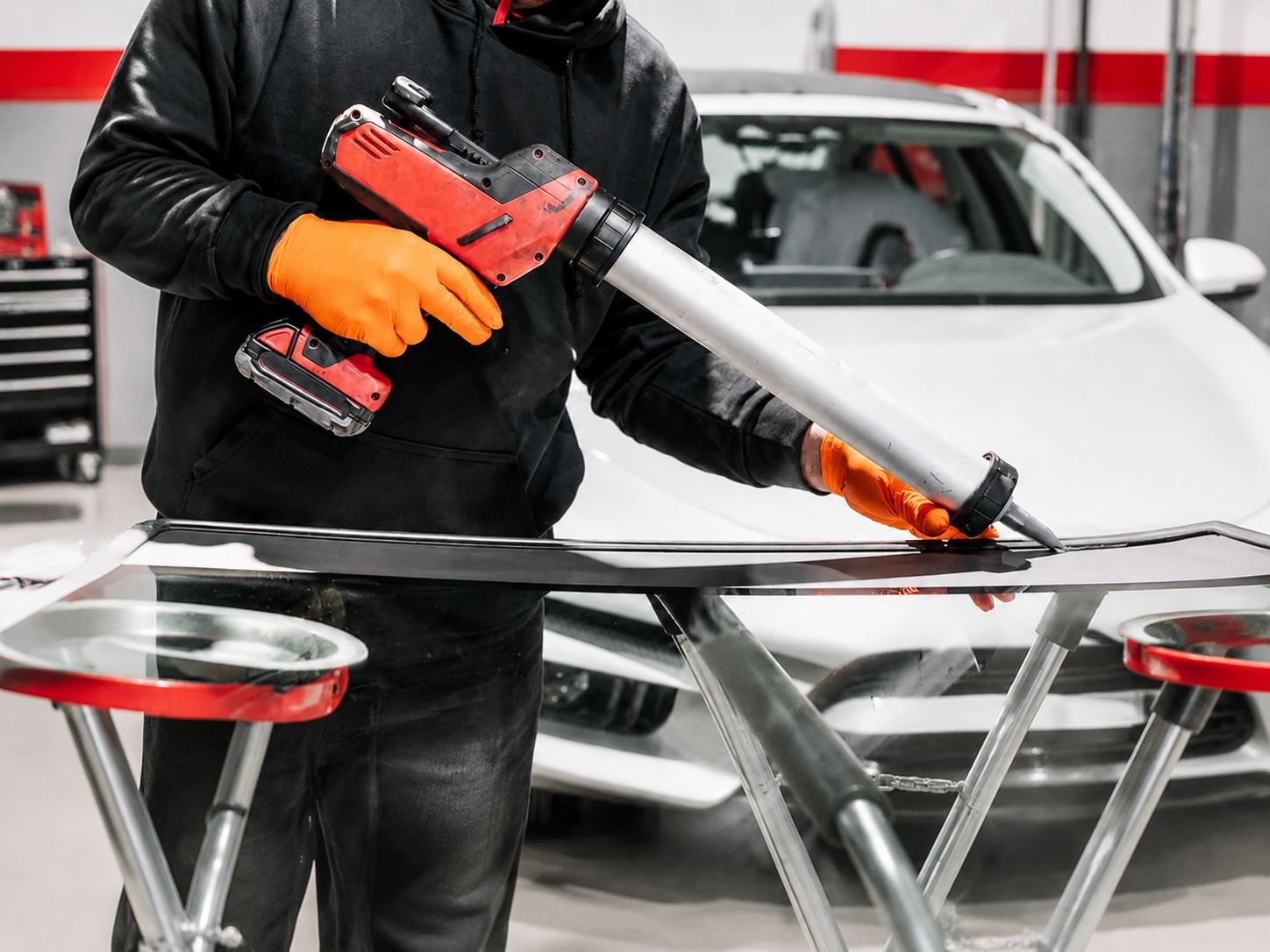
Never apply windshield adhesive using a standard circular nozzle tip. A round bead rolls over during glass compression, trapping air pockets along the bond line that cause chronic water leaks, aerodynamic wind whistle, and localized stress weakness. Always use a pre-cut triangular V-notch nozzle (typically 8–10 mm wide by 11–14 mm high). When the glass is set into position, the triangular apex collapses progressively from center to edges, evacuating air and creating a smooth, flat, void-free bonding cross-section. For automated production lines, integrating an automatic sealant filling machine and robotic dispensing system ensures bead geometry tolerance within ±0.2 mm across thousands of windshields daily.
Stage 4: Glass Setting, Height Calibration, and Decking
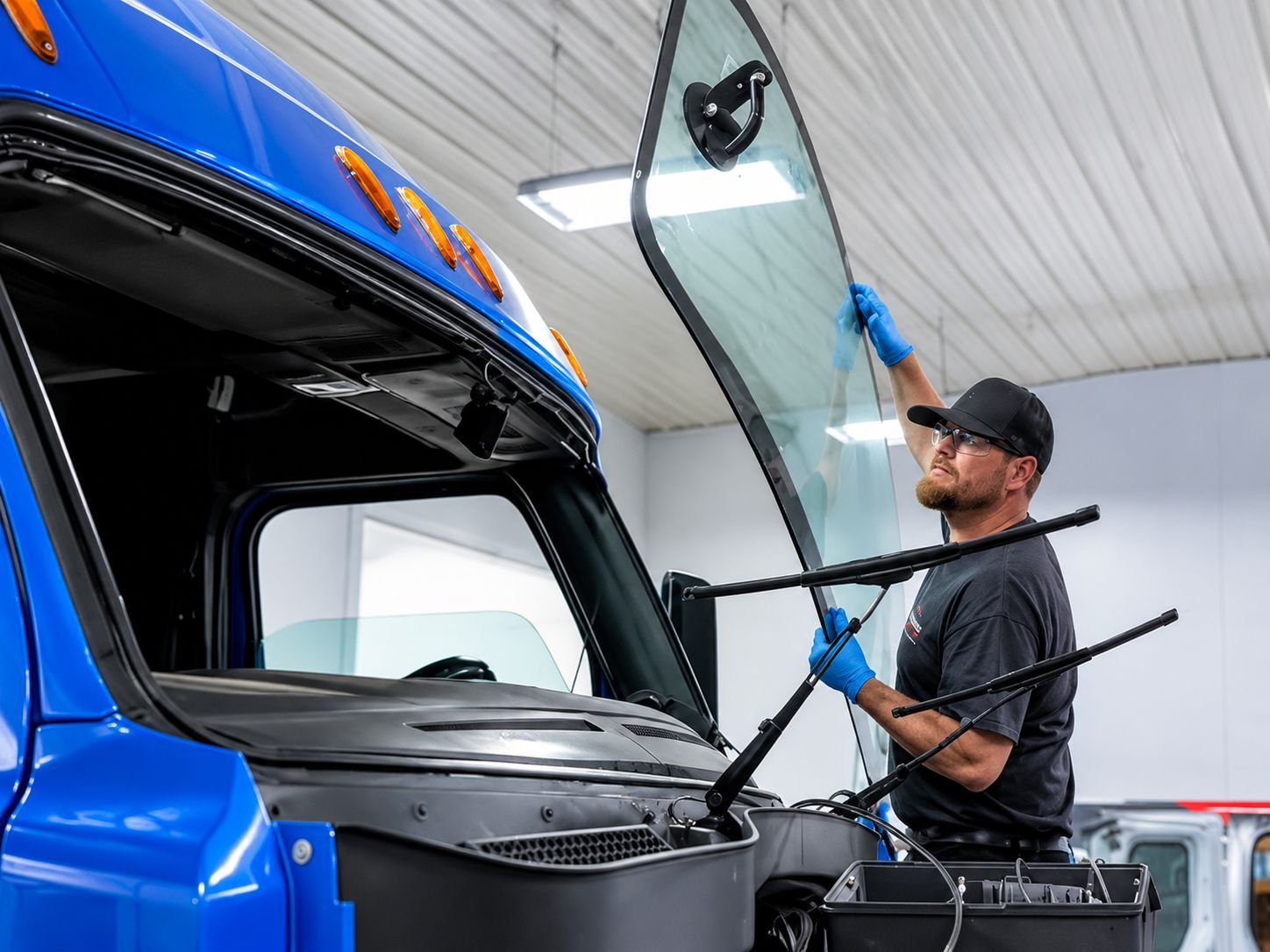
Position the windshield within the open time of the adhesive (typically 10 to 15 minutes at standard ambient conditions). Technicians must use heavy-duty dual-pad suction lifters to lower the glass evenly onto the aperture without sliding. Sliding smudges the triangular bead and destroys joint thickness consistency. Maintain a final cured adhesive thickness of 3.0 mm to 4.5 mm using OEM setting blocks to prevent glass-to-metal contact.
Troubleshooting Common Autoglass Bonding Failures & Failure Modes
Adhesive bond failures are categorized into cohesive failure (desirable: polymer fractures internally) and adhesive failure (catastrophic: clean peeling from glass or paint). Understanding failure physics prevents warranty claims and structural accidents.
5.1 Adhesive Delamination vs. Cohesive Fracture
In destructive peel tests (such as quick knife adhesion testing per SAE J1720), a compliant bond demonstrates 100% cohesive failure—meaning the cured polyurethane elastomer itself tears internally while leaving a permanent rubber layer attached to the glass ceramic frit and pinchweld. If the urethane peels away cleanly leaving a shiny glass or metal substrate, severe adhesive failure has occurred. Common root causes include improper silane primer wiping, primer expired past shelf-life, or moisture condensation on the glass during cold-weather installations.
5.2 Environmental Traps: Winter Curing Kinetics and Summer Skinning
One-component moisture-curing polyurethanes depend directly on temperature and relative humidity (RH). At 23°C and 50% RH, cure propagation proceeds at approximately 3.5 mm to 4.0 mm per 24 hours. However, in winter conditions (e.g., 5°C and 20% RH), cure rates plummet by up to 70%, extending nominal 1-hour SDAT adhesives to over 6 hours. Conversely, high-humidity summer environments (>35°C / 85% RH) cause rapid skin formation within 5 minutes, leading to dry-joint defects if the glass is not decked immediately. Technicians must consult environmental curing charts or specify booster-accelerated 2K polyurethanes during winter fleet retrofits.
ChemPU Case Study: European Bus OEM Eliminates Large-Format Glass Cracking
A leading passenger coach builder reduced panoramic windshield stress cracking by 98.4% and cut workshop tack time by 65% through custom ChemPU high-modulus polyurethane adhesive formulation.
CLIENT CHALLENGE
- A European electric bus manufacturer experienced 4.2% glass corner cracking during high-chassis torsion road trials.
- Existing competitor adhesive had an 8-hour tack-free window, bottlenecking the assembly line to just 12 coaches per week.
- Thermal expansion between the composite roof canopy and massive 4.2 m² curved panoramic windshield was exceeding joint shear limits.
CHEMPU SOLUTION
- Engineered a specialized High Modulus, High Initial Tack (HM/HT) polyurethane with 550% elongation at break.
- Implemented custom pre-heated dispensing nozzles and optimized primer-activator bonding chemistry for large-format frit lines.
- Accelerated safe vehicle handling time to 45 minutes, allowing continuous sequential chassis transport.
RESULTS & QUANTIFIED VALUE
- Windshield Stress Failures: 4.2% failure rate slashed down to <0.06% over 18 months.
- Assembly Bay Throughput: Increased from 12 to 28 units/week (+133%).
- Warranty Defect Savings: Documented annual savings exceeding €185,000 in glass replacement and repair labor.
Data source: ChemPU Automotive OEM Technical Service Log, Project EU-EB74. Vehicle type: 12-meter Low-Floor Electric Bus. Adhesive product: ChemPU PU-9100 HM/NC.
B2B Procurement Guide: Factory Direct Sourcing, OEM/ODM Customization & RFQ Checklist
Direct sourcing of polyurethane windshield adhesives from certified chemical manufacturers delivers 25% to 40% cost reductions while ensuring lot-to-lot viscosity consistency, customized cartridge/sausage packaging, and full OEM homologation support.
Essential Specification Parameters for Your Supplier RFQ
When drafting a Request for Quote (RFQ) for bulk windshield polyurethane adhesive procurement, verify the following core parameters:
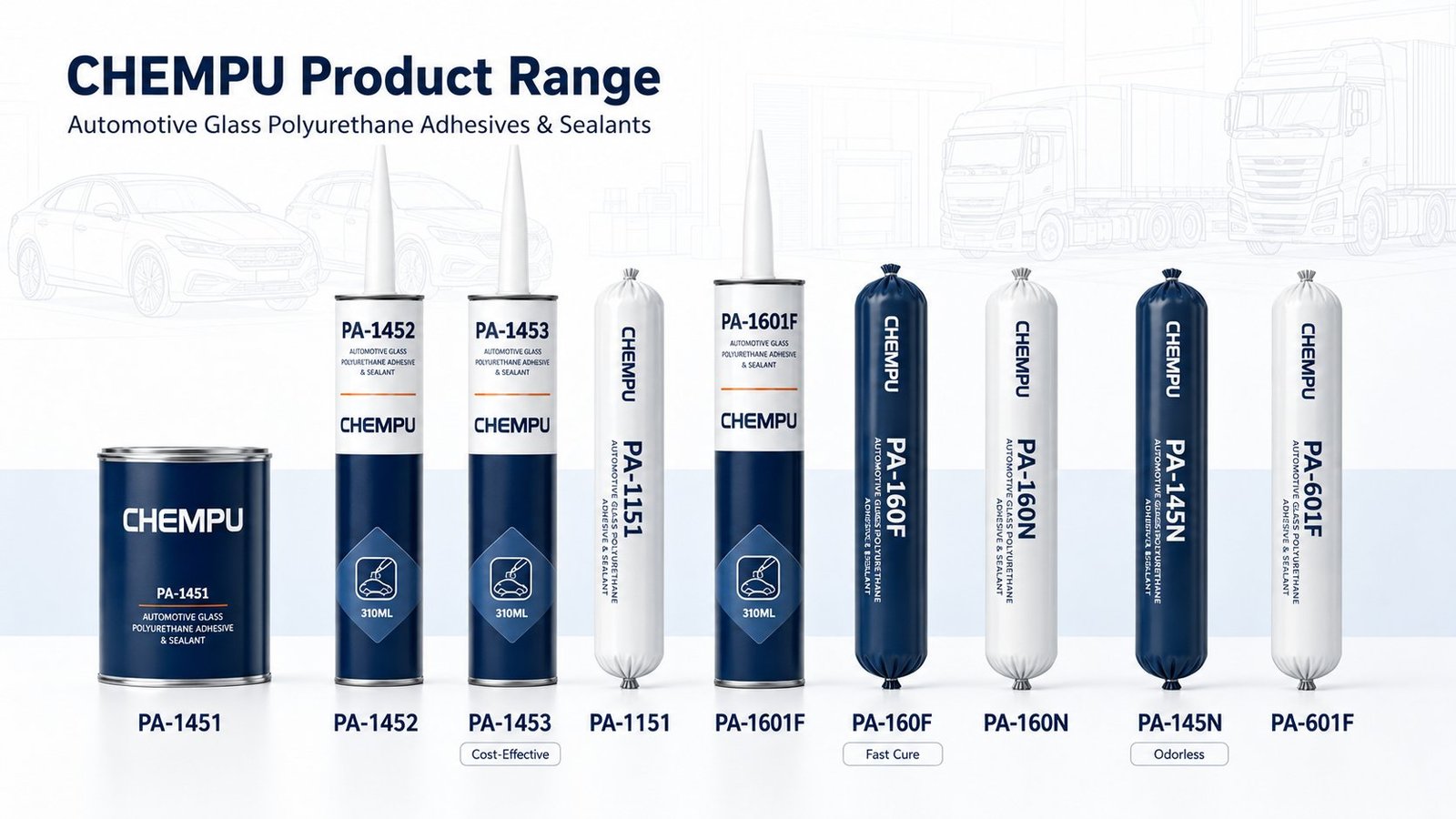
- Packaging Format: Standard 310 ml aluminum cartridges, 400 ml / 600 ml aluminum foil sausages, or 200 L industrial drums for automated dispensing cells.
- Viscosity and Extrudability: Extrusion rate (e.g., >400 g/min at 23°C with 4 mm nozzle at 0.4 MPa) to ensure compatibility with high-speed pneumatic caulking guns.
- Crash Certification Documentation: Third-party dynamic crash test reports certified to FMVSS 212/208 and ECE R43.
- Shelf Life & Moisture Barrier: Multi-layer foil packaging guaranteeing 9 to 12 months shelf stability below 25°C.
Dr. Marcus Chen, Senior Polymer Chemist
Chief R&D Specialist · ChemPU Automotive Materials · 18+ Years Experience
Dr. Chen specializes in high-modulus isocyanate prepolymer synthesis, crash-compliant elastomeric bonding, and automated dispensing technologies for Tier-1 automotive manufacturers and national transport fleets across Europe, North America, and Asia.
Polyurethane Windshield Adhesives — Frequently Asked Questions
Summary: Engineering Crash Safety Through Chemical Integrity
Automotive windshield bonding is an uncompromising safety-critical discipline where chemical formulation directly dictates human survival during severe vehicle rollover and collision events. Balancing High Modulus structural stiffness with Non-Conductive electrical isolation and certified Safe Drive-Away Time guarantees regulatory compliance, eliminates warranty rework, and protects brand reputation.
- Safety Compliance First: Never deploy uncertified adhesives that lack verifiable FMVSS 212/208 crash test accreditation.
- Match Formula to Vehicle Tech: Mandate Non-Conductive (NC) >10¹⁰ Ω·cm chemistries for all vehicles equipped with forward-facing ADAS cameras or heating grids.
- Precision Dispensing: Standardize on triangular V-groove bead nozzles and calibrated sealant tools to eradicate internal joint voiding.
CHEMPU FACTORY DIRECT INDUSTRIAL SUPPLY
Ready to Source OEM-Certified Polyurethane Windshield Adhesives?
Connect directly with ChemPU application engineers to request free laboratory sample cartridges, comprehensive technical data sheets (TDS/MSDS), and competitive OEM/ODM wholesale container quotes within 24 hours.
Related Technical Guides
Continue with ChemPU engineering resources covering structural sealing, dispensing tooling, and industrial filling automation.
Transportation Sealing
RV Roof Sealant & Caravan Seam Waterproofing Guide
Technical sealing specifications for recreational vehicle seams, aluminum-to-fiberglass joints, and heavy-duty chassis weatherproofing.
Application Tools
Professional Pneumatic Caulking Guns & Nozzle Selection
High-ratio dispensing guns, cold-knife wire cut-out accessories, and specialized triangular V-notch nozzle extrusion systems.
Manufacturing Automation
High-Speed Automatic Cartridge & Sausage Sealant Filling Machines
Turnkey industrial filling machinery, volumetric dosing stations, and robotic packaging lines for sealant manufacturers.

