
Automotive refinish technicians often confront paint blistering, solvent popping, or delamination along sealed body seams. These coating failures typically trace back to rushing flash-off cycles when applying an automotive primer sealer over welded sheet joints.
Applying wet topcoats before primer solvents evaporate traps aromatic hydrocarbons under curing polymer films. As bake booth heaters rise to 60°C, expanding solvents force microscopic pinholes through elastomeric sealants, destroying corrosion resistance.
Achieving durable intercoat adhesion requires precise evaporation windows and balanced crosslink density between substrate primers, seam sealers, and topcoats. This protocol defines flash-off thermodynamics, dry film thickness control, and paint compatibility guidelines.
Key Takeaways: Primer Sealer Flash-Off & Adhesion Rules
- Thermodynamic Flash-Off: Allow a minimum 15 to 20 minute flash-off at 20°C for 2K sealers before baking to vent fast-evaporating esters and ketones.
- Intercoat Chemical Bonding: Applying basecoats within the certified open window creates cross-linked covalent bonds without sanding.
- Solvent Trapping Prevention: Thick primer films trap heavy solvents, causing solvent-pop craters and cohesive failure along seam sealer edges.
- Mechanical Scuff Threshold: If primer cures beyond 24 hours, mechanical scuffing with P400 to P600 abrasive pads becomes mandatory.
- Polymer Compatibility: Never apply polyester spray fillers directly over uncured seam sealer or 1K wash primers.
Thermodynamics of Solvent Flash-Off & Trapping Hazards
Liquid paint and sealer formulations rely on solvent blends balancing rapid atomization with proper leveling. During the initial flash-off period, volatile solvents such as acetone and butyl acetate evaporate into ambient air.
When technicians accelerate drying with infrared lamps too quickly, the surface skin crosslinks prematurely. Trapped tail solvents like xylene vaporize beneath the hardened skin, producing clusters of pinholes known as solvent boil.
Vapor Pressure and Air Velocity Dynamics
Proper flash-off depends on airflow velocity across vehicle panels. In downdraft spray booths, laminar air movement at 0.25 to 0.35 m/s sweeps away saturated solvent vapor boundaries, speeding natural desorption.
Applying a specialized automotive primer sealer over bare metal joints requires controlled dry film builds of 25 to 35 microns. Excessive wet film builds double solvent retention time, demanding extended flash periods before topcoat application.
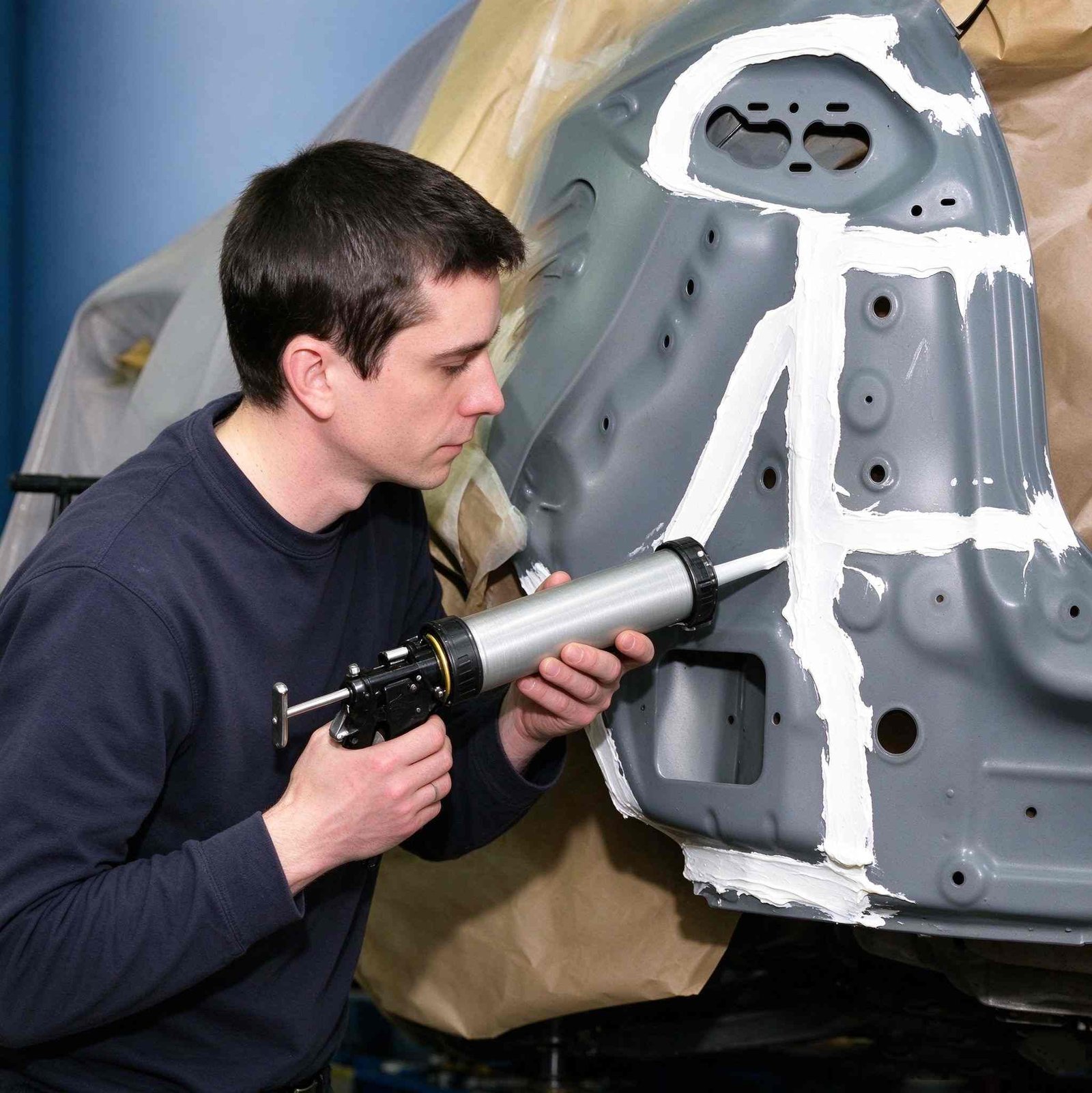
Figure 1: Refinish technician inspecting smooth primer sealer leveling along automotive body panel seams prior to basecoat spraying.
Primer Sealer Types & Intercoat Performance Benchmark
Refinish facilities deploy various sealer technologies depending on substrate condition and throughput requirements. The table below compares flash-off intervals, chemical crosslinking windows, and cross-hatch adhesion ratings under ASTM D3359.
| Sealer Chemistry | Flash-Off Time (20°C) | Recoat Window (No Sand) | ASTM D3359 Adhesion |
|---|---|---|---|
| 2K Urethane Primer Sealer | 15 – 20 minutes | 30 min – 4 hours | 5B (0% flaking) |
| 2K Epoxy Sealer Barrier | 25 – 35 minutes | 1 hour – 24 hours | 5B (0% flaking) |
| 1K Aerosol Non-Sand Sealer | 10 – 15 minutes | 20 min – 1 hour | 3B – 4B (Small flakes) |
| Waterborne Primer Sealer | 20 – 30 min (Air assist) | 45 min – 8 hours | 5B (0% flaking) |
Chemical vs Mechanical Intercoat Bonding
Within the open recoat window, unreacted isocyanate or epoxy functional groups bond directly with basecoat resins. This chemical cross-linking produces unified molecular entanglement across paint layers without requiring mechanical abrasion.
Once a sealer cures beyond its open window, surface energy drops significantly. Technicians must scuff the cured film to generate micro-grooves, re-establishing mechanical keying before spraying basecoat colors.
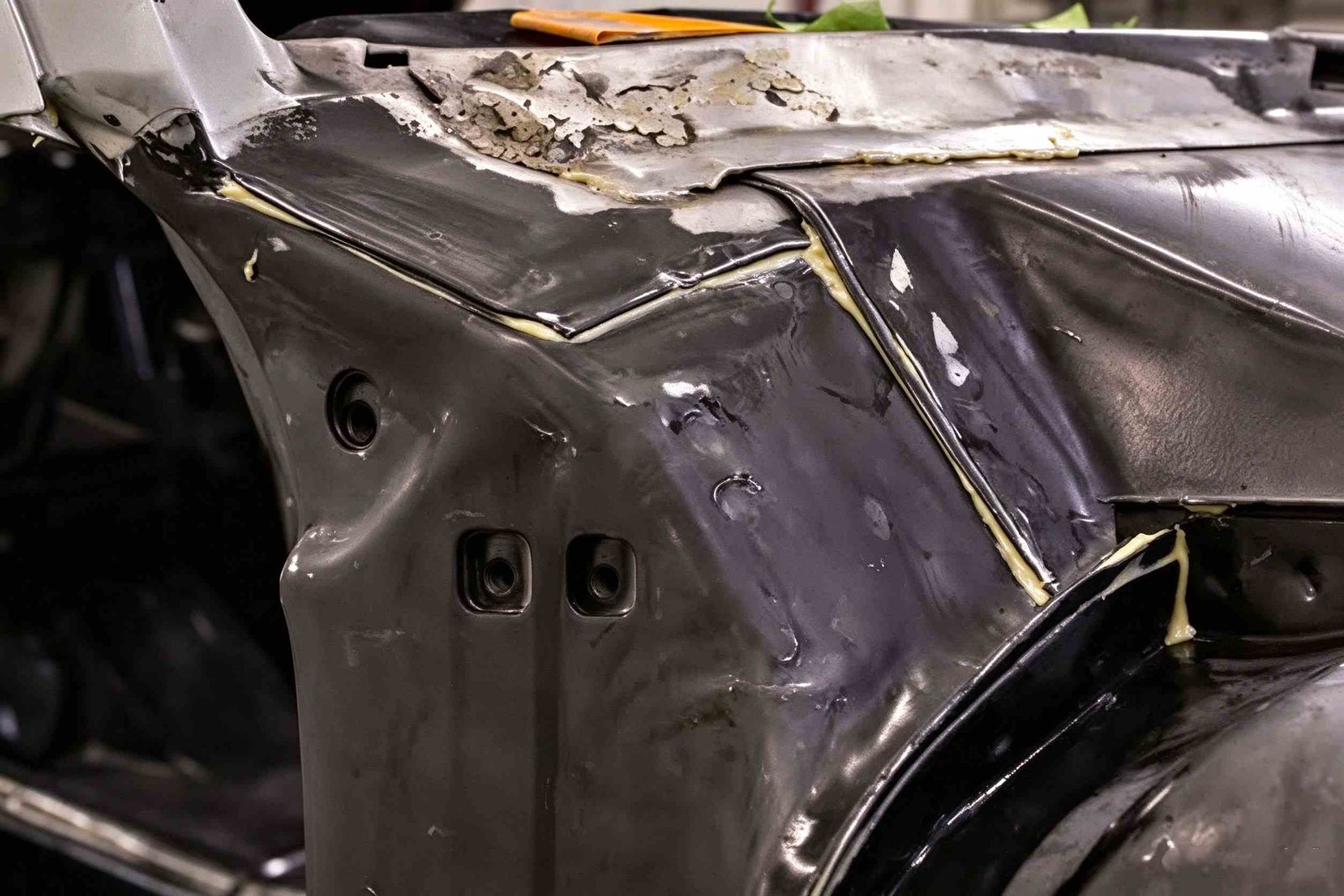
Figure 2: Precision seam sealer bead applied over cured primer sealer along stamped automotive body overlaps.
Standard Operating Procedure: Sealer Application & Paint Window
Refinish operations eliminate paint peeling and edge mapping by adhering to this calibrated four-step spray booth protocol.
Four-Step Spray Booth Protocol
- Surface Tack & Degrease: Blow off repair panels with dry compressed air. Wipe surfaces using slow-evaporating solvent degreaser, finishing with anti-static tack cloths.
- Sealer Atomization: Mix high-solids primer sealer formulations with medium-temp activator. Spray one full wet coat at 1.8 to 2.0 bar using a 1.3 mm to 1.4 mm HVLP fluid tip.
- Enforced Flash-Off: Maintain spray booth downdraft air for 20 minutes at 20°C. Confirm complete solvent evaporation by checking uniform matte reflection across seam edges.
- Wet-on-Wet Topcoating: Spray basecoat within 30 to 60 minutes of sealer flash-off. Integrate seam sealing procedures using certified automotive seam sealer beads along structural flanges.
Dry Film Thickness (DFT) and Edge Feathering
Excessive dry film thickness creates spongy paint layers susceptible to stone chip delamination. Technicians calibrate spray overlap to maintain 25 to 35 microns DFT across repair boundaries.
Feathering sealer edges smoothly into intact OEM coatings prevents distinct shadow lines around repair zones. Seamless transitions guarantee flawless metallic orientation in subsequent basecoat layers.
Diagnosing & Preventing Paint Defects Along Seam Edges
Paint defects adjacent to seam sealer beads often stem from chemical incompatibilities or premature forced drying. Understanding defect root causes ensures first-time repair success.
Solvent pop occurs when topcoats skin over damp sealer films. During oven bake cycles, trapped reducer vapors boil upward, punching micro-volcano craters into the clearcoat.
Wrinkling and Lifting Over Bare Metal Primers
Aggressive topcoat solvents penetrate uncured 1K primers, lifting underlying resins into a wrinkled texture. Switching to cross-linked 2k epoxy primer or high-solid urethane sealers establishes an impervious barrier against solvent attack.
As detailed in our epoxy primer corrosion protocol, applying sealer over fully flashed foundations ensures rock-solid intercoat durability across extreme weather conditions.
Typical Application Scenario: Commercial Bus Roof & Beltline Refinish
Eliminating Beltline Clearcoat Peeling in Transit Fleets
Fleet Profile: A municipal bus refurbishment facility repainting side beltlines and roof gutter joints across 45 transit buses.
Field Failure: Paint crews allowed only five minutes flash-off after spraying primer sealer over fresh seam joints before applying acrylic urethane topcoats. Within eight months of commercial wash cycling, topcoat layers began delaminating along joint perimeters, peeling off in long strips under high-pressure sprayers.
Corrective SOP: Engineering revised the process to spray ChemPU two-component automotive primer sealer coating at 30 microns DFT. Crews observed a mandatory 25-minute ambient flash-off, confirming complete solvent evaporation before basecoat spraying.
Verification Results: Cross-hatch adhesion testing under ASTM D3359 achieved a perfect 5B rating with zero square flaking. Eighteen-month fleet inspections showed zero clearcoat peeling or edge micro-blistering along refurbished beltline seams.
Frequently Asked Questions: Primer Sealer & Flash Times
What happens if you spray basecoat before automotive primer sealer flashes completely?
Spraying topcoat prematurely traps active reducer solvents beneath the curing film. During booth bake cycles, trapped vapors expand, creating pinholes, solvent popping, dull gloss, and severe intercoat delamination over time.
How do you tell when an automotive primer sealer is ready for topcoat?
A properly flashed 2K primer sealer shifts from a wet, glossy reflection to a uniform, soft matte appearance across the entire panel. A light fingertip touch on masking paper should feel non-tacky without picking up wet paint.
Do you need to sand automotive primer sealer before basecoat?
No sanding is needed if basecoat is applied within the product open window (typically 30 minutes to 4 hours). If the sealer cures past 24 hours, mechanical scuffing with P500 to P600 abrasive pads becomes necessary.
Technical Review by ChemPU Paint Systems & Refinish Coatings Lab
Authored by Senior Automotive Coatings Application Engineers specializing in 2K urethane primer sealers, paint booth airflow kinetics, and ASTM D3359 cross-hatch adhesion protocols. Certified under ISO 9001 and IATF 16949 standards.
Source High-Productivity Automotive Primer Sealers
Upgrade your commercial collision and bus manufacturing operations with ChemPU certified automotive primer sealer formulations. Eliminate solvent popping, shorten bake cycles, and achieve 5B cross-hatch adhesion over factory seams.
Direct WhatsApp Technical Inquiry: +86 15216655520

