
Automotive refinish centers and assembly plants regularly face severe customer complaints when replacement wheel arches and underbody panels display uneven acoustic coatings. Replicating modern robotic spray textures requires far more than basic pneumatic caulking guns.
Vehicle manufacturers specify heavy-bodied sprayable seam sealer formulations across trunk floors, shock towers, and wheel housings. These hybrid polymers absorb stone impacts and dampen chassis resonance, protecting structural steel from gravel erosion.
Improper pneumatic air pressure balance produces excessive overspray mist, coarse cratering, or premature nozzle blockage. Matching factory orange peel and stippled finishes demands disciplined calibration of dual-regulator pneumatic spray applicators. This protocol outlines standard calibration benchmarks to reproduce factory textures reliably.
Key Takeaways: Sprayable Sealer Gun Calibration Standards
- Dual-Regulator Pneumatic Tuning: Independent control of material piston pressure and atomizing air controls bead width and droplet stippling.
- OEM Texture Replication: Matching factory orange peel requires balancing fluid feed rates against nozzle atomization pressure.
- Nozzle Distance & Velocity: Maintain an applicator standoff distance between 20 cm and 30 cm to prevent fluid puddling and sagging.
- Substrate Corrosion Barrier: Spray only over scuffed, cured 2K epoxy primer to guarantee 1,000-hour ASTM B117 salt spray protection.
- Acoustic & Impact Defense: Cured 1.5 mm to 2.0 mm coatings reduce structural cabin noise while repelling high-velocity gravel strikes.
Pneumatic Atomization Physics: Material Drive vs Air Jet Ratio
Standard pneumatic extrusion guns utilize a single air circuit to drive a mechanical piston. In contrast, spraying high-viscosity sprayable seam sealer requires specialized dual-circuit spray guns equipped with independent regulators.
The primary regulator controls fluid piston thrust, pushing dense thixotropic paste into the mixing chamber. The secondary regulator feeds high-velocity compressed air around the annular nozzle ring, atomizing the paste stream into uniform droplets.
Atomizing Pressure Dynamics & Droplet Formation
Excessive atomization air velocity shears paste droplets into fine airborne mist. This atomization error causes overspray drift across adjacent vehicle panels and leaves rough, sandpaper-like finishes lacking protective film build.
Conversely, insufficient atomizing air pressure leaves extruded material in coarse chunks. Operators must achieve balanced pressure equilibrium where paste shears cleanly into uniform 1.0 mm to 2.5 mm droplets that merge into OEM textures.
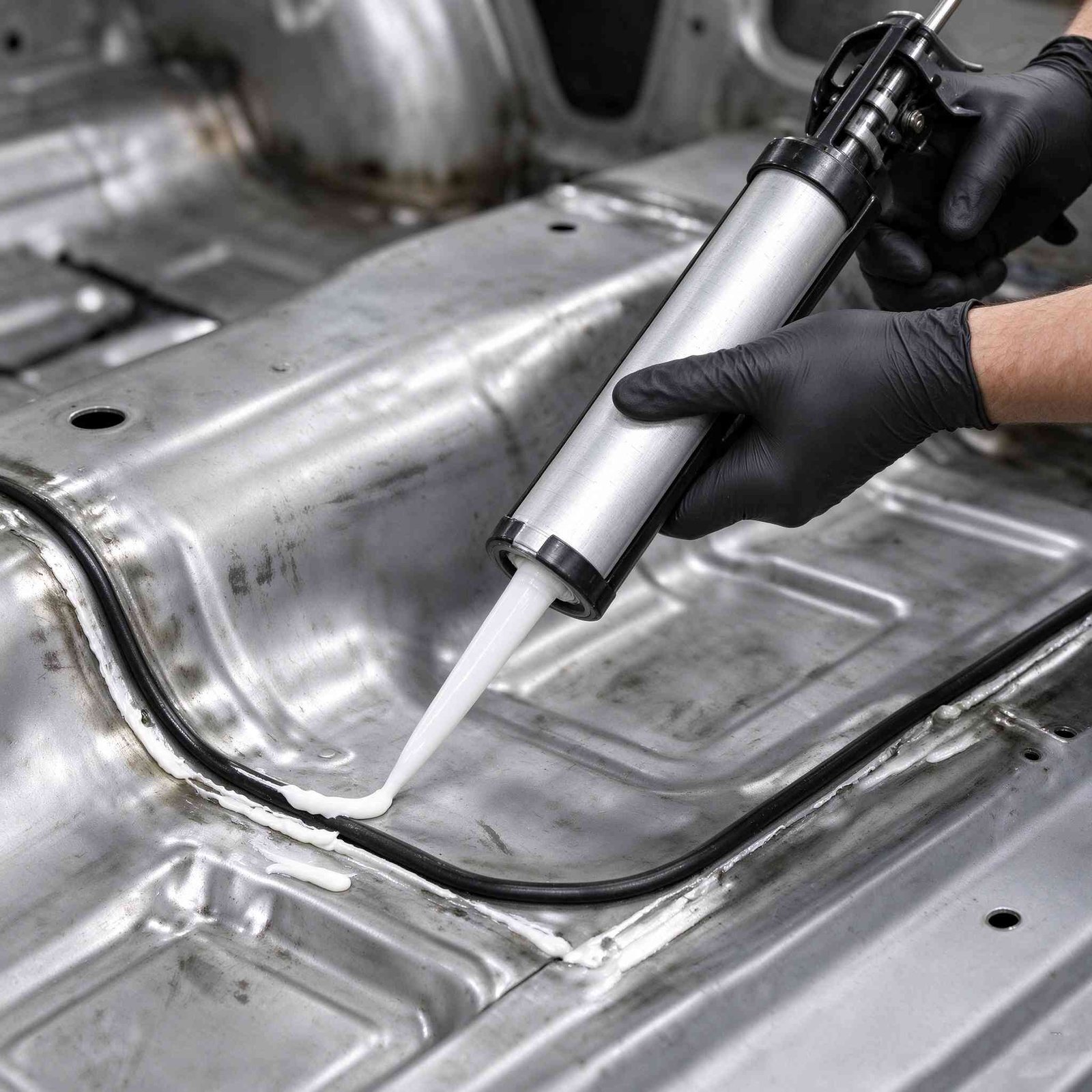
Figure 1: Manual preparation and seam sealing over vehicle floor pan joint before applying sprayable underbody barrier coatings.
Pneumatic Gun Calibration Parameters: Pressure & Texture Matrix
Replicating distinct OEM factory finishes requires precise pneumatic air adjustments. The calibration matrix below outlines air pressure settings and standoff distances for four common automotive texture profiles.
| OEM Target Texture | Piston Pressure (Bar) | Atomizing Air (Bar) | Standoff Distance | Typical Vehicle Area |
|---|---|---|---|---|
| Heavy OEM Orange Peel | 3.5 – 4.5 Bar | 1.5 – 2.2 Bar | 20 – 25 cm | Inner wheel wells, rear aprons |
| Fine Stippled Texture | 2.5 – 3.2 Bar | 2.5 – 3.5 Bar | 25 – 30 cm | Floor pans, spare tire tubs |
| Wide Flat Ribbon Bead | 4.0 – 5.5 Bar | 0.0 Bar (Air Closed) | 1.5 – 3.0 cm | Door skin bottoms, trunk gutters |
| Coarse Stoneguard Barrier | 4.5 – 5.0 Bar | 1.0 – 1.5 Bar | 15 – 20 cm | Rocker panels, chassis lower rails |
Temperature Effects on Paste Viscosity
High-solids polymers exhibit temperature-dependent viscosity curves. Cold cartridges stored below 18°C increase hydraulic resistance, requiring excessive piston pressures that lead to erratic pulsing beads.
Store and condition cartridges at 20°C to 25°C before loading pneumatic equipment. Stable material temperatures ensure repeatable atomization and consistent droplet texture across full production shifts.
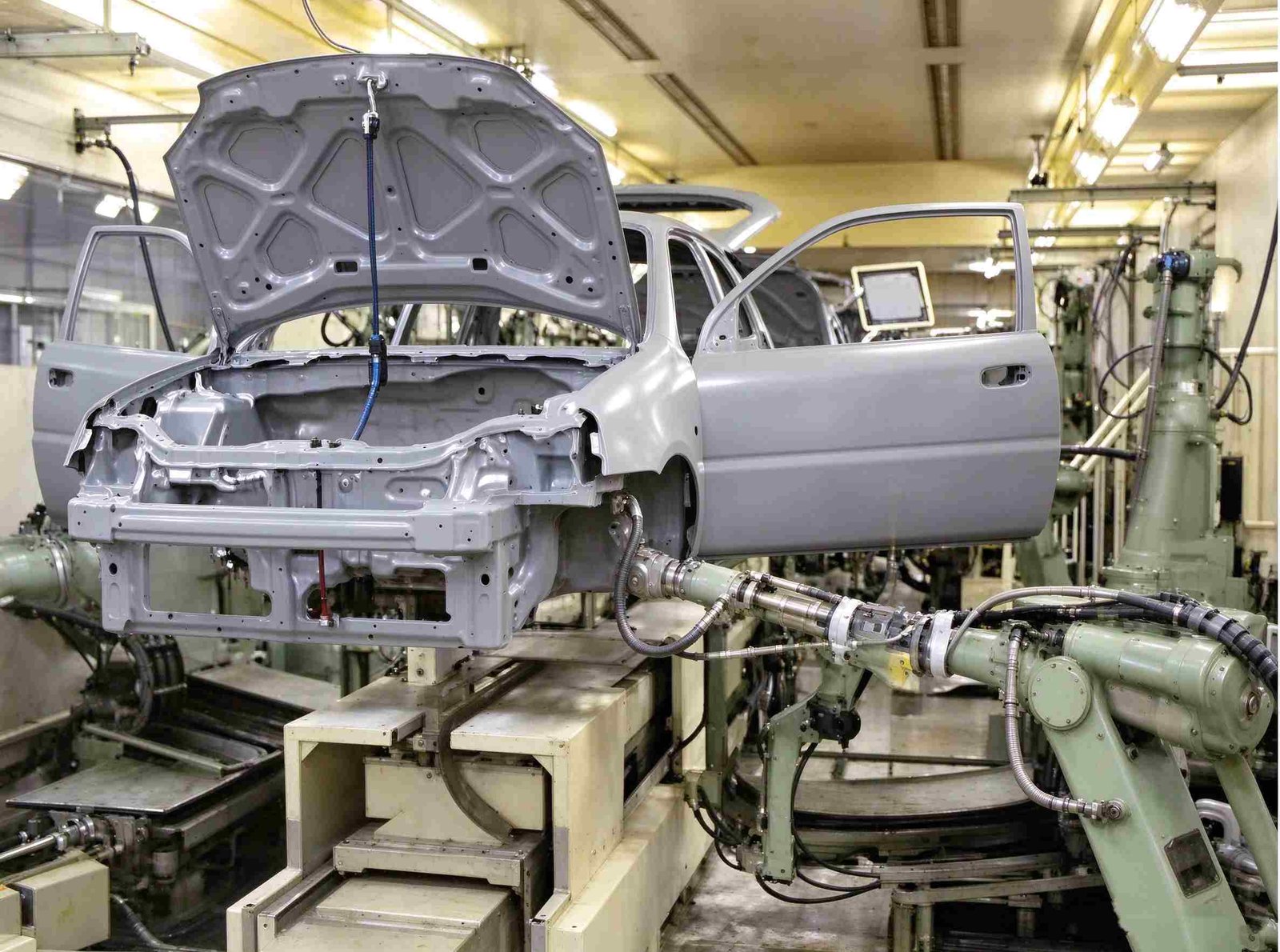
Figure 2: Robotic dispensing systems applying precision seam sealer ribbons and sound-damping coatings along automated automotive production lines.
Standard Operating Procedure: Pneumatic Gun Calibration & Application
Reproducing factory textures requires following a disciplined calibration sequence before spraying vehicle body panels.
Four-Phase Sprayable Gun Calibration Sequence
- Substrate Cleaning & Masking: Abrade 2K epoxy primer with P320 pads, solvent degrease, and tape off surrounding paintwork using plastic masking film to contain atomized overspray.
- Piston Drive Pressure Baseline: Load the cartridge into the pneumatic applicator. Set the material feed regulator to 3.5 Bar with atomizing air fully closed, dispensing a test bead onto masking paper to verify fluid flow.
- Atomization Fine-Tuning: Gradually open the secondary atomization air regulator between 1.8 and 2.2 Bar. Perform test passes on test cardboard, adjusting nozzle distance until droplet stippling matches original vehicle texture.
- Production Application & Purge: Apply continuous, overlapping passes at 90 degrees to the panel surface. Maintain a steady travel speed of 25 cm per second. Purge the gun nozzle with solvent immediately after application.
Gun Travel Speed & Film Build Control
Inconsistent applicator travel speed creates heavy puddles and dry overspray patches along floor seams. Slow movement builds excessive wet film thickness, inducing vertical sagging on wheel housing walls.
Technicians should maintain a uniform 50% overlap pattern on successive passes. Consistent stroke overlapping ensures continuous 1.5 mm dry film build without structural voids.
Common Spray Application Defects & Defect Prevention
Automotive vehicle manufacturers evaluate wheel arch coatings during end-of-line audits. Surface defects compromise stone chip defense and expose bare metal seams to moisture infiltration.
Using professional pneumatic dispensing equipment outlined in our dispensing and sealant application guide eliminates pressure fluctuations, preventing application defects during large production runs.
Dry Spray Cratering & Nozzle Clogging
Dry spray occurs when atomizing air pressure is set too high relative to fluid piston pressure. Paste droplets dry partially in mid-air before hitting the panel, creating porous, poorly adhered finishes.
If the applicator sits idle for more than 10 minutes, atmospheric moisture begins curing paste inside the nozzle tip. Keep spare nozzle tips on hand and clean mixing chambers between cartridge changes.
Typical Application Scenario: Rear Quarter Panel & Wheel Arch Restoration
Replicating OEM Rear Wheel Well Stoneguard Texture
Repair Facility: A certified commercial collision center repairing a collision-damaged rear quarter panel and replacing the inner wheel housing on an all-wheel-drive SUV.
Field Failure: The technician applied stoneguard coating using a standard Schutz siphon gun. The coarse, spattered finish mismatched the opposite factory wheel well, which featured a refined 1.8 mm stippled orange peel pattern. The quality inspector flagged the texture variance immediately.
Corrective SOP: Technicians stripped the mismatched coating, re-primed with 2K epoxy primer, and loaded ChemPU silane-modified sprayable seam sealer into a dual-regulator pneumatic spray gun. Piston pressure was set to 3.8 Bar, with atomizing air tuned to 2.1 Bar and standoff distance held at 22 cm.
Audit Results: Optical profiling confirmed the replacement wheel housing texture matched factory droplet diameter (1.2 mm) and wet film thickness within 5%. The vehicle passed quality inspection without refinish penalties.
Frequently Asked Questions: Sprayable Sealers & Equipment Tuning
Can you spray seam sealer using a standard HVLP paint spray gun?
No. High-viscosity sealers cannot pass through standard HVLP fluid tips or siphon tubes. Sprayable sealers require specialized dual-regulator pneumatic guns designed for direct cartridge extrusion.
How do you switch from textured spray to a flat ribbon bead?
Close the secondary atomizing air valve completely and increase piston drive pressure. Attach a specialized wide-slot nozzle and guide the gun 2 cm above the seam to lay smooth ribbon beads.
Can sprayable seam sealer be painted wet-on-wet with basecoats?
Yes. Modern silane-modified polymers can be topcoated wet-on-wet within 20 to 60 minutes of application. Always verify paint compatibility on a test panel before full vehicle baking.
Technical Review by ChemPU Pneumatic Tooling & Refinish Lab
Authored by Senior Automotive Refinish Specialists focusing on pneumatic gun calibration, dual-circuit fluid dynamics, and ASTM B117 salt spray corrosion protection. Certified under ISO 9001 and IATF 16949 standards.
Source Professional Sprayable Seam Sealers & Applicators
Upgrade your automotive body shops and assembly lines with ChemPU high-performance sprayable seam sealers and pneumatic applicator systems. Match OEM orange peel textures and deliver 1,000-hour corrosion resistance.
Direct WhatsApp Technical Inquiry: +86 15216655520

