
Automotive repair facilities occasionally compromise structural safety by confusing structural adhesives with elastomeric sealants. Substituting an elastic seam sealer where crash specifications call for two-part panel bond epoxy creates catastrophic joint failure risks during collision impacts.
Structural panel adhesives incorporate glass-bead technology to achieve lap shear strengths exceeding 20 MPa. In contrast, automotive seam sealers prioritize joint flexibility, vibration damping, and weatherproofing with low lap shear properties (1.5 to 3.5 MPa).
Understanding this mechanical boundary ensures compliance with OEM collision standards and Federal Motor Vehicle Safety Standards (FMVSS). This technical guide analyzes shear modulus physics, impact peel resistance, and proper repair zone allocation.
Key Takeaways: Structural Bonding vs Elastic Sealing
- Shear Strength Hierarchy: Structural 2K epoxy panel bonding adhesives deliver 20 to 28 MPa shear strength; seam sealers max out below 3.5 MPa.
- Mechanical Purpose: Panel adhesives transfer chassis torsional loads. Seam sealers absorb vibration and block water ingress along joint perimeters.
- FMVSS Safety Boundaries: Never substitute seam sealer for panel adhesive on quarter panels, roof skins, or structural door intrusion beams.
- Bondline Thickness Control: Structural adhesives incorporate 10 mil (0.25 mm) glass spacer beads to prevent complete squeeze-out under clamp pressure.
- Coordinated Joint Assembly: Modern repair standards mandate structural panel bonding on inner mating flanges followed by external seam sealer encapsulation.
Mechanical Mechanics: Rigid Load Transfer vs Elastic Accommodation
Vehicle body-in-white structures experience complex multi-axial stresses including tension, torsion, and cyclic shear during highway driving. Two-part panel bond epoxy formulas utilize cross-linked polymer networks reinforced with elastomeric toughening agents.
These high-modulus adhesives distribute crash energy uniformly across wide mating surfaces, preventing localized stress concentrations. The cured epoxy acts as a rigid structural gusset that increases overall unibody torsional rigidity.
The Role of Joint Elongation in Seam Sealers
Conversely, seam sealers formulated from polyurethanes or silane-modified polymers (SMP) exhibit low shear modulus but remarkable elongation capabilities (300% to 600%). Their primary function is accommodating differential thermal expansion between dissimilar metals.
Applying certified automotive seam sealer along panel steps seals external gaps against water intrusion without fighting the rigid load path carried by inner structural adhesives.
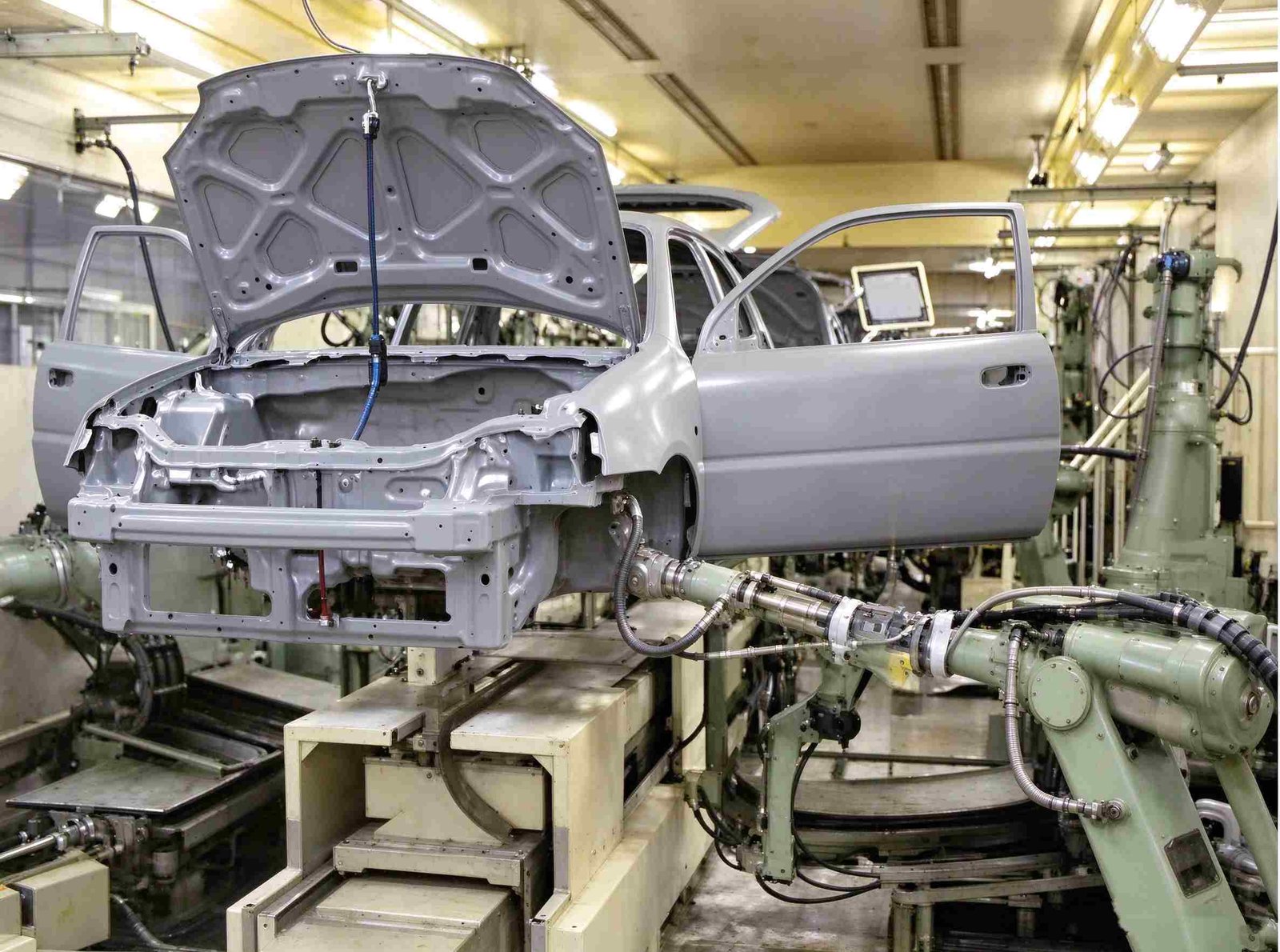
Figure 1: Automated structural adhesive and sealant dispensing along automotive chassis overlap flanges on modern vehicle assembly lines.
Structural Adhesive vs Seam Sealer Technical Benchmark
Evaluating technical specifications highlights the profound performance differences between load-bearing adhesives and perimeter sealants. The table below compares lap shear, elongation, bondline control, and primary ASTM testing methods.
| Engineering Property | 2K Epoxy Panel Bond | 1K/2K Seam Sealer | Test Method |
|---|---|---|---|
| Lap Shear Strength | 20 – 28 MPa | 1.5 – 3.5 MPa | ASTM D1002 |
| Tensile Elongation at Break | 5% – 15% (Rigid) | 300% – 600% (Elastic) | DIN 53504 / ASTM D412 |
| Impact Peel Resistance | > 25 N/mm (Toughened) | Not Rated for Crash Loads | ISO 11343 |
| Glass Spacer Beads | Present (10 mil / 0.25 mm) | None (Non-structural) | Microscopic Caliper |
| Corrosion Barrier Capability | > 1,000 hrs (ASTM B117) | > 1,000 hrs (ASTM B117) | ASTM B117 Salt Spray |
Why Bondline Glass Beads Matter
Structural adhesives contain calibrated micro-glass beads measuring 0.25 mm in diameter. When technicians clamp vehicle panels during quarter panel replacement, clamping pressure pushes excess resin out the sides.
These rigid glass beads act as positive mechanical stops. They guarantee an optimal 10 mil bondline thickness. Without spacer beads, over-clamping squashes adhesive down to metal contact, degrading joint shear strength.
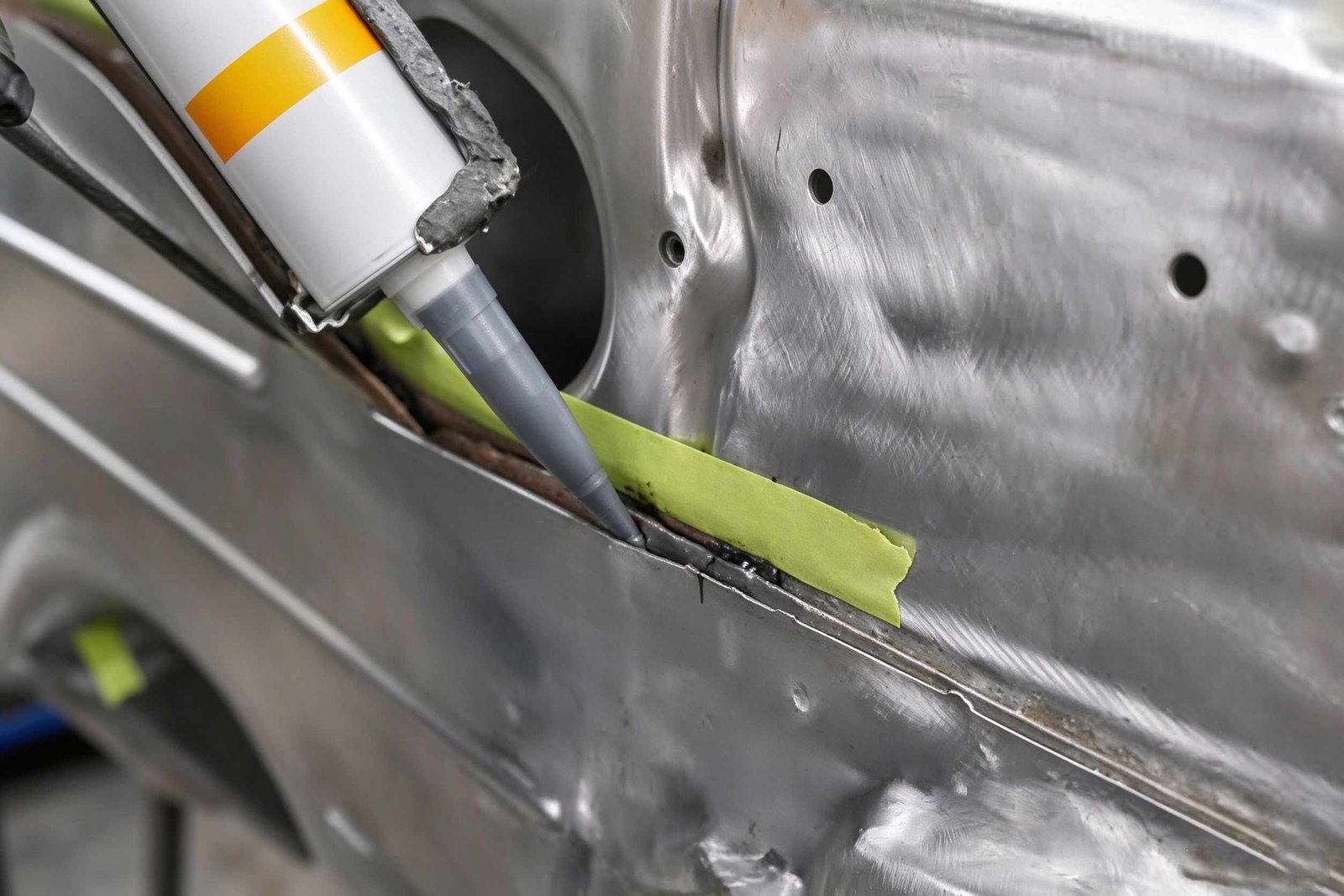
Figure 2: Technician preparing automotive body structure for high-strength panel adhesive bonding and subsequent seam sealing.
Standard Operating Procedure: Coordinated Bonding & Sealing SOP
OEM collision repair specifications require combining structural adhesives and perimeter sealers into an integrated repair workflow.
Four-Stage Assembly Protocol
- Substrate Preparation: Grind mating flanges to bare metal using P80 abrasive discs. Blow away metal debris and clean thoroughly with solvent degreaser.
- Structural Adhesive Extrusion: Purge and balance a cartridge of high-strength panel bond adhesive. Apply a continuous 8 mm bead along the center of the mating flange, buttering bare metal surfaces to prevent air voids.
- Panel Clamping & Cure: Position the replacement panel within the 45-minute working time. Apply locking clamps every 100 mm, allowing glass spacer beads to gauge bondline thickness. Cure at 20°C for 24 hours or heat-cure at 60°C for 45 minutes.
- External Seam Sealing: After adhesive curing, scuff exterior joint transitions with P220 pads. Extrude high-performance automotive seam sealer along external overlap steps to encapsulate the joint against water and dirt ingress.
Weld-Bonding Hybrid Applications
Many OEM specifications call for weld-bonding. Technicians execute squeeze-type resistance spot welds directly through wet structural adhesive. The adhesive seals the joint and absorbs fatigue stress, while spot welds provide instant mechanical holding power.
Technicians must never attempt weld-bonding through seam sealers. Polyurethane and silane sealers burn violently under resistance welding currents. This reaction contaminates weld nuggets and creates severe shop fire hazards.
OEM Safety Boundaries: Where Seam Sealer is Forbidden
Automobile manufacturers establish strict legal boundaries defining where structural adhesives are mandatory and where seam sealers are strictly prohibited from serving as fasteners.
Structural components such as front frame rails, A-pillars, B-pillars, and suspension mounting aprons must never be bonded solely with adhesive. Technicians must follow explicit OEM statements requiring mechanical fasteners.
Crash Energy Management Zones
In frontal impact zones, engineered crush structures absorb kinetic energy through controlled metal crumpling. Seam sealers provide zero structural reinforcement in these zones. They function strictly as acoustic dampers and weather barriers.
Utilizing verified panel bond materials on approved outer skins restores factory structural rigidity and preserves occupant survival cell integrity.
Typical Application Scenario: Rear Quarter Panel Collision Replacement
Restoring Factory Torsional Rigidity in Commercial Light Trucks
Shop Profile: A high-volume certified collision center repairing side-impact damage across 35 commercial utility pickup cabs and bedsides.
Field Failure: An inexperienced technician replaced an outer bedside panel using 1K polyurethane seam sealer as the primary bonding agent along the upper bed rail flange, skipping 2K structural epoxy to save time. After four months of hauling gravel, body flex caused the adhesive joint to sheer completely off, popping paint lines and creating massive body rattles.
Corrective SOP: Engineering required disassembling the joint, grinding flanges back to bare steel, and applying ChemPU 2K toughened epoxy panel bond adhesive with 10 mil glass spacer beads. The flange was clamped for 45 minutes under heated curing lamps. After full cure, external stepped edges were sealed with ChemPU polyurethane seam sealer.
Verification Results: Ultrasonic joint inspection confirmed complete, void-free adhesive coverage across the entire 1,800 mm bedside flange. Torsional twist bench testing proved the repaired assembly matched original factory unibody rigidity with zero flex-induced joint fatigue.
Frequently Asked Questions: Panel Bond vs Seam Sealer
Can you use seam sealer instead of panel bond adhesive on door skins?
No. Door skins require structural panel bonding adhesives along hem flanges to prevent skin fluttering and structural peeling during side-impact events. Seam sealers lack the high lap shear strength (20+ MPa) required to hold door panels securely.
Can you weld through panel bonding adhesive?
Yes, if using squeeze-type resistance spot welding (STRSW) while the structural epoxy adhesive is still wet. This technique is known as weld-bonding. However, you must never weld through cured adhesive or through elastomeric seam sealers.
Why does structural panel bond feel rigid while seam sealer stays flexible?
Structural adhesives use dense, crosslinked epoxy networks formulated for high tensile and shear strength, yielding low elongation (5% to 15%). Seam sealers use long-chain polyurethane or silane polymers engineered to expand and contract (300% to 600% elongation) without tearing.
Technical Review by ChemPU Structural Adhesives & Joining Research Group
Authored by Senior Materials Engineers specializing in crash-resistant 2K epoxy formulations, ASTM D1002 lap shear characterization, and FMVSS automotive joint integrity protocols. Certified under ISO 9001 and IATF 16949 standards.
Source Certified 25 MPa Structural Panel Adhesives
Upgrade your collision repair and vehicle manufacturing operations with ChemPU high-strength panel bonding adhesives and elastomeric seam sealers. Exceed 20 MPa lap shear benchmarks and guarantee OEM crash safety compliance.
Direct WhatsApp Technical Inquiry: +86 15216655520

