
Automotive structural repairs frequently suffer from premature rust perforations along spot-welded pinch welds. Collision technicians often misunderstand how weld-through primer and external seam sealers cooperate to protect overlap flanges.
Resistance spot welding generates localized temperatures exceeding 1,400°C. This intense heat vaporizes pre-existing factory e-coat around weld nuggets. Without internal conductive zinc protection, atmospheric moisture wicks between mated steel layers through capillary action, causing rapid crevice corrosion.
Relying solely on external caulking beads leaves raw internal contact faces vulnerable to electrolytic attack. This standard operating procedure evaluates zinc sacrificial mechanisms, welding spatter reduction, and dual-layer flange sealing protocols according to AWS D8.8 standards.
Key Takeaways: Pinch Weld Corrosion Defense Rules
- Dual-Layer Defense: Internal zinc coatings provide sacrificial galvanic defense inside mating flanges; external seam sealers block bulk water intrusion.
- Controlled Zinc Film Build: Apply a single thin coat of zinc-rich primer (15 to 25 microns) to avoid porous welds and excessive spatter.
- External Step Prep: Grind and clean exterior weld heat tint thoroughly before applying 2K epoxy primer and elastomeric seam sealer.
- AWS D8.8 Compliance: Excessively thick zinc coatings contaminate molten weld nuggets, reducing joint tensile shear strength below OEM safety thresholds.
- Capillary Sealing: Tool exterior seam sealer beads with firm pressure to force elastomeric polymer into micro-gaps along spot-welded seams.
Electro-Chemical Dynamics: Internal Zinc vs External Barrier
Spot-welded sheet assemblies create natural capillary gaps ranging from 0.05 mm to 0.3 mm between mating panels. Capillary forces draw salt brine, road wash, and condensation deep into these enclosed seams.
Applying high-solids zinc weld-through primer coats internal surfaces with conductive metallic particles. Zinc possesses a lower electrochemical potential (-0.76 V) than iron (-0.44 V). Consequently, zinc corrodes preferentially to protect base steel.
The Welding Heat-Affected Zone (HAZ)
Electric current passing through copper electrodes vaporizes protective zinc within a 5 mm radius of the weld nugget. The surrounding heat-affected zone forms porous zinc oxide residues; adjacent bare steel margins oxidize into heat tint.
External sealing provides the second defense layer. Encapsulating exterior flange steps with automotive seam sealer isolates the entire weld zone from moisture and oxygen, halting galvanic corrosion permanently.

Figure 1: Structural vehicle body flange inspection prior to spot welding and precision seam sealer extrusion in commercial workshop.
Flange Protection Technologies & Performance Benchmark
Comparing joint preparation methods reveals why vehicle crash repair standards require coordinated multi-product integration. The table below compares salt spray durability, weld porosity, and lap shear retention under ASTM B117 and AWS D8.8 testing.
| Joint Coating Strategy | ASTM B117 Salt Spray | Spot Weld Nugget Porosity | Failure Mode |
|---|---|---|---|
| Bare Flange + External Sealer Only | < 350 hours | 0% (Clean metal fusion) | Internal crevice rust perforation |
| Heavy Zinc Primer (>50 μm) Alone | 400 – 600 hours | High (Gas voids & spatter) | Weld nugget tensile shear failure |
| Zinc Primer (20 μm) + PU Sealer | > 1,000 hours | < 2% (Acceptable AWS D8.8) | Base metal ductile fracture |
| Zinc Primer + 2K Epoxy + MS Sealer | > 1,500 hours | < 1% (OEM Grade) | Base metal ductile fracture |
Zinc Over-Application and Weld Porosity Risks
Spraying excessive film thickness of weld-through primer causes severe welding defects. Liquid zinc boils at 907°C. This is significantly below the melting point of structural steel (1,538°C).
Trapped zinc vapors erupt violently through the molten steel pool during current discharge, blowing metal out as spatter. The resulting weld nugget suffers from internal gas voids and reduced cross-sectional load capacity.
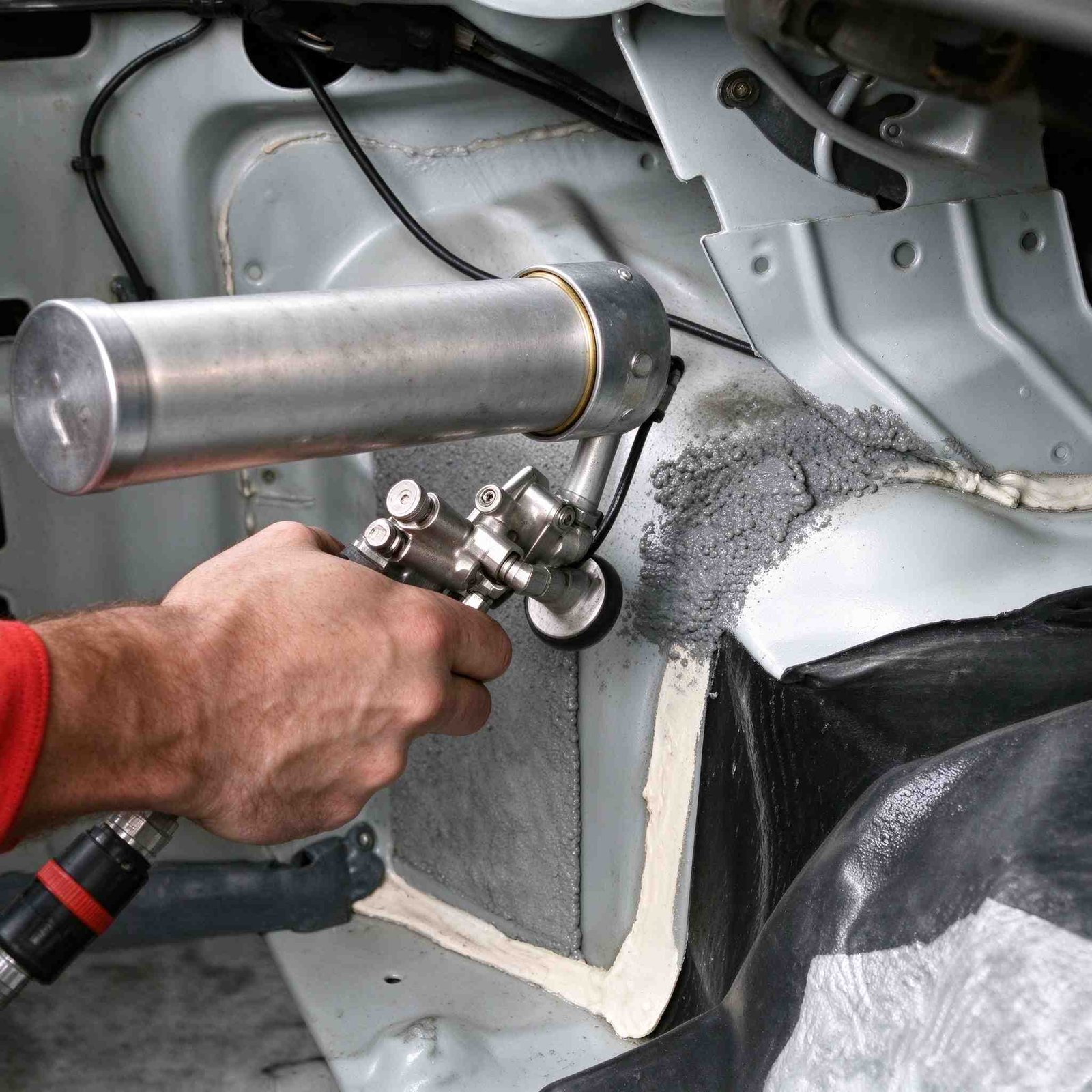
Figure 2: Spray application of protective coatings and sealers over welded structural panels to establish durable barrier protection.
Standard Operating Procedure: Flange Prep, Welding & Sealing
Executing robust pinch weld repairs requires strict adherence to this calibrated five-step collision repair protocol.
Five-Step Pinch Weld Repair Protocol
- Flange Cleaning: Grind panel mating surfaces to bare steel using 3M Clean and Strip discs. Degrease thoroughly with residue-free solvent.
- Mating Face Coating: Apply one light, uniform coat of high-solids zinc weld-through primer (15 to 25 microns DFT) to mating flange contact areas. Allow 15 minutes flash-off.
- Resistance Spot Welding: Clamp panels firmly using calibrated locking pliers. Execute squeeze-type resistance spot welds (STRSW) according to OEM current parameters.
- Exterior Cleanup & 2K Epoxy: Remove exterior heat discoloration using wire wheels. Apply two coats of 2k epoxy primer across outer flange steps and weld nuggets.
- Seam Sealer Encapsulation: Scuff cured epoxy with P220 pads. Apply calibrated beads of automotive seam sealer, tooling edges smoothly to eliminate water traps.
Proper Tooling Technique for Flange Overlaps
Leaving an un-tooled, round bead over stepped pinch welds creates tiny undercuts where moisture collects. Technicians use nylon profiling spatulas to press sealant firmly into the 90-degree flange transition.
As detailed in our seam sealer over epoxy primer protocol, tooling creates a feathered edge that sheds moisture continuously while expanding without cracking during chassis flex.
OEM Repair Bulletins & Crash Structure Joint Standards
Modern Advanced High-Strength Steels (AHSS) used in B-pillars and rocker sills require strict adherence to OEM repair instructions. Excessive heat input damages tailored metallurgy.
Vehicle manufacturers strictly prohibit applying zinc primer over exterior surfaces before seam sealing. Zinc forms a powdery oxidation layer that compromises polyurethane sealant adhesion over time.
Zinc Chemistry vs Copper-Rich Formulations
While copper-based primers offer higher electrical conductivity, zinc formulations provide vastly superior cathodic protection. Metallic zinc sacrificial action continues protecting adjacent steel even if microscopic fissures form within weld zones.
Deploying certified weld-through primer chemistry ensures replacement panels achieve factory crash test performance while resisting 1,000 hours of continuous ASTM B117 salt spray exposure.
Typical Application Scenario: Rocker Panel Replacement on Light Trucks
Preventing Pinch Weld Delamination in Utility Pickup Fleets
Fleet Profile: A commercial fleet maintenance depot replacing rusted outer rocker panels and cab floor pinch welds across 50 mining utility pickups.
Field Failure: Previous repair technicians applied heavy coats of aerosol zinc primer over both internal and exterior flange surfaces. Then they caulked outer seams immediately with 1K polyurethane sealer. Within 12 months of gravel road service, road vibration caused outer sealer beads to peel off in continuous ribbons, revealing loose powdery zinc beneath the rubber.
Corrective SOP: Engineering implemented ChemPU high-conductivity weld-through primer applied strictly to internal mating surfaces at 20 microns DFT. Exterior pinch weld steps were ground clean after welding. Technicians primed external joints with two coats of 2K epoxy primer, scuffed with P220 pads, and encapsulated flanges with high-modulus polyurethane seam sealer.
Verification Results: Destructive chisel testing on weld sample coupons confirmed weld nuggets tore parent metal with zero interfacial flaking. Two-year follow-up fleet inspections in harsh de-icing salt environments showed 100% sealant adhesion and zero crevice corrosion along rocker pinch welds.
Frequently Asked Questions: Weld Primers & Pinch Welds
Can seam sealer be applied directly over weld-through primer?
No. OEM repair standards strictly forbid applying seam sealer directly over weld-through primers. Zinc primers form powdery, low-strength surface layers that degrade sealant adhesion over time. Technicians must clean exterior flange steps and apply 2K epoxy primer before seam sealing.
Why does weld-through primer cause heavy spatter during spot welding?
Heavy spatter occurs when zinc primer is applied too thickly. Metallic zinc vaporizes at 907°C, well below the melting point of steel. Trapped zinc gas expands explosively through the molten steel pool, creating porosity and blowing out liquid metal spatter.
What is the ideal film thickness for weld-through primer?
The optimal dry film thickness is 15 to 25 microns (one light, semi-transparent coat). This thickness provides sufficient electrical conductivity for welding and galvanic protection without causing excessive weld nugget porosity.
Technical Review by ChemPU Joining & Structural Corrosion Engineering Group
Authored by Senior Metallurgical & Joining Application Engineers specializing in STRSW resistance spot welding, AWS D8.8 automotive weld standards, and multi-layer zinc sacrificial coatings. Certified under ISO 9001 and IATF 16949 standards.
Source Certified Weld-Through Primers & Seam Sealers
Equip your collision repair centers and commercial assembly plants with ChemPU high-conductivity weld-through primers and structural seam sealers. Prevent pinch weld crevice corrosion and meet OEM weld shear benchmarks.
Direct WhatsApp Technical Inquiry: +86 15216655520

