
A failed building joint does far more than create an unsightly exterior leak—it initiates relentless structural decay. When seasonal thermal expansion, seismic vibration, or foundation settlement forces joint movement beyond an uncertified caulk’s elastic limit, the seal ruptures. Only a correctly specified construction sealant can absorb that movement cycle after cycle without splitting. Moisture then infiltrates deep into the building envelope. As a result, concrete carbonates, embedded steel rebar corrodes, cavity insulation saturates, and toxic mold spawns behind interior drywall.
According to architectural forensic studies, up to 80% of building envelope moisture intrusions originate at failed joint interfaces. Yet professional joint sealing products typically represent less than 1% of total structural project budgets. Moreover, most joint failures are not chemical defects. Instead, they stem from specifiers choosing the wrong polymer modulus, ignoring the ASTM C920 movement class, or violating the fundamental 2:1 width-to-depth joint geometry ratio.
How to Specify a Construction Sealant That Lasts a Lifetime
With over two decades of experience formulating elastomeric polyurethanes, modified silane polymers, and architectural silicones for commercial contractors across Central and South America, Africa, Europe, and North America, SHCHEMPU has engineered this authoritative technical guide. Below, we break down standard certifications, polymer chemistry selection, substrate adhesion dynamics, joint engineering mathematics, and diagnostic troubleshooting. Consequently, you can ensure lifetime weatherproofing integrity across your commercial facades.
Key Takeaways
- Industry Standards Dictate Joint Movement: Every construction sealant must be specified strictly by performance classifications under ASTM C920 and ISO 11600. Class 25 sealants accommodate standard masonry expansion. However, high-movement precast concrete facades and curtain wall transitions require Class 35, Class 50, or Class 100/50 ratings to endure cyclical wind load and thermal racking without cohesive tearing.
- Polymer Chemistry Decides Substrate Longevity: 1K Polyurethane (PU) provides unmatched mechanical tear resistance and concrete bite for structural tilt-up walls. Conversely, MS Polymer (hybrid SMP) sealants offer zero-shrinkage, isocyanate-free non-staining weatherability and immediate paintability. In addition, neutral cure architectural silicone remains mandatory for UV-intense structural glass and aluminum curtain walls.
- The 2:1 Geometry Rule and Backer Rods Prevent 3-Point Adhesion: A joint sealant must only adhere to the two opposing joint faces. Violating the golden 2:1 width-to-depth ratio or omitting closed-cell polyethylene backer rods induces internal shear stresses exceeding 300%. Consequently, catastrophic adhesive debonding or cohesive center rupture occurs during thermal contraction.
The Building Envelope’s Critical Barrier: Why the Wrong Construction Sealant Fails First
Architectural joint sealants act as dynamic elastomeric gaskets engineered to bridge dimensional variations across dissimilar building materials. While representing under 1% of total facade construction costs, sealant failures account for over 80% of all post-completion building envelope water ingress claims.
Thermal Expansion, Dynamic Wind Sway, and Seismic Movement
Modern high-rise commercial structures and industrial warehouses are not static monuments. Instead, they are dynamic, flexible engineering assemblies. Exterior building panels expand under summer solar radiation and contract under sub-zero winter winds. Concrete tilt-up walls, aluminum curtain wall mullions, and architectural masonry move at vastly divergent coefficients of linear thermal expansion ($CTE$). For instance, an aluminum framing member expands at nearly two and a half times the rate of adjacent precast concrete. Furthermore, high-velocity wind loads impart continuous positive pressure and negative suction across exterior envelope facades. Consequently, joint beads endure relentless multi-axial shear and tensile strain. An improperly specified exterior joint sealing compound quickly fatigues under these cyclical dynamics. Ultimately, it splits open and leaves the building structure defenseless against atmospheric moisture.
Moisture Intrusion, Rebar Corrosion, and Concrete Spalling
When rain driven by gale-force winds strikes a building facade, capillary suction pulls standing water directly through hairline cracks in degraded joint seals. Once liquid moisture enters the joint cavity behind precast panels, it initiates an insidious electrochemical chain reaction. First, carbon dioxide dissolved in rainwater triggers concrete carbonation. As a result, the internal pH of concrete drops from an alkaline 12.5 down to neutral 9.0. At this threshold, the protective passivation layer surrounding structural steel rebar dissolves. Then, as internal rebar rusts, it expands up to 600% of its original volume. This expansion generates tremendous internal tensile pressure. Consequently, severe concrete cracking, delamination, and dangerous exterior spalling follow. Installing a durable construction sealant at every panel interface—with resilient polyurethane building sealants or specialized elastomeric waterproof coatings—is therefore the fundamental specification safeguard against premature structural deterioration.
Air Leakage, Thermal Bridging, and HVAC Energy Inefficiency
In addition to liquid water protection, architectural building envelope joints serve as the airtight pressure boundary required for commercial energy compliance (such as ASHRAE 90.1, IECC, and LEED certifications). However, unsealed or ruptured perimeter joints around window framing, curtain wall spandrels, and parapet caps allow massive uncontrolled air infiltration and exfiltration. Conditioned interior air escapes while humid outdoor air penetrates internal wall cavities. Subsequently, hidden interstitial condensation zones form, ruining batt insulation and degrading the overall R-value of the facade. A continuous, airtight construction sealant bead utilizing premium architectural silicone sealants or hybrid polymers therefore eliminates thermal bridging and maintains internal HVAC energy efficiency.
| Building Joint Category | Primary Stress Vectors | Expected Movement Range | Optimal Sealant Chemistry |
|---|---|---|---|
| Precast Facade Panel Joints | Thermal tension & wind shear | ±25% to ±50% | Low-Modulus 1K PU or MS Polymer |
| Window & Door Perimeters | Differential CTE flex & slam vibration | ±15% to ±25% | Neutral Silicone or Hybrid MS Polymer |
| Horizontal Concrete Pavements | Heavy wheel traffic & puncture shear | ±25% | Self-Leveling Polyurethane Joint Sealant |
| Curtain Wall Structural Glazing | Continuous UV radiation & cyclic wind suction | ±50% to +100/-50% | High-Grade Neutral Structural Silicone |
| Natural Granite & Marble Facades | Thermal movement & plasticizer migration risk | ±25% to ±50% | Non-Staining MS Polymer (ASTM C1248 passed) |
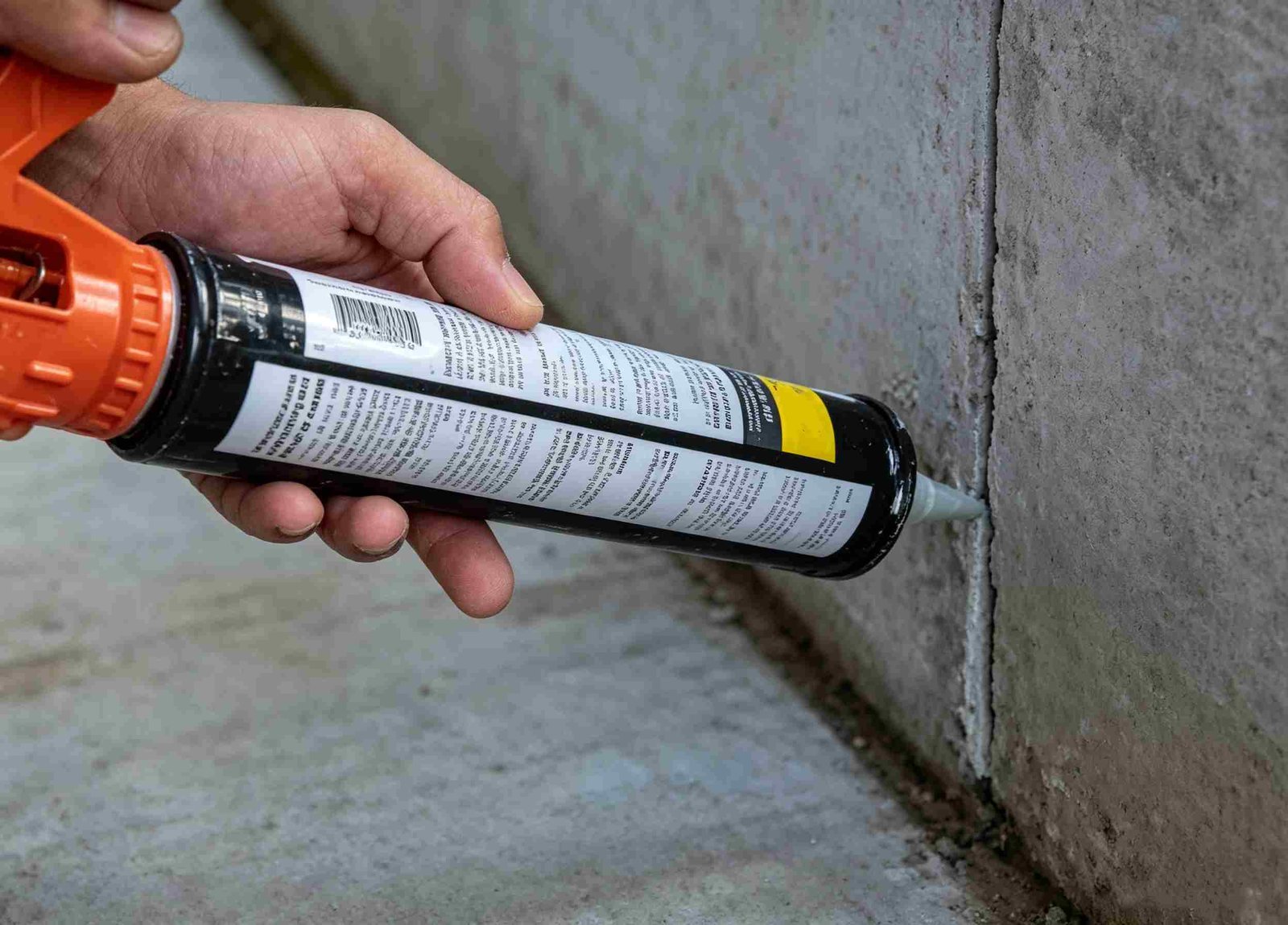
International Standards & Classifications: ASTM C920, ISO 11600, and CE Marking
Specifying a building sealant by commercial brand name alone is a critical project risk. Instead, structural engineers and project specifiers must mandate compliance with ASTM C920 (Standard Specification for Elastomeric Joint Sealants) or ISO 11600, which classify sealants by type, grade, class, and substrate suitability.
Decoding ASTM C920 Construction Sealant Classes: Type, Grade, Class, and Use
Under the North American ASTM C920 standard, an elastomeric sealant is designated through four key parameters:
- Type: Type S designates single-component (1K) moisture-curing sealants ready for direct extrusion. In contrast, Type M designates multi-component (2K) formulations requiring mechanical mixing prior to gun application.
- Grade: Grade P denotes pourable or self-leveling sealants formulated specifically for horizontal deck joints. Meanwhile, Grade NS denotes non-sag or gun-grade paste sealants designed for vertical facades, overhead soffits, and sloped joints without slumping.
- Class: Specifies the percentage of cyclic joint movement the cured elastomeric bead can withstand without failure. Standard classifications include Class 12.5, Class 25, Class 35, Class 50, and Class 100/50 (which withstands 100% joint expansion and 50% joint compression).
- Use: Defines substrate exposure suitability: Use T (traffic areas subject to vehicular/pedestrian wear), Use NT (non-traffic building envelope areas), Use M (tested on mortar/masonry), Use G (glass substrates), Use A (aluminum framing), and Use O (other specific building materials like granite or PVC).
For in-depth analysis on project submittals, review our guide on ASTM C920 sealant movement classes and specifier requirements.
Construction Sealant Modulus Dynamics: Low Modulus vs. High Modulus
In sealant engineering, tensile modulus is the ratio of tensile stress to elongation (measured at 100% or 50% strain). However, choosing the wrong modulus is one of the most common causes of facade delamination:
- Low Modulus Sealants: Formulated to stretch with extremely low internal pulling force. They are essential for low-tensile-strength, porous substrates such as aerated concrete, precast panels, sandstone, and exterior insulation finishing systems (EIFS). Otherwise, high-stress pulling on soft concrete causes adhesive failure where the sealant pulls off the concrete surface layer.
- High Modulus Sealants: Possess high tensile stiffness and strong resistance to deformation. They are required in structural silicone glazing (SSG), transportation manufacturing, and high-impact industrial flooring. In these applications, the joint must transfer mechanical wind shear or resist sharp vehicle wheel point-loading.
Non-Staining Standards for Natural Stone: ASTM C1248
When architectural stone panels (such as white Carrara marble, porous granite, limestone, or sandstone) are sealed with standard commercial sealants, trouble follows. Plasticizers, silicone oils, or unreacted solvent molecules can leach out of the bead. Next, they migrate into the microscopic pore structure of the stone. As a result, an irreversible dark halo (oil-bleed staining) appears along the joint margins. This halo also attracts atmospheric soot and exhaust grime. The international test standard ASTM C1248 (Standard Test Method for Staining of Porous Substrate by Joint Sealants) evaluates whether an elastomeric sealant causes bleeding or stain penetration under compressive heat and UV exposure. Premium non-staining MS polymer formulas and specialized non-bleed silicones are certified to pass ASTM C1248. Consequently, they show zero discoloration on sensitive luxury facades. Learn more about selecting non-staining sealants for natural stone cladding.
Chemistry Face-Off: Construction Sealant Polymers — Polyurethane (PU) vs. MS Polymer vs. Silicone
No single sealant chemistry solves every architectural interface. However, understanding the trade-offs between 1K Polyurethane (PU), Modified Silane Polyether (MS Polymer), and Neutral Silicone allows project managers to select the optimum balance of mechanical toughness, UV longevity, paintability, and cost efficiency.
1K Polyurethane (PU): Mechanical Toughness and Superior Concrete Bite
One-component moisture-curing polyurethane has been the cornerstone of commercial civil engineering for decades. Cross-linking via ambient humidity, 1K PU formulations deliver tremendous mechanical tensile elongation (exceeding 600% to 800%), high tear propagation resistance, and outstanding abrasion tolerance. In addition, PU exhibits natural polar affinity for cementitious substrates. It often establishes primerless adhesion to cured concrete, fiber cement boards, and brick masonry. However, its main limitation is susceptibility to prolonged intense ultraviolet radiation. Over 10 to 15 years of extreme direct sunlight, unpainted aromatic polyurethanes can experience surface micro-crazing and yellowing. Therefore, standard PU is best suited for precast vertical joints that will be painted, sheltered facade joints, or horizontal civil expansion joints.
MS Polymer (SMP / Hybrid Polymer): The Modern Zero-Shrinkage Benchmark
Modified Silane Polymers (also known as Silyl-Modified Polyethers or SMP) combine the mechanical elastomeric toughness of polyurethane with the exceptional UV stability and weatherability of silicone. Featuring a polyether polymer chain terminated with moisture-reactive alkoxysilane groups, MS Polymers offer distinctive advantages on modern jobsites:
- 100% Solids, Zero Solvent Shrinkage: Unlike solvent-laden caulks that shrink up to 15-25% during curing and create concave bead depressions, MS Polymers cure with zero volume loss. As a result, they maintain flush architectural tooling lines.
- Isocyanate-Free and Odorless: Meets strict European REACH, VOC regulations, and indoor environmental air quality standards (LEED v4 compliance).
- Direct Overpaintability: Can be coated with water-based exterior architectural latex paints and acrylic facade coatings without wrinkling or curing delay. This is a crucial capability where silicone cannot be painted.
- Non-Bubbling Cure: PU releases microscopic $CO_2$ gas bubbles when reacting with high ambient moisture or damp concrete. In contrast, MS Polymer cross-links by releasing trace methanol, curing bubble-free even on slightly damp masonry surfaces.
Neutral Cure Silicone: Unrivaled UV Longevity and Temperature Extremes
Featuring an inorganic silicon-oxygen ($Si-O-Si$) molecular backbone, neutral cure silicone sealants possess bond energies ($452\,\text{kJ/mol}$) significantly higher than incoming solar ultraviolet photon energy ($300-400\,\text{kJ/mol}$). Consequently, 100% silicone will not chalk, harden, crack, or lose elasticity even after 30+ years of intense solar radiation. In addition, it maintains operational flexibility across extreme thermal spectrums (-50°C to +150°C). Silicone is therefore the undisputed standard for glass curtain walls, skylight mullions, structural glazing, and exterior metal cladding. However, standard silicone cannot be painted. It also exhibits moderate tear resistance compared to PU and can attract airborne electrostatic dirt. Explore our technical comparison between PU vs MS Polymer vs Silicone chemistries.
| Performance Parameter | 1K Polyurethane (PU) | MS Polymer (SMP) | Neutral Architectural Silicone |
|---|---|---|---|
| Curing Mechanism | Ambient humidity reaction (releases $CO_2$ gas) | Silane moisture cross-linking (methanol byproduct) | Neutral atmospheric cure (alkoxy or oxime) |
| Movement Capability (ASTM C920) | ASTM Class 25 to Class 35 | Flexible Class 25 to Class 50 | High-movement Class 50 up to Class 100/50 |
| UV & Weathering Resistance | Good (may yellow over 10-15 yrs) | Excellent (non-yellowing) | Outstanding (30+ years unpainted) |
| Paintability | Yes (after full cure) | Yes (immediate / wet-on-wet) | No (repels architectural paints) |
| Mechanical Tear Resistance | Highest (unmatched toughness) | High | Moderate to Low |
| VOC & Isocyanate Content | Contains trace isocyanates/solvents | 100% Solvent-Free & Zero Isocyanates | Low VOC / Solvent-Free |
| Substrate Staining Risk (ASTM C1248) | Low to moderate on soft stone | Zero stain (plasticizer-free grades) | High risk on unprimed marble/granite |
Need project-specific chemistry validation or certified ASTM C920 test reports for your facade submittal?
Substrate-Specific Construction Sealant Selection: Concrete, Masonry, Glass, and Metal
Adhesion is a surface chemical phenomenon. Therefore, ensuring long-term bond integrity requires matching the sealant’s reactive molecular structure to the specific porosity, surface alkalinity, and thermal movement profile of each building material.
Precast Concrete Panels, Tilt-Up Walls, and Masonry Brickwork
Precast and tilt-up concrete panels are characterized by micro-porous surfaces, high alkalinity, and significant thermal dimensional shifts. For vertical panel joints, specifiers should therefore choose a low-modulus 1K PU or MS Polymer rated ASTM C920 Class 35 or 50. In addition, concrete joint surfaces must be structurally sound, dry, and thoroughly prepared. Mechanically wire-brush or diamond-grind them to remove residual form-release agents, curing compounds, and loose laitance. For dense, wet climates, an epoxy-polyurethane silane primer guarantees long-term chemical bonding even under standing water exposure. See our step-by-step engineering manual on sealing precast concrete and masonry expansion joints.
Door and Window Perimeter Weatherproofing Interfaces
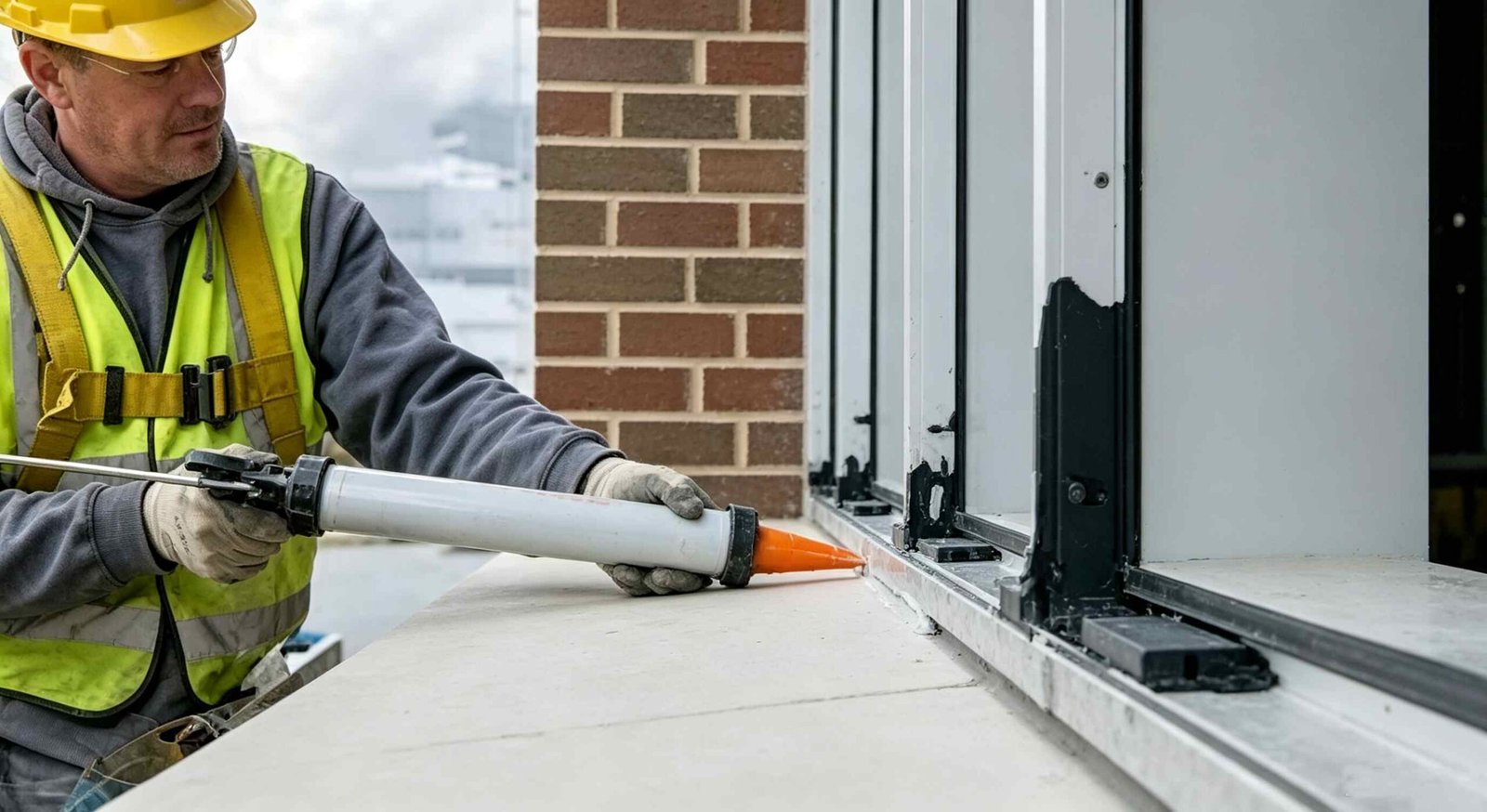
Fenestration perimeters represent high-risk transitional joints. Here, rigid aluminum or vinyl (uPVC) window frames abut rough exterior masonry, brick veneer, or EIFS cladding. Because the frame expands at a much faster rate than surrounding concrete, perimeter sealants must possess exceptional shear flexibility. In addition, they need strong adhesion to anodized aluminum and powder-coated metal finishes. Neutral cure silicone or MS Polymer is therefore ideal for window perimeter joints. It maintains an airtight and driving-rain-proof seal around residential and commercial rough openings without transferring stress to the glazing units.
Wall Corners, Parapets, and Internal Building Settlement Cracks
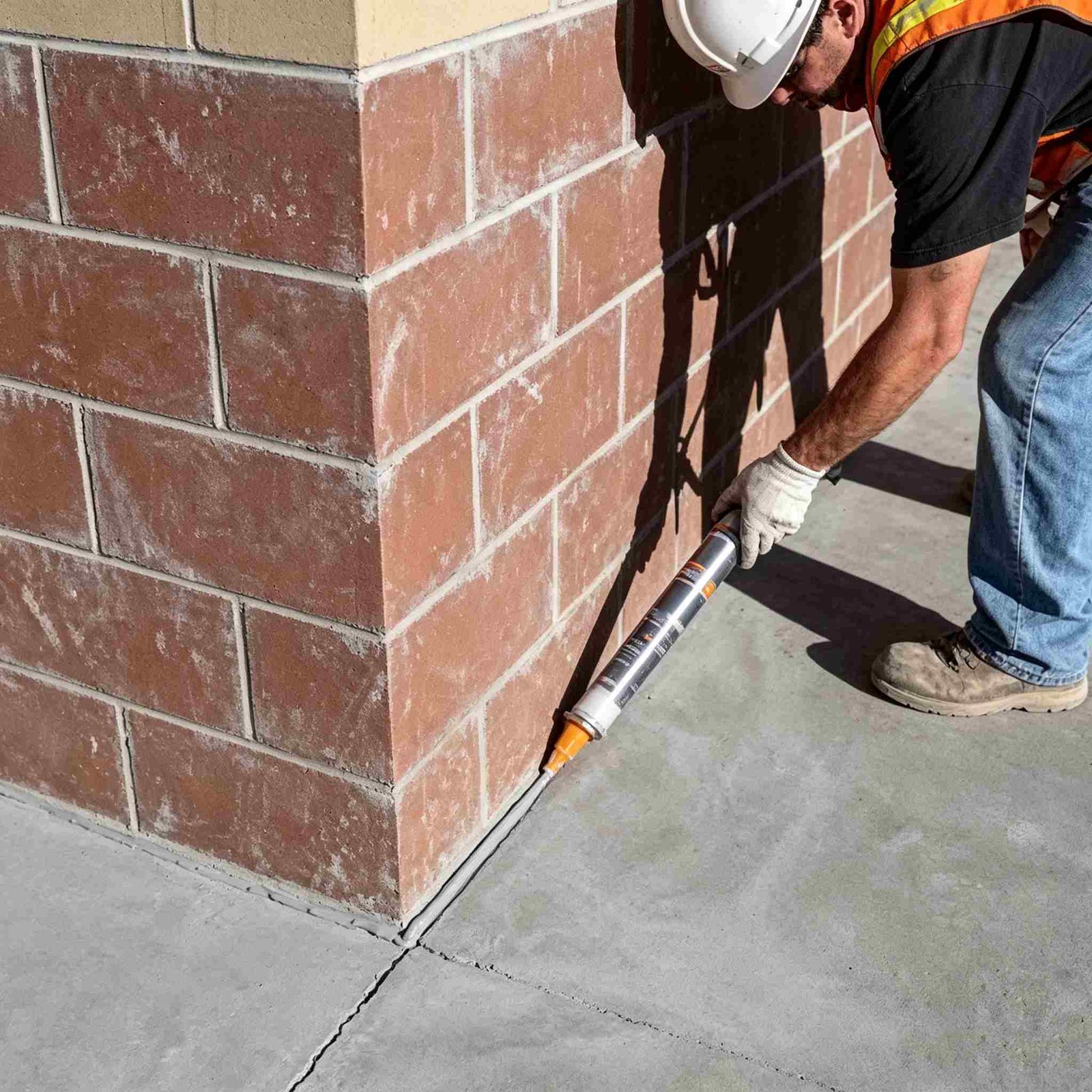
Building internal corners, parapet coping transitions, and slab-to-wall interfaces experience complex multidirectional structural settlement and shear displacement. However, applying standard inflexible acrylic caulks in these junctions inevitably leads to edge tearing within 12 months. Instead, specifiers require high-elongation MS Polymer sealants. These products bridge irregular corner profiles and bond tenaciously to both concrete and gypsum substrates. As a result, they provide an elastic, paintable weather-barrier that flexes as the building settles.
Joint Design Engineering: Geometry, Backer Rods, and Preventing 3-Point Adhesion
The primary mechanical rule of architectural joint design is: Sealant must only adhere to two opposing substrate faces. Adhesion to a third surface (the back of the joint) restricts elastomeric elongation. Consequently, localized stress concentrations form and cause premature joint failure.
The Golden 2:1 Width-to-Depth Ratio in Construction Sealant Joints
A joint bead that is too deep suffers severe internal tearing when stretched. Decades of engineering research codified into ASTM C1193 therefore establish a clear rule: in any moving joint over 12 mm (1/2 inch) wide, the depth of the sealant bead ($D$) must equal exactly half of the joint width ($W$):
• For narrow joints 6 mm to 12 mm wide (1/4″ to 1/2″): Depth = Width (1:1 Ratio), with minimum depth of 6 mm.
• In standard joints 12 mm to 25 mm wide (1/2″ to 1″): Depth = 1/2 Width (2:1 Ratio), typically 6 mm to 12 mm.
• Across wide expansion joints beyond 25 mm (1″ to 2″): Maximum Depth = 12 mm to 15 mm regardless of width.
• Hourglass geometry requirement: When tooled concave, internal strain distributes evenly across the bead cross-section.
The Role of Backer Rods and Preventing 3-Point Adhesion
If a sealant bead adheres to the two side walls AND the rear joint base, it is trapped in “three-point adhesion.” When the joint opens during winter contraction, the sealant cannot neck down freely in an hourglass curve. Instead, tearing stresses focus at the bottom corners. Consequently, catastrophic cohesive splitting occurs along the entire bead length. However, installing a cylindrical polyethylene backer rod performs three vital functions:
- Controls Sealant Depth: Sets the exact depth to ensure the specified 2:1 geometry ratio.
- Acts as a Bond Breaker: Polyethylene does not bond to polyurethane, MS polymer, or silicone construction sealants, ensuring two-point adhesion only.
- Creates an Hourglass Profile: The curved crown of the rod shapes the backside of the bead into a concave arch, minimizing internal tension.
Backer Rod Selection: Use closed-cell polyethylene for exterior horizontal joints and wet areas, because it does not absorb water. However, puncturing closed-cell rods during insertion can release trapped gas. Consequently, outgassing bubbles appear in uncured polyurethane. For vertical facade panels, specifiers therefore frequently utilize non-gassing hybrid polyolefin or open-cell rods with an approved bond-breaker tape.
Horizontal Floor Pavement Joints and Self-Leveling Formulations
Horizontal expansion joints in commercial concrete floors, warehouse logistics decks, and parking pavements require specialized handling. Because these joints are subject to heavy forklift traffic, vehicular tire abrasion, and chemical fluid spills, vertical non-sag sealants are too time-consuming to tool flat. Instead, contractors rely on self-leveling polyurethane joint sealants (ASTM C920 Type S, Grade P, Class 25, Use T). These low-viscosity moisture-curing polymers pour smoothly into horizontal expansion cracks. Next, they naturally level out flush with the concrete surface. As a result, they provide an impact-resistant seal without manual troweling.
Dispensing Tools, Sausage Cartridges, and Dry Tooling Best Practices
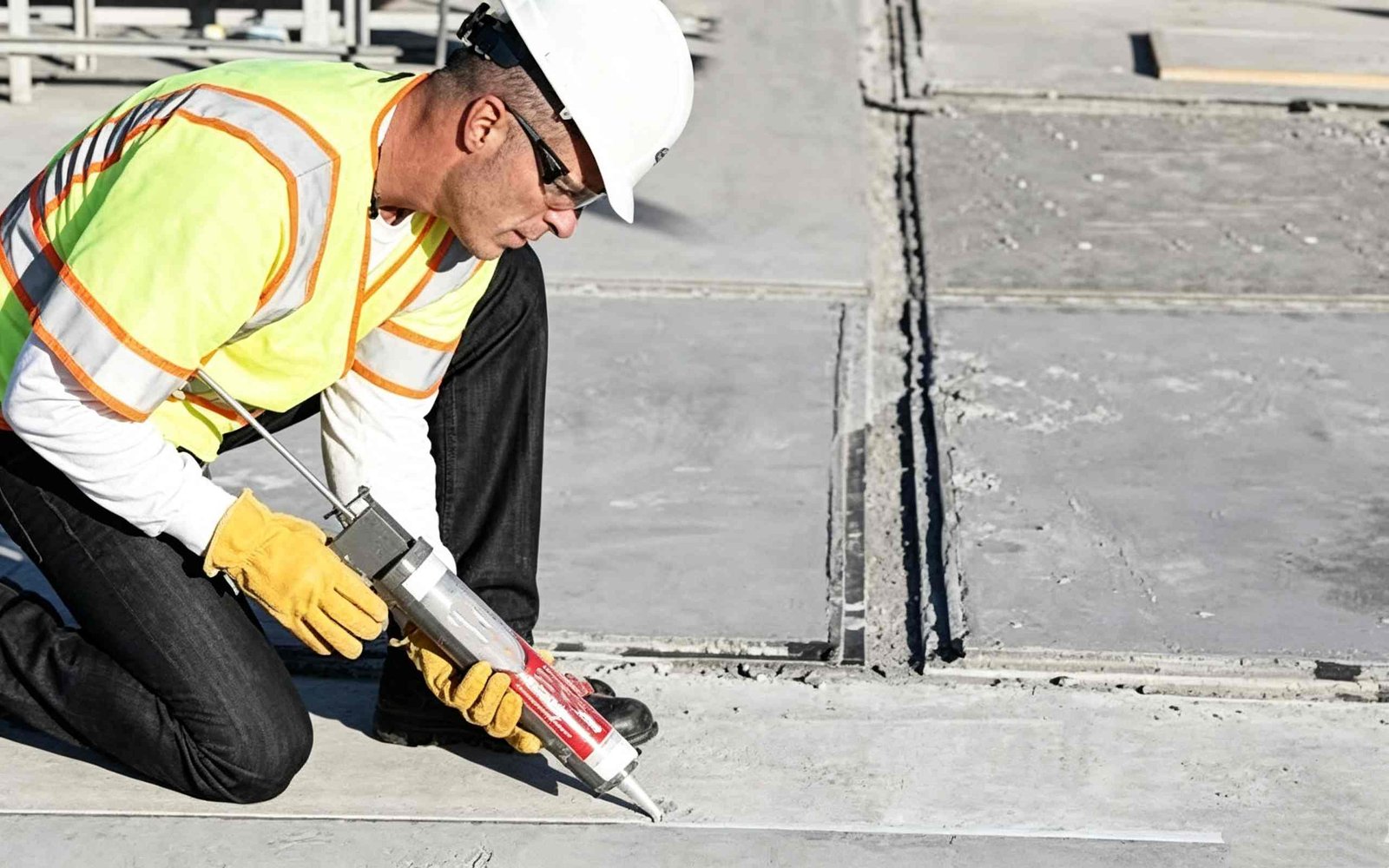
Commercial sealant installation requires professional pneumatic or high-thrust manual caulking equipment. On large-scale architectural projects, 600 ml aluminum foil sausage packs are the international standard. They cut packaging waste by 90% compared to rigid 310 ml plastic cartridges while reducing freight shipping volume. In addition, utilizing professional barrel caulking guns and ergonomic joint tooling spatulas ensures uniform extrusion pressure without air voids. Always execute dry tooling using concave spatulas to force the sealant firmly against joint sidewalls. However, spraying soapy water as a tooling lubricant is prohibited on exterior facades. Soapy residue breaks primer adhesion and discolors paint lines.

Diagnosing and Troubleshooting Common Construction Sealant Failures
When a building joint fails in service, structural forensic investigators classify the issue into two primary failure mechanisms: Adhesive Failure (debonding from substrate) or Cohesive Failure (internal tearing within the sealant body). Correct diagnosis therefore determines whether the problem was chemical incompatibility or geometric design error.
| Failure Symptom | Classification | Root Engineering Cause | Corrective & Preventative Action |
|---|---|---|---|
| Edge Peeling from Concrete | Adhesive Failure | Moisture on substrate during application; laitance or oil contamination; unprimed porous concrete. | Grind joint sidewalls clean; ensure moisture <4%; apply certified silane primer before gunning. |
| Splitting Down Center of Bead | Cohesive Failure | Joint movement exceeded class (e.g. Class 25 in 40% joint); bead too deep (violating 2:1 ratio). | Redesign joint geometry; insert correct backer rod to achieve 2:1 ratio; upgrade to Class 50 sealant. |
| Internal Bubbling & Blistering | Gassing / Moisture Defect | Applying 1K PU on wet concrete; outgassing from punctured closed-cell backer rods under sun exposure. | Switch to non-gassing MS Polymer; do not puncture backer rods; avoid gunning in direct midday sun. |
| Dark Staining on Granite Facade | Plasticizer Bleeding | Using standard commercial silicone containing low-cost plasticizers or fluid silicone plasticizing oils. | Specify strictly ASTM C1248-certified non-staining MS Polymer or specialized non-bleed silicone. |
| Paint Peeling / Fish-Eyes | Incompatibility Defect | Attempting to paint over standard silicone sealant, or painting 1K PU before skin cure complete. | Use paintable MS Polymer or color-matched pre-tinted architectural sealants. |
SHCHEMPU Case Study: Sealing Precast Facade Panels on a Multi-Story Commercial Development
By transitioning from failing commercial caulk to an engineered low-modulus MS Polymer construction sealant system with optimized 2:1 joint geometry, a premier commercial contractor resolved 100% of precast facade water ingress claims across 30,000 square meters of exterior envelope.
CLIENT CHALLENGE
- Client: General facade engineering contractor in Central and South America, Africa, Europe, North America.
- Issue: Severe joint splitting and water penetration across 14,000 linear meters of exterior precast concrete panel joints within 14 months of building completion.
- Root Cause: Previous contractor used high-modulus caulk without backer rods (3-point adhesion). Consequently, the beads suffered UV cracking under intense 45°C summer desert exposure.
OUR SOLUTION
- Product: Specified SHCHEMPU Low-Modulus MS Polymer Construction Sealant (ASTM C920 Class 50, Grade NS, 100% solids).
- Engineering Retrofit: First, mechanically removed degraded sealant and routed joints to 20 mm width. Next, installed 25 mm closed-cell polyethylene backer rods to establish exact 2:1 (10 mm depth) geometry.
- Packaging & Supply: Supplied Box size: 20 pieces per box 600 ml sausage packs with custom facade-matched concrete grey pigment.
RESULTS & VALUE
- Facade Leak Callbacks: Pre repair rate of 1% to 3% → 0% water penetration during consecutive monsoon storm cycles.
- Installation Efficiency: As a result, 600 ml sausage packaging reduced applicator cartridge change-out downtime by 35%.
- Warranty Guarantee: Consequently, the project secured a 10-year joint weatherproofing certificate backed by third-party ASTM C920 test documentation.
Data source: SHCHEMPU Commercial Engineering Field Log 2020-2026. Project Type: High-rise Commercial Precast Facade. Product Series: SMP-650 Architectural Series.
Sourcing Commercial Construction Sealants: Direct Factory Specifications for General Contractors
Procuring architectural construction sealants directly from certified chemical manufacturers unlocks substantial cost savings for large-scale developments. In addition, it ensures strict batch-to-batch quality control, customized color matching, and full regulatory compliance.
Packaging Economics: Sausage Packs vs. Cartridges
For civil engineering contractors and commercial glazing teams, packaging selection for construction sealants directly impacts installation labor and logistical overhead. While 310 ml rigid plastic cartridges suit light spot repair, 600 ml aluminum foil sausage packs represent 85% of volume in commercial architectural contracts. Foil sausages also pack flat when empty. Consequently, they eliminate bulky dumpster disposal costs on urban jobsites and save up to 20% on ocean container freight costs per metric ton of extruded sealant.
OEM Private Label, Custom Color Matching, and Technical Support
Large-scale facade projects frequently require sealant beads to blend seamlessly with custom precast concrete aggregates, powder-coated RAL window frames, or anodized bronze curtain wall fins. To achieve this seamless blend, SHCHEMPU provides automated computerized spectrophotometer color matching. Specifically, we formulate polyurethane and MS polymer construction sealant beads in exact RAL/Pantone shades. Furthermore, we support regional distributors with OEM private label cartridge artwork, bilingual technical data sheets (TDS), and full container load (FCL) mixed shipments combining architectural joint sealants, self-leveling concrete sealers, specialized vehicle roof sealants, and pneumatic caulking guns.
Equip Your Commercial Project with Certified Architectural Sealants
Connect directly with SHCHEMPU chemical formulation engineers. We provide free substrate adhesion testing, ASTM C920 certification submittal packages, and factory-direct volume pricing for global distributors and general contractors.
Authored by SHCHEMPU Architectural Technical Engineering Department
Specializing in high-performance polyurethane, modified silane polymer, and architectural silicone sealants for high-rise commercial facades, precast concrete structures, and industrial joint design. Reviewed by senior chemical polymer formulation engineers with 14+ years of global B2B application expertise.

