
Automotive glazing technology has undergone a fundamental transformation with the rise of modern electric vehicles (EVs) and advanced driver assistance systems (ADAS). Heavy skateboard battery packs and rigid aluminum chassis demand unprecedented torsional unibody stiffness. Applying traditional aftermarket urethanes to contemporary EV platforms creates severe safety hazards. Glazing specialists must specify high modulus non-conductive windshield adhesive to ensure mechanical integrity and electrical isolation.
Modern EV architectures integrate sensitive embedded antennas, head-up displays (HUD), heating grids, and forward-facing vision sensors directly into windshield glass. Deploying certified high modulus windshield adhesive reinforces chassis rigidity, while an engineered non-conductive windshield adhesive prevents galvanic corrosion along aluminum pinchwelds.
This standard engineering guide delivers an exhaustive technical breakdown of high-modulus and non-conductive polyurethane chemistry. We analyze shear modulus mechanics, electrical resistivity thresholds, electrochemical corrosion pathways, and ADAS camera optical stabilization. Certified technicians, fleet managers, and collision estimators will master precise installation rules for high-voltage vehicles.
Executive Summary: Modulus Physics & Electrical Isolation Rules
- High Shear Modulus (G ≥ 2.0 MPa): Modern EVs require high-modulus adhesive to restore structural body rigidity, preventing windshield glass twisting, creaking, and corner stress fractures.
- High Volume Resistivity (> 1010 Ω·cm): True non-conductive polyurethanes use specialized non-conductive carbon black, blocking electrical ground loops and stray current leakage.
- Galvanic Corrosion Prevention: Bonding glass to aluminum or mixed-metal EV pinchwelds with standard conductive urethane forms an electrochemical galvanic cell, causing rapid aluminum pitting.
- ADAS Optical Stiffening: Forward-facing cameras mounted on windshield brackets require high-modulus bonding to prevent micro-vibrations from disrupting lane-keep algorithms.
Mechanical Dynamics: Why Heavy EVs Demand High-Modulus Polyurethane
When installing ev windshield adhesive, technicians must realize electric vehicles present completely different chassis dynamics compared to internal combustion cars.
Chassis Torsional Stiffness and Battery Mass Dynamics
Electric vehicles carry heavy floor-mounted traction battery packs weighing between 400 kg and 700 kg. This concentrated mass significantly alters how kinetic energy and twisting forces transfer through the body frame during aggressive cornering.
OEM structural engineers integrate the windshield glass as an active shear-stiffening diaphragm. High-modulus urethane features a high shear modulus (G10% ≥ 2.0 MPa), whereas standard urethanes register only 0.5 to 1.2 MPa.
Preventing Glass Stress Fractures and Noise
Installing a low-modulus aftermarket adhesive into a modern EV allows excessive relative displacement between the steel or aluminum aperture and the glass perimeter.
Over thousands of kilometers, this unibody flex creates audible squeaking, damages pinchweld paint coatings, and frequently causes spontaneous diagonal stress cracks across tempered and acoustic glass corners.
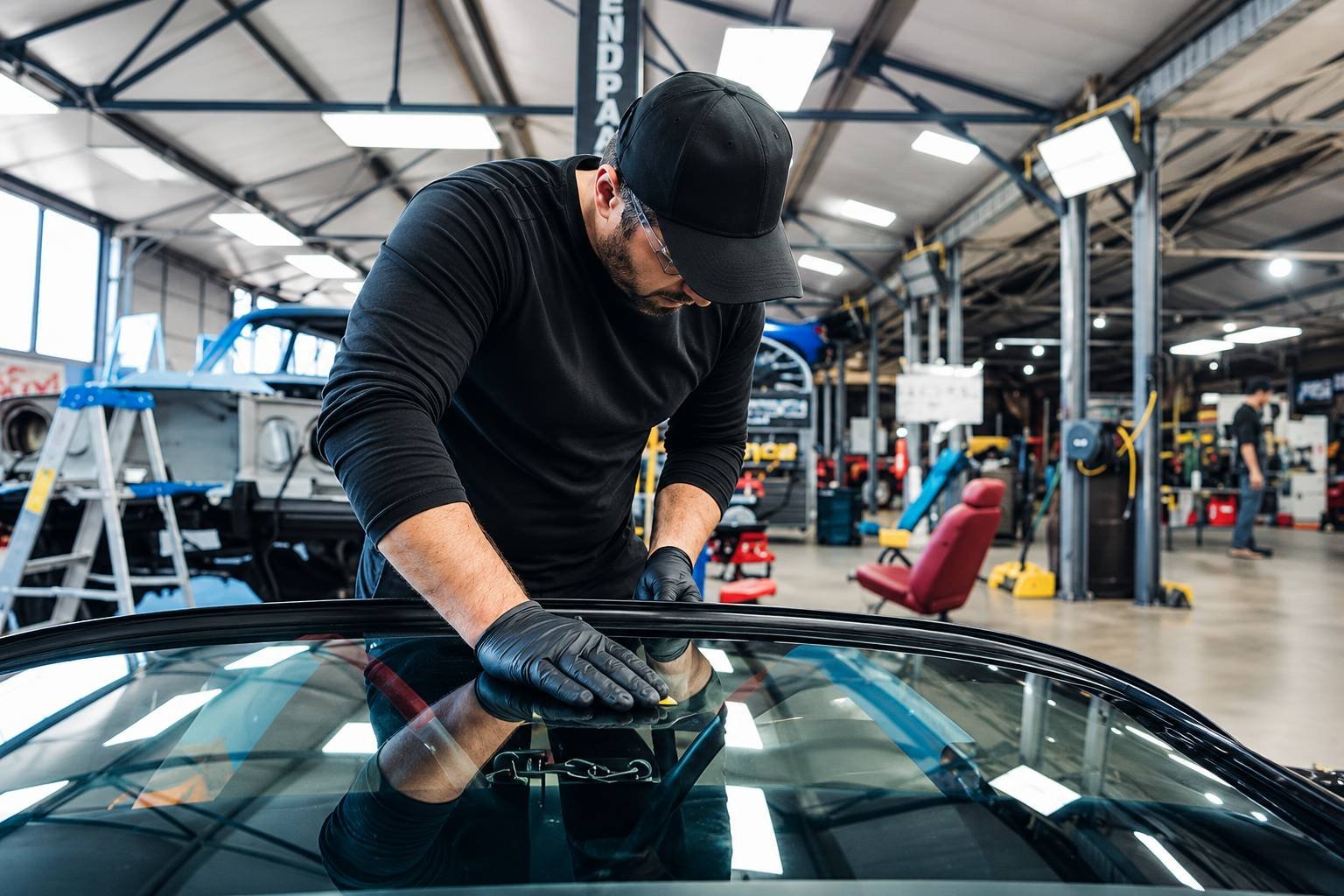
Technical Specification Matrix: High-Modulus vs. Standard Urethane
The engineering matrix below highlights the critical mechanical and electrical boundaries distinguishing HM/NC urethanes from standard glass adhesives.
| Property Parameter | Standard Aftermarket Urethane | High Modulus / Non-Conductive (HM/NC) | Engineering Significance for EVs |
|---|---|---|---|
| Shear Modulus (G10%) | 0.6 to 1.2 MPa | ≥ 2.0 to 2.5 MPa | Increases unibody torsional stiffness by up to 25% |
| Volume Resistivity (ρv) | 105 to 107 Ω·cm (Conductive) | > 1010 Ω·cm (Insulating) | Prevents antenna interference & galvanic battery loops |
| Tensile Lap Shear Strength | 3.5 to 5.0 MPa | ≥ 6.5 to 8.0 MPa | Withstands violent airbag deflection shock forces |
| Aluminum Corrosion Risk | High (Galvanic cell formation) | Zero (Dielectric barrier) | Stops moisture-driven electrochemical aluminum pitting |
Galvanic Corrosion & ADAS Vision Calibration Stability
Beyond structural mechanical loads, electrical resistivity plays a vital safety role in electric vehicle architectures.
The Chemistry of Galvanic Corrosion on Aluminum Pinchwelds
Standard black polyurethanes contain carbon black particles that conduct electrical current. When applied to modern aluminum unibodies, conductive carbon acts as an active noble cathode, while the aluminum pinchweld acts as an sacrificial anode.
Whenever road salt, rainwater, or atmospheric humidity penetrates perimeter trim, a closed galvanic battery forms. Over months, severe galvanic corrosion corrodes the aluminum aperture into powdery aluminum oxide, destroying adhesive bonding.
ADAS Camera Calibration and Vibration Elimination
Modern vehicles feature forward-looking ADAS cameras mounted directly to windshield brackets. If soft urethane allows the glass to flutter under aerodynamic buffeting, the optical angle shifts microscopically.
This subtle angular deflection misaligns forward collision warning, lane departure prevention, and automated emergency braking sensors. Deploying rigid adas windshield adhesive ensures stable, oscillation-free optical tracking.

Standard Operating Procedure: Five-Stage EV Installation SOP
Executing this standardized procedure guarantees structural compliance, electrical isolation, and optical sensor stability on high-voltage vehicles.
Step 1: Aluminum Pinchweld Inspection and Specialized Priming
Trim existing urethane down to an even 1mm to 2mm bed. Inspect for bare aluminum scratches. Apply specialized all-in-one etch primer designed specifically for multi-metal substrate protection.
Step 2: Glass Frit Degreasing and Black Primer Activation
Clean the ceramic frit perimeter with pure isopropanol. Apply a continuous band of dielectric glass primer using a clean, lint-free applicator. Allow ten minutes for full solvent flash-off.
Step 3: High-Viscosity HM/NC Urethane Extrusion
High-modulus polyurethanes feature high viscosity. Warm cartridges to 40°C in an approved heater box before extrusion. Use a high-thrust pneumatic or electric caulking gun to lay down a tall triangular V-notch bead.
Step 4: Precision Glass Decking and Gap Verification
Set the replacement windshield into the aperture within the adhesive open time. Use mechanical stop blocks to ensure an exact 4mm to 5mm cured bond line thickness, maintaining precise camera pitch angles.
Step 5: Dynamic Safe Drive-Away Time and ADAS Recalibration
Strictly observe certified Safe Drive-Away Times (SDAT) under ambient workshop conditions. Once fully cured, connect an approved diagnostic scanner to perform static target calibration or dynamic driving calibration for all forward-facing ADAS cameras.
Engineer’s Technical Trade-Offs: Boundaries of HM/NC Formulations
Auto glass technicians must understand where high-modulus formulations introduce technical trade-offs during shop operations.
- High Extrusion Viscosity: HM/NC polyurethanes require heavy-duty electric or pneumatic dispensers; manual caulking guns will bend or seize due to high paste resistance.
- Narrow Temperature Cure Windows: Moisture-curing HM urethanes slow drastically below 5°C (40°F); shops in cold climates must utilize heated 2-component (2K) boosted polyurethanes to guarantee SDAT.
- Higher Material Sourcing Cost: Special non-conductive channel black pigments and high-purity prepolymers increase product costs by 20% to 35% compared to basic commercial urethanes.
Frequently Asked Questions: EV & ADAS Adhesives
What does “high modulus” mean in automotive windshield adhesive?
High modulus refers to an adhesive’s resistance to deformation and shear stress under heavy mechanical loads. High-modulus polyurethanes possess a shear modulus of 2.0 MPa or greater, allowing the cured adhesive bead to act as an active structural member that reinforces unibody torsional rigidity by up to 25%.
Why must windshield adhesive be non-conductive on electric vehicles?
Electric vehicles feature integrated windshield heating elements, in-glass radio/GPS antennas, and sensitive electronic control units. Non-conductive adhesives possess a volume resistivity exceeding 1010 Ω·cm, which prevents stray currents, eliminates antenna interference, and stops electrochemical galvanic corrosion between carbon and aluminum unibodies.
Can a standard aftermarket urethane be used on an EV in an emergency?
No. Using standard urethane on an EV violates OEM repair procedures and federal safety standards. Low-modulus adhesive allows excessive unibody flex that can crack the glass or misalign ADAS cameras, while conductive carbon black accelerates severe galvanic corrosion on aluminum pinchwelds, voiding manufacturer warranties.
Engineering Summary: Electrified Glazing Demands Certified Chemistry
Electric vehicles and advanced driver assistance systems have elevated automotive windshield bonding into an exacting high-technology science. By mandating high-modulus, non-conductive polyurethane adhesives, auto glass professionals preserve structural unibody stiffness, prevent catastrophic electrochemical corrosion, and guarantee flawless optical tracking for life-saving ADAS sensors.
Authored by ChemPU Automotive Application Engineering Team
Specializing in OEM direct-glazing polyurethane formulation, crash-retention validation per FMVSS 212 standards, and high-performance structural elastomeric bonding solutions for global automotive manufacturers.
Quality Certification: ISO 9001 / IATF 16949 Certified Adhesive Manufacturing
Source Certified High Modulus & Non-Conductive EV Polyurethanes
Partner with ChemPU, an ISO 9001 and IATF 16949 certified Chinese manufacturer. We provide high-modulus, non-conductive polyurethane windshield adhesives compliant with OEM EV specifications, dielectric primers, and private label cartridges for international distributors.
Direct WhatsApp Technical Inquiry: +86 15216655520

