
Automotive windshield replacement carries zero tolerance for structural bonding failure. During a severe collision, a detached windshield invalidates passenger airbag deployment and reduces roof crush resistance. Technicians frequently debate whether chemical bonding relies entirely on adhesive tensile strength or comprehensive surface chemistry. Specifying an uncertified sealant or skipping critical substrate preparation introduces catastrophic liability risks for commercial fleets.
Modern vehicles treat automotive glass as an active shear panel within the monocoque chassis. Selecting a certified urethane windshield adhesive ensures dynamic impact energy transfers safely into vehicle pillars. Many workshops struggle with extended cure downtime, cold weather viscosity stalls, and substrate delamination under cyclic road torsion.
This technical guide delivers an engineering analysis of polyurethane direct glazing systems. We examine prepolymer cross-linking chemistry, mechanical modulus ratings, and workshop installation parameters. Auto glass technicians and fleet maintenance managers will discover proven protocols to guarantee FMVSS 212 barrier crash compliance.
Executive Summary: Key Takeaways for Auto Glass Technicians & Fleet Engineers
- Structural Load Transfer: Modern direct glazing uses high-strength windshield polyurethane adhesive to contribute up to 30% of total unibody torsional stiffness.
- Chemical Cross-Linking: Atmospheric moisture activates single-component isocyanate prepolymers, forming stable polyurea linkages that resist dynamic shear stress.
- Strict SDAT Adherence: Safe drive-away time directly dictates passenger airbag safety; never release vehicles before adhesive lap shear strength reaches minimum engineering thresholds.
- Substrate Preparation Determines Bond Integrity: Black glass primer blocks ultraviolet radiation degradation while protecting bare metal pinchwelds against corrosive pitting.
The Engineering Evolution: From Rubber Channels to Structural Polyurethane
Urethane windshield adhesive transforms vehicle stationary glass into a rigid structural diaphragm. This chemical bond transfers dynamic crash loads across the cabin aperture under strict international motor vehicle standards.
Limitations of Legacy Mechanical Gaskets and Butyl Tapes
Automotive assembly prior to the late 1970s relied on extruded rubber locking gaskets or soft butyl mastic ribbons. These legacy systems provided weatherproofing barriers against rain intrusion. Butyl ribbons lack cohesive tensile strength, exhibiting continuous creep under sustained loads.
When vehicle speeds increased and aerodynamic flush-glazing gained prominence, soft mastics failed to keep windshields retained during front collisions. Modern passenger safety designs mandate structural automotive windshield sealant materials capable of sustaining multi-ton separation forces.
Roof Crush Resistance and Cabin Integrity (FMVSS 216)
Under the FMVSS 216 roof crush resistance standard, vehicle roofs must withstand multiple times the vehicle curb weight. In modern unibody sedans and SUVs, the bonded windshield accounts for up to 45% of total cabin crush resistance during rollover events.
The cured polyurethane windshield sealant holds the laminated glass plate rigidly across A-pillars. This structural arch prevents roof collapse, preserving essential occupant survival space inside damaged passenger compartments.
Polyurethane Adhesive Chemistry: Prepolymers, Isocyanates, and Moisture Curing
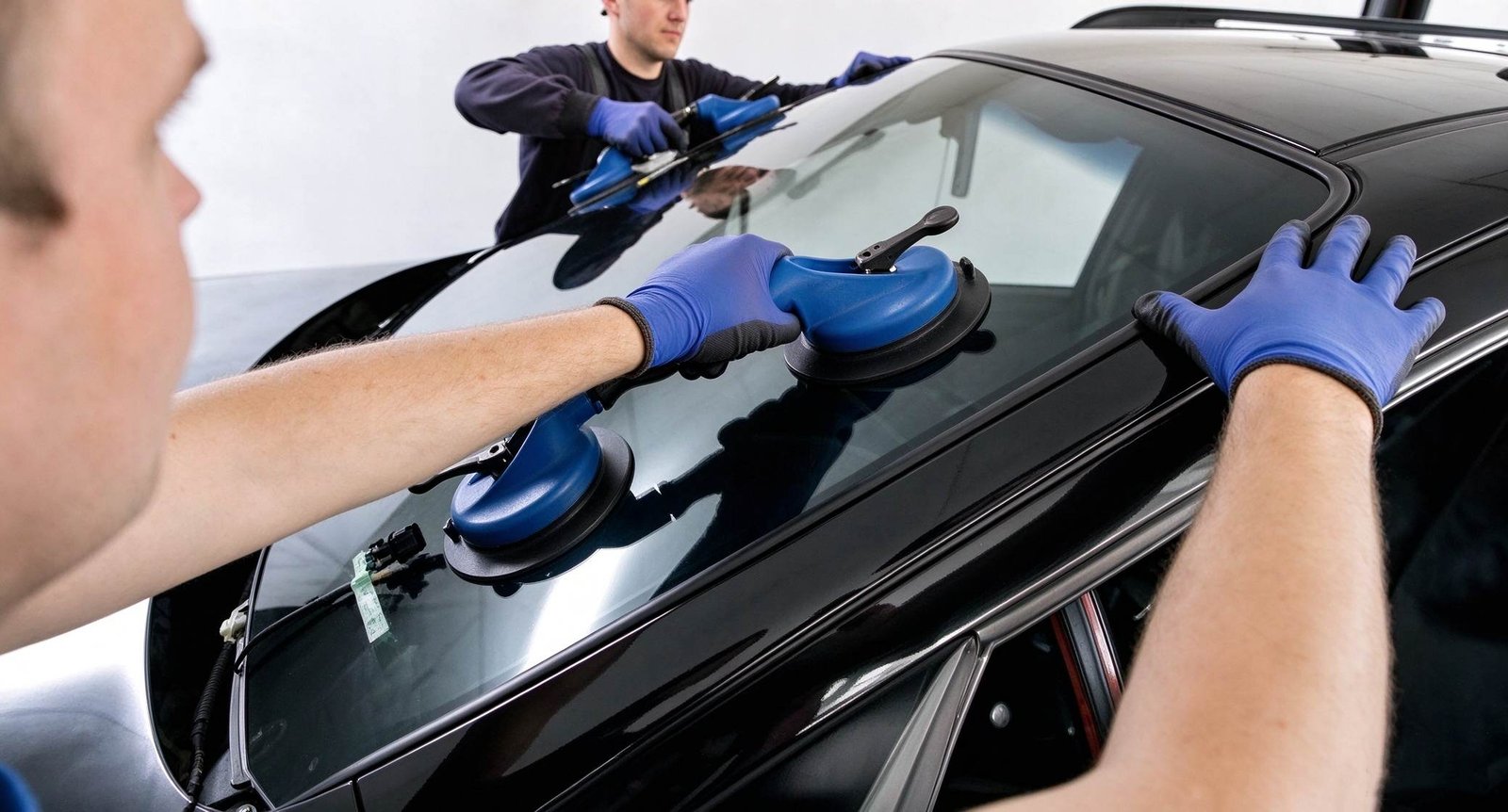
The chemical performance of direct glazing relies on polyurethane polymer synthesis. Formulations combine polyols with aromatic diisocyanates, typically methylene diphenyl diisocyanate (MDI), yielding an isocyanate-terminated prepolymer paste.
The Moisture-Curing Chemical Reaction
Single-component (1K) windshield polyurethanes react with ambient atmospheric moisture rather than chemical mixing agents. Water molecules diffuse into the extruded bead, reacting with terminal isocyanate groups (-NCO) to generate unstable carbamic acid intermediates.
These intermediates dissociate into primary amine compounds and release gaseous carbon dioxide ($CO_2$). The amine immediately reacts with remaining isocyanate groups to create stable polyurea cross-linked networks throughout the adhesive matrix.
Carbon Black Reinforcement and UV Barrier Performance
Automotive grade windshield urethane incorporates high concentrations of specialized carbon black particles. These sub-micron particles provide physical thixotropic body, preventing bead slump on vertical pinchweld pillars during glass placement.
Carbon black blocks damaging ultraviolet rays from penetrating through peripheral float glass frit bands. Without this active light-shielding filler, direct solar exposure triggers photo-oxidative polymer backbone chain scission, causing catastrophic adhesive chalking.
Classification of Windshield Adhesives: 1K Moisture-Cure vs. 2K Accelerated Systems
Commercial glass shops choose adhesive systems based on fleet operational requirements, climate constraints, and vehicle chassis designs. Different chemistries address distinct production turnaround demands.
| Performance Parameter | Standard 1K Polyurethane | Fast-Cure 1K Polyurethane | 2K Booster / Accelerated System |
|---|---|---|---|
| Curing Mechanism | Atmospheric Moisture | Accelerated Moisture Catalyst | Chemical Paste Component B |
| Safe Drive-Away Time (SDAT) | 4 to 24 Hours | 30 Minutes to 2 Hours | 15 to 30 Minutes |
| Tensile Lap Shear Strength | ≥ 4.0 MPa | ≥ 5.5 MPa | ≥ 6.5 MPa |
| Temperature Dependency | High (Stalls below 5°C) | Moderate | Independent of Humidity |
| Dispensing Equipment | Standard Manual / Battery Gun | High-Thrust Battery Gun | Dual-Cartridge Static Mixer Gun |
High Modulus (HM) Formulations
High modulus polyurethanes deliver a shear modulus rating of $G_{10\%} \ge 2.0 ext{ to }2.5 ext{ MPa}$. This elevated stiffness reinforces passenger compartments, preventing dynamic chassis flex from misaligning windshield-mounted ADAS camera sensors.
Non-Conductive (NC) Formulations
Modern glass frequently incorporates integrated heating wires, rain sensors, and embedded radio antennas. Applying a non-conductive adhesive for auto glass featuring volume resistivity above $10^{10}\ \Omega\cdot ext{cm}$ prevents galvanic corrosion on aluminum pinchwelds while maintaining radio signal clarity.
Typical Application Scenarios: Field Challenges and Engineering Solutions
Direct glazing procedures encounter distinct operational obstacles across mobile automotive service and high-speed industrial manufacturing lines.
Scenario A: Mobile Auto Glass Replacement in Sub-Zero Ambient Conditions
Mobile repair vans operating in winter climates face ambient temperatures hovering near 0°C. Cold air dramatically reduces absolute humidity, slowing moisture-diffusion cure rates. Standard polyurethanes stiffen inside aluminum packaging, causing dispensing nozzle blowouts.
Technicians resolve this constraint by preheating adhesive cartridges inside 12-volt thermal warming boxes to 45°C. Using a dedicated fast curing automotive direct glazing adhesive provides certified Safe Drive-Away Time even in low relative humidity environments.
Scenario B: Commercial Bus and Rail Vehicle Direct Glazing
Large transit buses and rail coaches feature massive panoramic laminated glass sections exceeding three square meters. Installers require an extended open working time of 20 to 30 minutes to lay continuous triangular beads before surface skinning occurs.
Engineers specify specialized urethane window adhesive systems with high green strength. This property supports heavy vertical glass mass without slipping or sagging before chemical cross-linking completes.
Standard Operating Procedure: Professional Windshield Direct Glazing Protocol
Adhering to a standardized, multi-step direct glazing process prevents wind noise, cabin water leaks, and catastrophic bond release. Technicians should execute this sequence systematically.
Step 1: Old Urethane Bead Trimming and Pinchweld Inspection
Cut away remaining old polyurethane using specialized pull knives or motorized oscillating blades. Maintain a smooth, level base layer measuring 1 to 2 millimeters in thickness. Intact OEM urethane provides an ideal bonding surface for fresh automotive glass adhesive.
Inspect the steel pinchweld flange for paint scratches, bare sheet metal, or corrosion pitting. Treat any exposed bare metal immediately using an approved anti-corrosion primer to halt rust oxidation.
Step 2: Substrate Degreasing and Surface Preparation
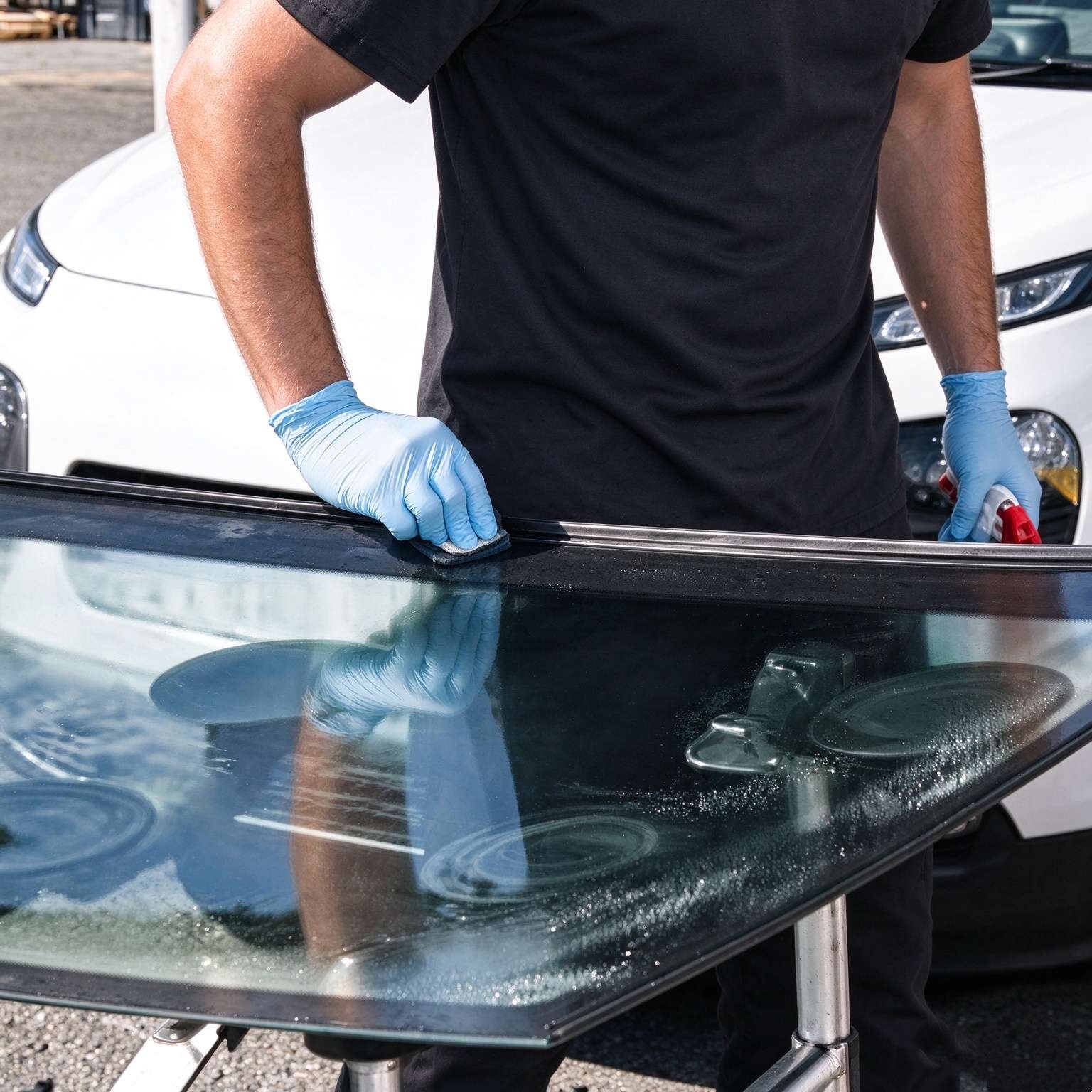
Clean the ceramic frit perimeter of the replacement windshield using an oil-free, alcohol-based glass cleaner. Apply the industry standard two-rag wiping method: wipe once with a solvent-dampened lint-free cloth, followed immediately by a clean dry cloth to capture dissolved oils.
Step 3: Black Primer Application and Flash-Off
Agitate the glass primer bottle vigorously for at least 30 seconds until the internal mixing ball rattles freely. Apply a continuous, thin film along the ceramic frit using a clean wool dauber. Allow the primer to flash off completely for 5 to 10 minutes until it dries to a matte black finish.
Step 4: Extruding the Triangular (V-Notch) Adhesive Bead
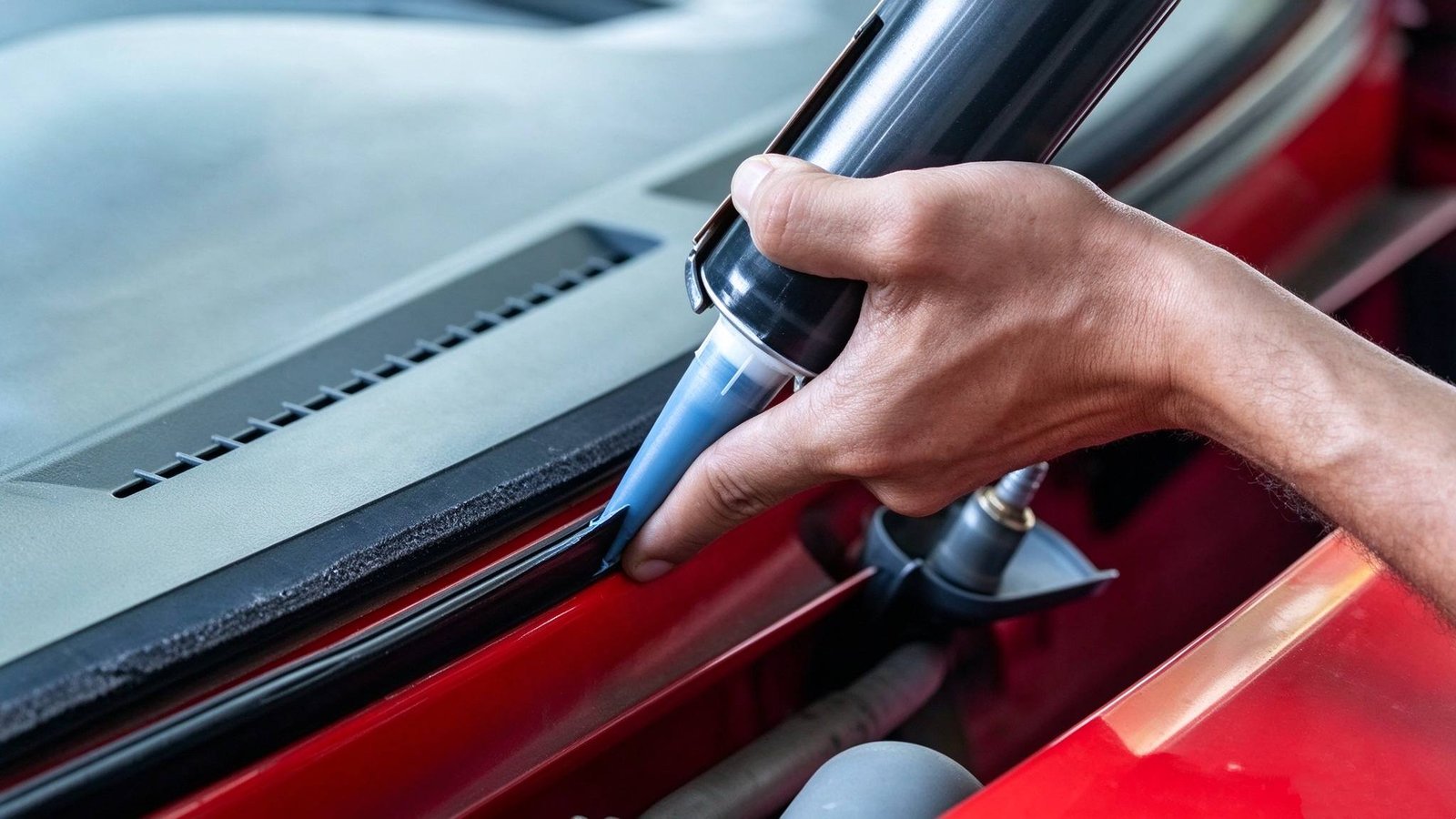
Professional auto glass technicians avoid round bead nozzles. Cut the plastic dispensing tip to create a triangular notch measuring 8 to 10 mm wide at the base and 12 to 15 mm tall.
Hold the professional caulking gun tool strictly perpendicular (90 degrees) to the glass surface. Extrude an unbroken bead around the perimeter, overlapping the start and finish points by 15 mm along the bottom center of the windshield.
Step 5: Deck Setting, Compression, and Retention
Mount heavy-duty vacuum suction cups onto the exterior glass surface. Lower the windshield into the vehicle aperture within 10 minutes of initial extrusion. Press gently along the perimeter until the bead compresses to a uniform thickness of 4 to 5 millimeters. Secure the top glass edge with non-marking retention tape.
Engineer’s Technical Trade-Offs: Boundaries of Polyurethane Adhesives
Polyurethane remains the preeminent direct glazing chemistry worldwide. Professional engineers must recognize operational boundaries and formulation trade-offs during glass repair operations.
- High Paste Viscosity: Quality high-modulus urethanes exhibit high extrusion force. Hand dispensing creates wrist strain; workshops require commercial battery-powered guns with 20:1 thrust ratios.
- Strict Moisture Dependency: Single-component polyurethanes stall curing in arid climates below 20% relative humidity. Technicians in desert environments must mist shop floors or switch to 2K accelerated systems.
- Zero Tolerance for Silicone Contamination: Never apply silicone caulk near polyurethane bond-lines. Residual silicone oils create permanent surface energy barriers, guaranteeing total adhesive release.
- Limited Shelf Life: Moisture-reactive isocyanates react through microscopic packaging permeation. Aluminum cartridges stored in humid warehouses exceed shelf stability within 9 to 12 months.
Frequently Asked Questions: Automotive Glass Polyurethane Adhesives
Can technicians apply polyurethane windshield adhesive without black glass primer?
Technicians should never skip black glass primer on standard automotive replacements. Modern OEM glass includes a ceramic frit band to obscure the bond line, but this ceramic layer remains permeable to microscopic ultraviolet radiation. The black primer provides chemical UV blocking and promotes silane molecular bonding across glass and bare metal pinchwelds.
What is the difference between Safe Drive-Away Time (SDAT) and full chemical cure?
Safe Drive-Away Time represents the minimum elapsed duration required for an adhesive to reach sufficient lap shear strength (typically 1.0 to 1.5 MPa) to retain the windshield during a barrier crash. Full chemical cure refers to complete isocyanate polymer cross-linking through the entire bead depth, which typically requires 24 to 48 hours depending on ambient humidity.
Why should automotive workshops avoid using household silicone for windshield glass?
Household and commercial RTV silicones provide weatherproofing sealing but lack structural tensile strength. Standard silicone delivers tensile lap shear strength below 1.0 MPa, whereas automotive polyurethane delivers 4.0 to 7.0 MPa. During a passenger airbag deployment, silicone tears cohesively, allowing the windshield to detach and ejecting safety systems into open air.
Engineering Summary: Selecting the Right Direct Glazing Solution
Automotive direct glazing has transformed structural vehicle engineering. Specifying certified urethane glass adhesive ensures compliance with international motor vehicle safety regulations. By combining proper triangular bead dimensioning, rigorous substrate priming, and calibrated Safe Drive-Away Times, fleet managers and technicians eliminate bonding failures.
Authored by ChemPU Automotive Application Engineering Team
Specializing in OEM direct glazing polyurethane synthesis, crash-retention validation (FMVSS 212/216), and non-conductive elastomeric bonding systems for passenger transport and commercial vehicle manufacturing.
Technical Standards Committee: ISO 9001 / IATF 16949 Certified Manufacturing
Source Certified OEM-Grade Windshield Polyurethane Adhesives
Partner with an ISO 9001 and IATF 16949 certified Chinese manufacturer. We provide private label 310ml aluminum cartridges, 400ml/600ml foil sausages, and fast-curing direct glazing solutions tailored for international distributors and fleet repair networks.
Direct WhatsApp Technical Inquiry: +86 137 7441 4434

