
Waterproofing failures rarely begin in the open field of a roof or deck. Over 90% of structural water intrusion originates at complex detailing nodes. Specifically, these vulnerable areas include parapet upstands, perimeter flashings, pipe penetrations, internal drains, and movement joints. In these critical locations, prefabricated sheet membranes struggle to maintain an unbroken bond as a consequence.
When an improperly specified barrier fails, water migrates unhindered beneath the concrete slab. Consequently, this moisture migration causes concrete carbonation, rebar corrosion, interior damage, and mold growth. This turns a minor envelope defect into costly commercial structural remediation. Specifying high-performance waterproof coatings and cold liquid-applied waterproofing membranes eliminates mechanical seams entirely.
Seamless application alone does not guarantee success. Chemical incompatibilities, trapped substrate moisture, improper film thickness gauge control, and neglected joints can cause premature blistering or delamination. Backed by chemical manufacturing expertise across global markets, SHCHEMPU presents this comprehensive engineering handbook. Specifically, this guide covers polymer chemistry, substrate preparation standards, DFT calculations, ASTM/EN compliance, and forensic troubleshooting.
Executive Summary: Key Takeaways for Contractors
- Monolithic Continuity Eliminates Seam Risk: Pre-formed sheet rolls require labor-intensive laps every 1 to 2 meters. In contrast, a liquid waterproofing membrane cures into a continuous envelope. As a result, it permanently bonds to the substrate and eliminates sub-membrane water tracking.
- Polymer Chemistry Dictates Longevity: Pure polyurethanes (PU) deliver superior tensile elasticity and permanent ponding resistance. Meanwhile, plural-component polyurea provides ultra-fast return-to-service and high abrasion resistance. In addition, acrylic elastomers excel in solar-reflective roof restorations, whereas MS hybrids offer zero-VOC safety on damp substrates.
- Rigorous Film Thickness Verification is Mandatory: Membrane performance is strictly governed by Dry Film Thickness (DFT). Therefore, applicators must use comb gauges to measure Wet Film Thickness (WFT) during installation. This calculation relies on the volume solids percentage (DFT = WFT × Volume Solids %) to prevent premature degradation.
- Surface Preparation Dictates Durability: Contractors must execute mechanical profiling (ICRI CSP 2–4) and electronic moisture testing (≤ 4% to 5%). In addition, installing 45-degree corner cant beads using compatible polyurethane construction sealants prevents the majority of field failures.
Why Cold-Liquid Waterproofing Membranes Outperform Traditional Sheet Systems
A liquid-applied waterproofing membrane (LAM) is a single- or multi-component elastomeric liquid polymer. It is cold-applied onto prepared civil surfaces, curing via atmospheric moisture, chemical reaction, or solvent evaporation into a monolithic rubber-like barrier.
100% Monolithic Continuity: Eliminating Mechanical Seam Failure
Traditional waterproofing has relied on torch-down bituminous sheets, PVC, or TPO rolls. While these systems perform reliably on unobstructed flat decks, their seams remain vulnerable. However, their vulnerability lies in their seams.
Every single lap joint represents a potential point of human installation error. Poor torching, defective adhesives, or dirty seam overlaps permit water ingress. Once moisture breaches a sheet system, it migrates horizontally beneath the membrane for dozens of meters. Consequently, pinpointing the actual puncture source becomes an expensive forensic challenge.
In contrast, liquid-applied systems cure into a seamless barrier across the entire slab. Because the polymer bonds directly to the concrete surface, horizontal sub-membrane water tracking is mechanically impossible. If mechanical impact punctures the membrane, water remains confined strictly to the damaged spot, allowing immediate inspection and repair.
Flashing Complex Upstands, Pipe Penetrations, and Parapets
Modern rooftops host complex mechanical infrastructure. HVAC condenser plinths, solar panel racking mounts, satellite anchors, lightning arrestors, and skylights crowd contemporary decks. Cutting and torching sheet membranes around cylindrical pipes or multi-angle steel brackets requires tedious manual cutting.
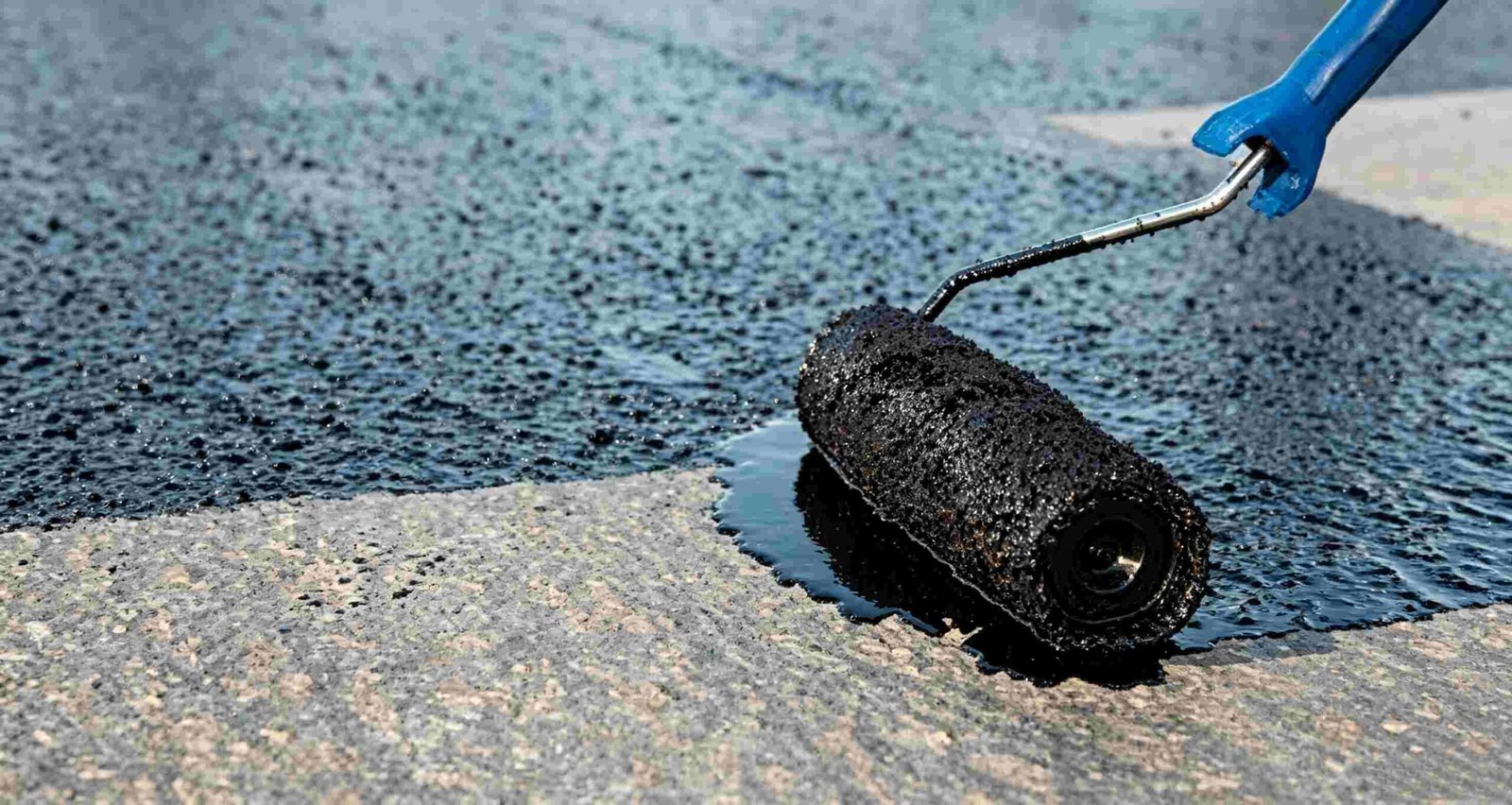
Cold-liquid membranes are applied with brush, roller, or airless spray. Therefore, they conform directly to complex geometric profiles without mechanical cutting. Liquid coatings self-terminate against vertical concrete upstands, brick parapets, and PVC pipes, thereby establishing watertight integrity across awkward details.
Polymer Chemistry Matrix: Comparing PU, Polyurea, Acrylic, Cementitious & MS Systems
No single waterproofing chemistry fits every building project. Choosing the optimal polymer requires evaluating exposure conditions, budget limits, traffic demands, and chemical exposure risks.
1K / 2K Pure Polyurethane (PU): Ultimate Elasticity & Ponding Water Resistance
Polyurethane remains the premier industry benchmark for commercial roofs, exposed podiums, and water-retaining structures as well. Formulated as single-component (1K) moisture-cure or two-component (2K) reactive chemistries, pure polyurethanes provide elongation at break exceeding 400% to 800%.
Crucially, high-grade polyurethane membranes exhibit complete resistance to standing ponding water. Unlike water-based acrylics that re-emulsify under continuous standing water, polyurethanes maintain full polymer integrity. For exposed outdoor applications, contractors apply an aliphatic polyurethane topcoat to prevent UV degradation and yellowing.
Fast-Set Plural Polyurea: Rapid Cure for Heavy Commercial Traffic
Polyurea chemistries react isocyanate prepolymers with amine-terminated polyether resins. Because this reaction occurs in seconds, it requires specialized high-pressure heated plural-component spray equipment.
Consequently, polyurea membranes set within 15 to 30 seconds and support foot traffic in minutes. They deliver exceptional tear strength, chemical resistance, and puncture durability. This makes polyurea the premier choice for parking garages, commercial airport runways, and industrial flooring.
Polymer-Modified Cementitious & Acrylic Systems: Internal and Non-Exposed Decks
Polymer cement slurries combine Portland cement with synthetic acrylic latex polymers. These materials are cost-effective, breathable, and also adhere tenaciously to damp concrete. They excel in under-tile wet areas, retaining walls, and internal foundations.
Acrylic coatings are water-borne elastomeric emulsions. They offer high solar reflectance, low cost, and easy roller cleanup. However, acrylics are unsuited for flat roofs prone to ponding water, as continuous water immersion causes re-emulsification and blistering over time.
Silyl-Modified Polymers (MS): Isocyanate-Free Moisture Tolerant Chemistry
MS polymer liquid membranes combine polyurethane durability with silicone UV weatherability. In addition, they contain zero solvents and zero isocyanates, making them non-hazardous for confined spaces.
Additionally, MS liquid polymers can bond to damp concrete substrates without primer bubbling. When paired with high-performance self-leveling joint sealants, they create an integrated, high-durability floor protection system.
| Property / Metric | Pure Polyurethane (PU) | Plural-Spray Polyurea | Water-Based Acrylic | Polymer Cementitious |
|---|---|---|---|---|
| Tensile Strength | ≥ 4.0 – 8.0 MPa | ≥ 14.0 – 22.0 MPa | 1.5 – 3.0 MPa | 1.8 – 2.5 MPa |
| Elongation at Break | ≥ 400% – 700% | ≥ 350% – 500% | 150% – 300% | 50% – 100% |
| Ponding Water Resistance | Excellent (Permanent) | Excellent (Permanent) | Poor (Re-emulsifies) | Moderate (Breathable) |
| Full Return to Service | 24 – 48 Hours | 1 – 2 Hours | 24 – 72 Hours | 3 – 7 Days |
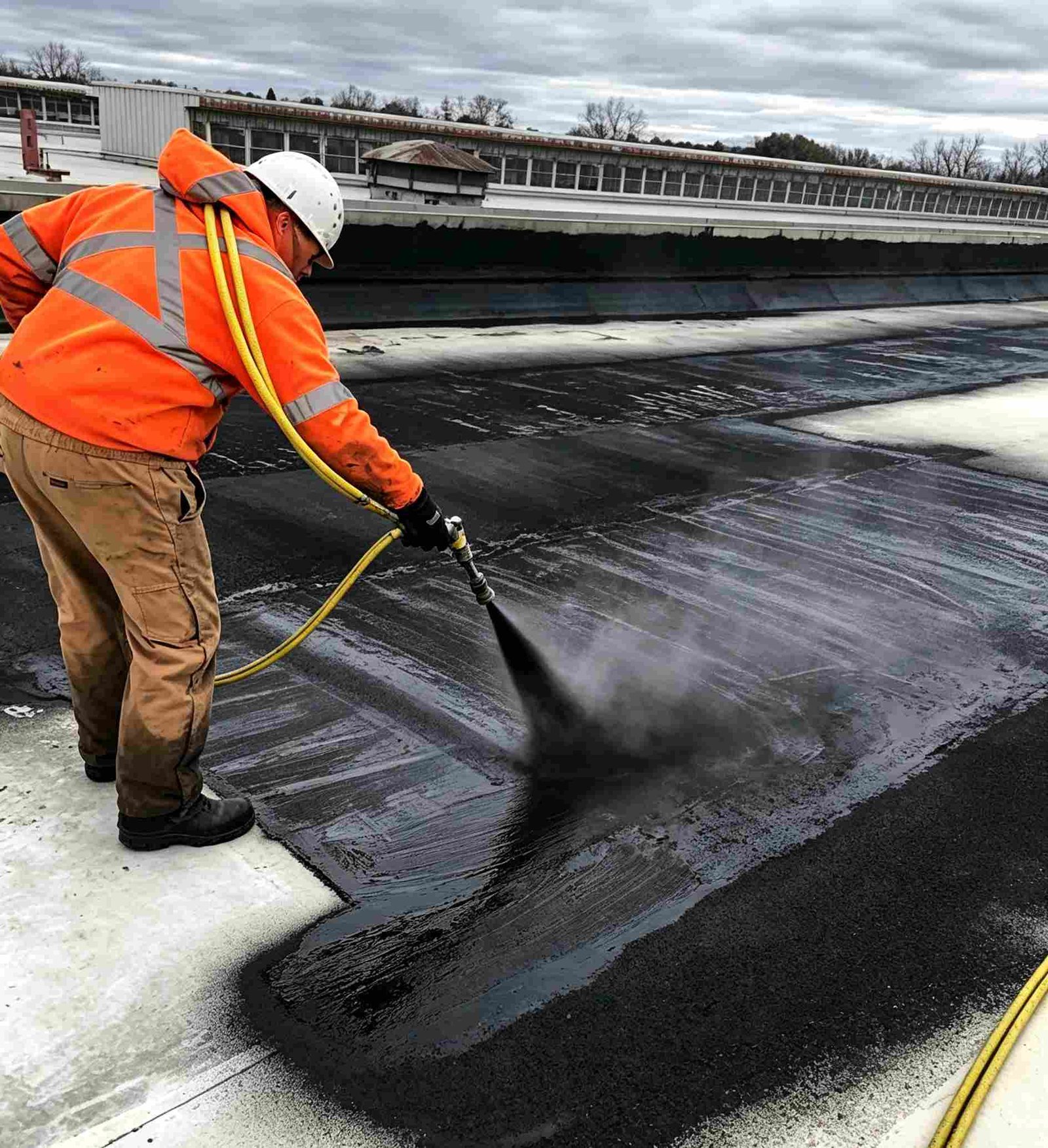
Engineering Field Scenario: Restoring Commercial Flat Roofs Under Heavy Ponding Conditions
A regional commercial distribution center experienced chronic roof leakage caused by seam failure in an aging single-ply sheet membrane. Heavy rain created localized ponding water, while sub-membrane water tracking damaged interior cold-storage insulation.
OPERATING CHALLENGE
- Substrate Conditions: Concrete roof slab with uneven slopes creating persistent ponding depressions, along with intense solar heat cycling.
- Failure Mechanism: The existing sheet system experienced lap seam detachment under thermal movement, permitting water to travel beneath the membrane.
TECHNICAL SOLUTION
- Substrate Preparation: Shot-blasted concrete to ICRI CSP 3, repaired perimeter cracks, and sealed movement joints with low-modulus polyurethane construction sealant.
- Multi-Tiered Membrane: Applied a two-component moisture-tolerant epoxy primer, followed by a heavy-duty polyurethane liquid membrane reinforced with non-woven polyester mesh.
- Reflective UV Barrier: Installed an aliphatic polyurethane reflective topcoat to protect against solar degradation and lower surface temperatures.
ENGINEERING PERFORMANCE
- Hydrostatic Flood Verification: A 48-hour ASTM D5957 flood test confirmed zero water intrusion across all ponding areas.
- Continuous Adhesion: Multi-season field inspections verified seamless bonding without blistering, seam parting, or substrate delamination.
Technical reference: SHCHEMPU field engineering report, commercial roof remediation protocol. Product series: PU-Waterproof 1K System.
Frequently Asked Questions: Liquid Waterproofing Membranes
Application, Primers & Ponding Water
Can liquid waterproofing membranes be applied over standing ponding water?
No. Never apply any liquid membrane directly onto standing water or puddles. While cured pure polyurethane and polyurea membranes resist standing water permanently, wet substrates prevent initial adhesion and cause blistering. All concrete substrates must therefore be surface-dry before application.
What is the difference between Wet Film Thickness (WFT) and Dry Film Thickness (DFT)?
WFT is the liquid coating thickness measured immediately upon application using a comb gauge. DFT is the cured polymer thickness remaining after solvents or water evaporate. The mathematical relationship is: DFT = WFT × Volume Solids %. For 100% solids coatings like polyurea, WFT equals DFT.
Why is a primer necessary before applying polyurethane liquid membranes?
Concrete is porous and contains entrapped air. A penetrating primer consolidates the surface, seals micro-pores, and consequently prevents pinholes in the base coat. Primers also dramatically enhance chemical bond strength to prevent wind-uplift delamination.
When should reinforcement fabric mesh be embedded into a liquid membrane?
Specifically, embed polyester fabric mesh at all dynamic stress points, including concrete cracks, expansion joints, drain sumps, and internal wall-to-floor junctions. On older cracked roofs, full-coverage reinforcement provides high tensile strength to bridge thermal crack movement.
Durability, Curing & B2B Procurement
How long does a liquid-applied polyurethane membrane last?
When properly installed to a certified DFT of 1.5 to 2.0 mm with an aliphatic UV topcoat, high-grade polyurethane membranes provide a service life of 15 to 25 years. Periodic topcoat re-application extends waterproofing longevity indefinitely as well.
Can you apply a liquid waterproofing membrane over existing roofing materials?
Yes. Liquid membranes can restore existing aged bituminous felt, single-ply PVC, metal decking, and concrete roofs without expensive tear-offs. The existing surface must therefore be sound, power-washed, dry, and primed with an adhesion promoter.
What causes pinholes and blistering in freshly applied liquid membranes?
Pinholes occur when air escapes unprimed concrete pores as the building heats up. Blistering occurs when trapped substrate moisture evaporates under solar heat, generating vapor pressure beneath an impermeable membrane. Proper surface drying and priming eliminate these defects completely as a result.
What packaging options are available for industrial and contractor projects?
SHCHEMPU provides 20 kg metal pails for manual roller application, 200 L industrial steel drums for heavy contractor projects, and 1,000 L IBC totes for automated high-volume spray packaging lines, complete with custom OEM labeling.
Direct Manufacturer Supply & Engineering Support
Source Factory-Direct Liquid Waterproofing Membranes & Coatings
Partner directly with SHCHEMPU for ASTM and EN compliant liquid waterproofing systems. We offer pure polyurethanes, fast-set polyurea, acrylic cool-roof coatings, and MS polymer membranes in bulk drums and IBC totes for contractors and distributors worldwide.

