
Installing automotive glass in winter conditions presents severe safety hazards for collision repair shops and mobile auto glaziers. When ambient temperatures plunge below 5°C (41°F), applying standard urethane windshield adhesive becomes technically demanding. Consequently, sub-zero temperatures decelerate chemical crosslinking and alter material viscosity.
Automotive technicians frequently encounter stiff polymer beads, poor glass surface wetting, and uncalibrated Safe Drive Away Times (SDAT). Without strict temperature management, vehicles released into cold environments risk catastrophic windshield detachment during passenger airbag deployment or rollover accidents.
Key Takeaways: Winter Direct Glazing Safety
- Absolute Humidity Drop: Cold winter air holds minimal moisture vapor, drastically retarding the chemical cure rate of 1K polyurethane systems.
- Dew Point & Micro-Frost: Moisture condensation on cold pinchwelds acts as a destructive parting agent, causing complete adhesive delamination.
- Viscosity Management: High material viscosity below 10°C requires preheating cartridges to 40°C–50°C in dedicated warming ovens before extrusion.
- Extended SDAT Window: Safe drive away time must be recalculated based on real-time vehicle storage temperature rather than heated shop ambient readings.
How Low Temperature Affects 1K Polyurethane Moisture Curing
Standard automotive direct glazing relies on one-component (1K) moisture-curing polyurethane. The formulation features prepolymers terminated with reactive isocyanate groups (-NCO). In normal ambient conditions (23°C, 50% Relative Humidity), atmospheric water molecules diffuse into the bead. Water hydrolyzes isocyanate to produce unstable carbamic acid, which decomposes into primary amines and carbon dioxide gas.
Amine groups immediately react with adjacent isocyanate groups to form robust polyurea crosslinks. This crosslinking delivers mechanical strength exceeding 6.0 MPa. In cold weather, two thermodynamic barriers stall this reaction.
The Drop in Absolute Humidity
Additionally, relative humidity percentages mislead technicians during winter. Air at 23°C and 50% RH contains approximately 10.3 grams of water per cubic meter. Air at 0°C and 80% RH contains only 3.8 grams of water per cubic meter. Winter air lacks the molecular moisture concentration required to sustain normal chemical diffusion through automotive glass adhesive beads.
Polymer Glass Transition and Viscosity Spikes
Polyurethane prepolymers exhibit higher internal shear resistance as temperatures drop toward their glass transition point ($T_g$). Extrusion force spikes dramatically from 800 N at 20°C to over 2200 N at 0°C. Manual caulking guns fail to extrude the stiff adhesive. Technicians pushing cold paste create irregular beads with trapped air pockets.
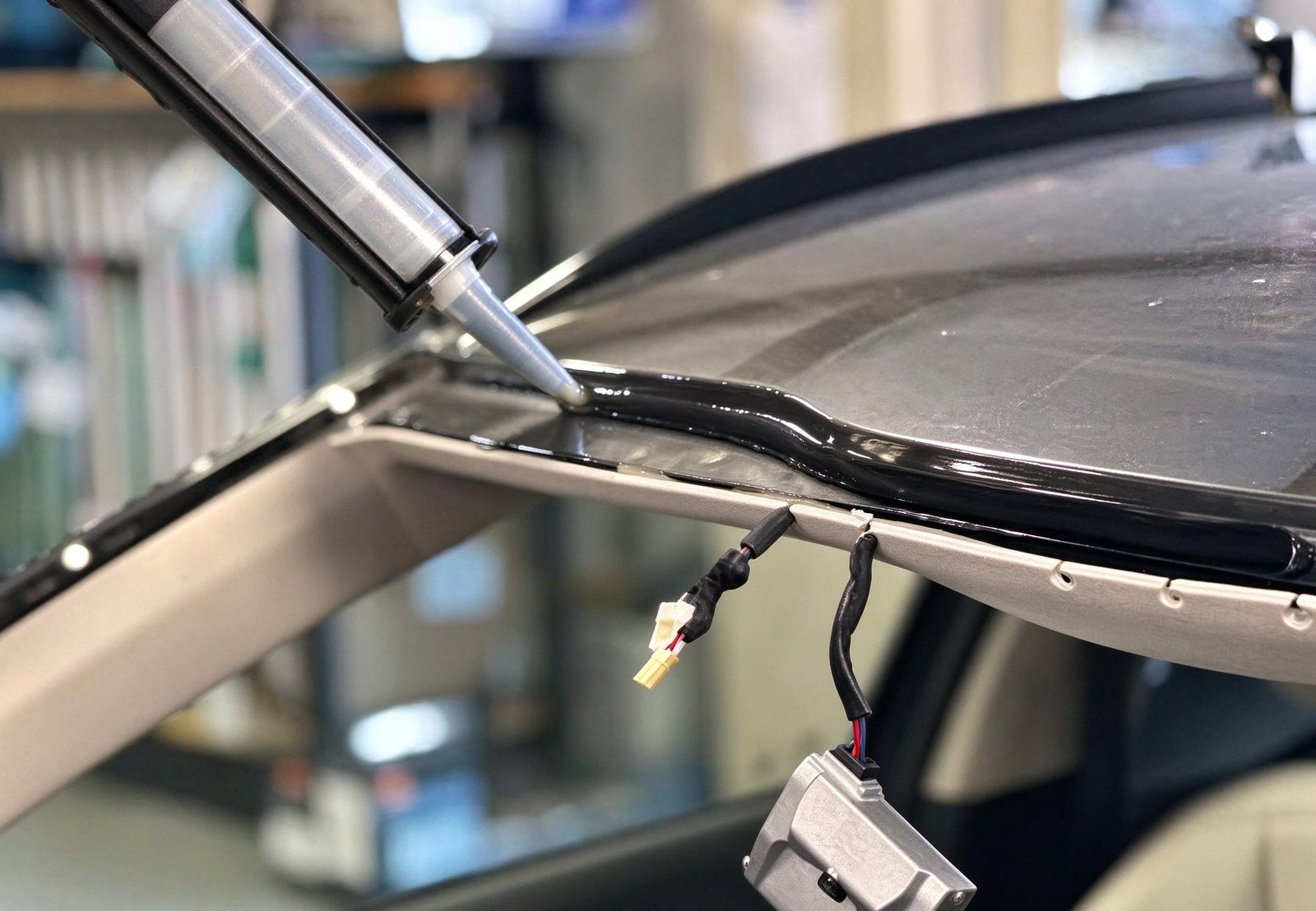
Figure 1: Extruding a uniform triangular bead of preheated polyurethane windshield adhesive onto automotive glass.
Temperature and Humidity Impact on Urethane Windshield Adhesive Curing Rates
Automotive glass adhesives exhibit predictable physical performance shifts under varying temperature profiles. The following laboratory test data illustrates the curing progression of an all-season urethane windshield adhesive tested across five thermal thresholds:
| Ambient Temp (°C) | Relative Humidity (%) | Extrusion Force (N) | Skin Formation (Min) | Cure Speed (mm/24h) | SDAT (Twin Airbag) |
|---|---|---|---|---|---|
| 23°C (73°F) | 50% | 750 N | 25 min | 3.8 mm | 1 Hour |
| 15°C (59°F) | 50% | 950 N | 40 min | 3.0 mm | 2 Hours |
| 5°C (41°F) | 60% | 1450 N | 75 min | 1.8 mm | 4 Hours |
| 0°C (32°F) | 75% | 2100 N (Cold) | 130 min | 1.0 mm | 8 Hours |
| -10°C (14°F) | 80% | 2800 N (Unheatable) | > 240 min | 0.4 mm | 24+ Hours (Halt) |
Cold Weather Standard Operating Procedure: Preheating and Substrate Prep
Executing a compliant winter windshield replacement demands strict adherence to chemical handling protocols. Professional auto glass facilities implement a five-step heating and preparation procedure.
Step 1: Adhesive Cartridge Conditioning
Never apply adhesive stored in an unheated mobile service vehicle. Place aluminum cartridges or sausage foils into a thermostatically controlled warming oven. Set the device between 40°C and 50°C (104°F–122°F) for at least 60 minutes.
Never expose cartridges to open flames, vehicle heating vents, or industrial heat guns. Uneven heating causes localized premature curing or boiling of plasticizers, ruining product integrity.
Step 2: Substrate Temperature and Dew Point Verification
Therefore, direct thermal imaging or infrared pyrometer scanning of the vehicle pinchweld is mandatory. The metal pinchweld and the ceramic frit band must remain at least 3°C (5°F) above the calculated dew point. When warm, humid shop air contacts sub-zero pinchweld steel, moisture instantly condenses into microscopic water films or frost.
Applying urethane windshield adhesive over invisible moisture causes catastrophic adhesive failure. In severe cases, 100% of the cured bead separates from the metal flange.
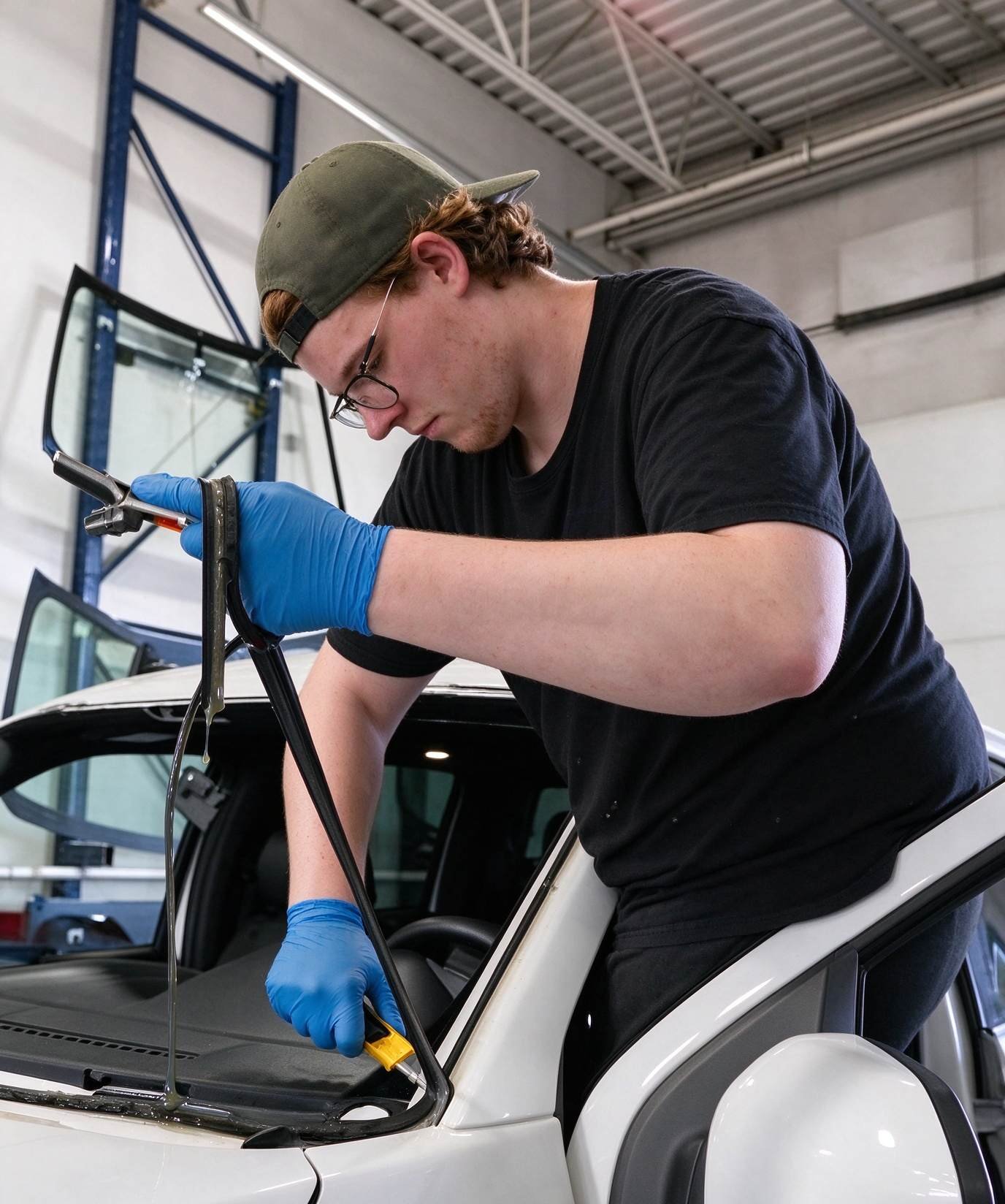
Figure 2: Setting the replacement windscreen into position with calibrated deck height to prevent winter adhesion failure.
Step 3: Primer and Activator Flash-Off Times
Solvent evaporation decelerates markedly in cold weather. Standard black glass primers require 3 to 5 minutes of flash-off time at 23°C. At temperatures below 5°C, double the flash-off time to at least 10 to 15 minutes. Inspect the primer visually to confirm a uniform, tack-free matte black film. Applying polyurethane over wet, unevaporated primer solvents traps volatile compounds, causing severe interface blistering.
Typical Application Scenario: Sub-Zero Fleet Glazing Service Failure Analysis
Case Overview: Winter Windshield Detachment on Commercial Delivery Vans
Incident Profile: A courier fleet in Northern Europe experienced water leaks and wind whistle on four newly replaced transit vans. During a 25 km/h frontal impact, the passenger airbag deployed. The blast blew the replacement windshield completely off the vehicle.
Root Cause Investigation: Chemical analysis showed mobile technicians performed on-site replacements in an unheated bay at -3°C (27°F). The technician extracted cold, unheated polyurethane adhesive directly from an outdoor service van. Cold ambient metal caused dew point condensation on the pinchweld. Adhesive cure progression was examined: after 6 hours, the polymer had cured less than 0.5 mm in depth, displaying 0.2 MPa lap shear strength compared to the required 4.5 MPa threshold.
Corrective Engineering Protocol: The fleet operation eliminated unconditioned outdoor winter installations. Technicians introduced portable 12V warming ovens for adhesive cartridges. They used ceramic radiant heaters to warm pinchweld steel to 15°C before application. SDAT release requirements were updated from 1 hour to an overnight 12-hour thermal stabilization standard.
Frequently Asked Questions: Winter Windshield Adhesive Curing
Can you use a heat gun or open torch to speed up urethane curing?
Never apply open torches or high-temperature industrial heat guns directly to uncured polyurethane beads. Intense heat boils volatile solvents and plasticizers. This creates internal porosity and micro-bubbles that reduce mechanical shear strength by over 50%. Controlled infrared lamps providing gentle warmth up to 35°C–40°C represent the only approved method for accelerating winter crosslinking.
What is the minimum safe ambient temperature for windshield replacement?
Most standard 1K polyurethanes specify a minimum application temperature of 5°C (41°F). Specialized cold-weather formulations engineered with high-reactivity catalysts permit installation down to -10°C (14°F). Even with low-temperature urethane windshield adhesive, the vehicle substrate must remain clean, oil-free, dry, and free of condensation or frost. Review our technical guide on Safe Drive Away Time calculations before releasing cold-weather installations.
Why does a vehicle need longer SDAT if parked outside after installation?
Chemical reaction kinetics follow the Arrhenius equation: reaction velocity drops by approximately half for every 10°C decrease in temperature. Moving a vehicle from a warm workshop into sub-zero weather immediately after glass installation halts polymerization. Calculate the vehicle’s safe release time based on the coldest temperature the vehicle will experience during its initial curing period.
Engineering Summary: Maintaining Glazing Integrity in Cold Climates
Cold weather windshield bonding requires disciplined engineering controls rather than shortcut methods. Professional auto glaziers must maintain cartridge preheating and conduct dew point audits. They must observe extended primer flash-off intervals and enforce conservative drive-away margins. Using certified urethane windshield adhesive manufactured under IATF 16949 standards ensures complete passenger structural protection throughout winter.
ChemPU Senior Technical Applications Team
Automotive Glazing & Polyurethane Chemical Engineering Specialist
ChemPU formulates and manufactures high-performance polyurethane adhesives for global automotive OEM direct glazing and aftermarket repair. Our technical division supports distributors and repair chains worldwide with customized cold-weather formulations and private label cartridges. Contact our engineering team directly via WhatsApp (+86 15216655520).
Source Certified OEM Direct Glazing Polyurethane Adhesives
Partner with ChemPU, an ISO 9001 and IATF 16949 certified Chinese manufacturer. We provide high-modulus polyurethane direct glazing adhesives, black glass primers, and private label cartridges for international distributors and fleet repair networks.
Direct WhatsApp Technical Inquiry: +86 15216655520

